
Когнитивно-семантические механизмы концептуализации коллективности в английских номинациях сообществ животных: корпусный анализ
Aннотация
Номинации сообществ животных не только обозначают множества животных, но и отражают различные способы их осмысления как единого целого, что обусловливает актуальность изучения их роли в концептуализации коллективности. Несмотря на наличие исследования коллективных существительных, когнитивного профилирования, метафорического расширения и оценочной семантики, взаимодействие этих механизмов в употреблении специализированных номинаций сообществ животных остаётся недостаточно изученным. Цель исследования заключается в выявлении когнитивно-семантических механизмов, лежащих в основе буквальных и метафорически расширенных употреблений английских номинаций herd, pack, flock, swarm, pride и colony. Материал исследования составили контексты, извлечённые из Корпуса современного американского английского языка (Corpus of Contemporary American English. COCA) за 2010 – 2019 гг. Из первоначально отобранных 2 563 контекстов после ручной фильтрации в итоговый корпус вошли 1 804 употребления, из которых 773 были классифицированы как буквальные, а 1 031 – как метафорически расширенные. Методика включала разграничение буквальных и метафорически расширенных употреблений с опорой на принципы MIPVU, выявление параметров когнитивного профилирования, их индуктивное обобщение в типы конструирования и контекстуальный анализ оценочного потенциала. Результаты показали, что при метафорическом расширении отдельные характеристики групповой организации животных переносятся на социальные технологические и абстрактные явления. Выявленные параметры профилирования были объединены в четыре типа конструирования: агентивные, пассивный, динамический и структурный. Результаты анализа позволяют предположить, что связанные с ними оценочные тенденции возникают в результате взаимодействия профилируемых характеристик и контекста, а не являются неизменными компонентами значения номинаций. Исследование ограничено шестью выбранными номинациями и данными COCA за 2010 – 2019 гг.; поэтому предложенную типологию следует рассматривать как аналитическое обобщение, а не как исчерпывающую классификацию. Полученные данные указывают на взаимосвязь униплексного конструирования, когнитивного профилирования, метафорического расширения и оценочного потенциала в концептуализации коллективности.
Ключевые слова: Номинации сообществ животных, Концептуализация коллективности, Лексико-семантическое поле, Униплексное конструирование, Когнитивное профилирование, Типы конструирования, Метафорическое расширение, Оценочный потенциал
К сожалению, текст статьи доступен только на Английском
Introduction
Language serves as a primary means of conceptualizing and categorizing experience, a view widely shared within cognitive linguistics (Langacker, 1987; Lakoff, 1987). From this perspective, the study of lexical-semantic fields (LSFs) reveals the principles underlying the systemic organization of linguistic knowledge. Of particular interest in this regard are what are referred to in the present study as animal community nominations. For the purpose of the present study, the expression animal community nominations is used as a working umbrella term for lexical units that designate animal collectives. It is not intended to replace established labels such as collective nouns, animal group nouns, or terms of venery, but it serves as a higher-order analytical designation for the broader domain of animal-group naming. The present article examines only a conventional lexical subset of this domain, namely herd, pack, flock, swarm, colony, and pride. Accordingly, the findings are interpreted with reference to this selected subset rather than to the full inventory of animal community nominations in English. These units not only denote forms of plurality but also represent cognitive models of group organization that shape specific models of interpretation. Within the framework of cognitive linguistics, such terms function as means of conceptualizing collectivity through the cognitive operations of structuring (“carving up”) and construal (Talmy, 2000). A central mechanism in this process is uniplexing, which enables a plurality of individuals to be construed as a unified Gestalt (Talmy, 2000). Consequently, the analysis of these units facilitates the identification of mechanisms underlying the cognitive profiling of collectivity within the investigated lexical-semantic field. This interpretation is consistent with cognitive-semantic approaches that regard meaning as the result of conceptual profiling and the selective structuring of knowledge (Boldyrev, 2014).
Drawing on prototype theory (Rosch, 1978; Lakoff, 1987; Taylor, 2003; Taylor, 2018), this lexical-semantic field exhibits a center-periphery organization. Literal meanings anchored in the biological domain constitute the category’s core, whereas the periphery comprises metaphorically extended uses related to social, technological, and other conceptual domains. This radial organization reflects the gradient structure of the category while enabling cognitive characteristics associated with collectivity to extend across conceptual domains through cross-domain conceptual mapping (Lakoff & Johnson, 2003). The historical roots of these nominations can be traced to the tradition of terms of venery, documented in The Book of St. Albans (1486), which records numerous specialized designations for groups of animals (Lipton, 1977). Although many historical terms have fallen out of use, several have remained part of contemporary English and, as Crystal (2011) observes, continue to serve as productive resources for conceptualizing collective entities beyond the biological domain. Within this broader domain, the present study focuses specifically on six conventional lexical items – herd, pack, flock, swarm, colony, and pride – which provide distinct lexical means of construing animal collectivity. Following Geeraerts’s understanding of meaning as encyclopedic knowledge (Geeraerts, 2009), these terms can function as cognitive instruments for conceptualizing both biological and social realities.
Previous studies have provided important insights into individual aspects of collective conceptualization. Research on collective nouns has explained their grammatical and semantic properties through mechanisms such as uniplexing and conceptual unity (Talmy, 2000; Levin, 2001; de Vries, 2021). Studies grounded in Cognitive Grammar have emphasized the role of profiling in shaping different construals of collectivity (Langacker, 1987; Joosten et al., 2007). Other research has examined metaphorical extension and evaluative meaning in discourse, demonstrating how animal-based metaphors contribute to the representation and evaluation of social actors (Musolff, 2016; Hart, 2014). However, these approaches have largely evolved independently and therefore do not explain how these cognitive mechanisms interact within a unified model of collective conceptualization. Consequently, the relationship between uniplexing, cognitive profiling, metaphorical extension, and evaluative potential remains insufficiently understood.
The present study addresses this gap by integrating uniplexing, cognitive profiling, metaphorical extension, and evaluative potential within a unified cognitive-semantic framework for the analysis of animal community nominations. Based on contemporary evidence from the Corpus of Contemporary American English (COCA), the present analysis investigates how cognitive-semantic mechanisms shape the conceptualization of collectivity in English animal community nominations. To this end, the study pursues three objectives: (1) to delineate the hierarchical organization of the lexical-semantic field of animal community nominations by distinguishing between the Literal Core and the Metaphorical Periphery; (2) to examine how uniplexing and cognitive profiling contribute to the construal of collective entities; and (3) to explore how metaphorically extended uses are associated with recurrent evaluative tendencies in contemporary English discourse.
Accordingly, the study addresses the following research questions:
RQ1. How are the literal and metaphorically extended uses of the selected animal community nominations organized within the proposed Literal Core – Metaphorical Periphery model?
RQ2. How do recurrent cognitive profiling parameters – agency, homogeneity, synchrony, density/intensity, hierarchy, and functional integration – generalize inductively into higher-order construal types?
RQ3. How are the identified higher-order construal types associated with recurrent evaluative tendencies in metaphorically extended uses in contemporary English discourse?
The principal theoretical contribution of the present study lies in the development of an integrated cognitive-semantic framework that explains how uniplexing, cognitive profiling, metaphorical extension, and evaluative potential interact in the conceptualization of collective entities. Application of the proposed framework to the corpus resulted in the development of a four-type analytical typology (Agentive, Passive, Dynamic, and Structural), which captures the dominant profiling tendencies observed across the analyzed corpus. Rather than constituting an exhaustive classification of collective construals, the proposed typology represents an analytical generalization of the recurrent profiling patterns identified in the present dataset.
Theoretical and Methodological Framework
The present study builds on these theoretical perspectives to propose an integrated cognitive-semantic framework for the analysis of animal community nominations.
Within the framework of cognitive linguistics, animal community nominations function as cognitive instruments that structure the conceptualization of collectivity and govern specific modes of semantic construal. Consistent with the established cognitive-semantic approaches to the lexicon (e.g., Langacker, 1987; Evans & Green, 2006), these nominations are viewed not merely as lexical labels but as cognitively structured lexical units that activate organized conceptual knowledge and support the interpretation of collective entities. Central to this perspective is the notion of construal, which refers to the ability of speakers to conceptualize the same situation in alternative ways (Langacker, 1987; Croft and Cruse, 2004). Linguistic meaning is therefore understood not as a direct reflection of objective reality but as the result of selective conceptualization and cognitive organization. This interpretation is consistent with cognitive-semantic approaches that view meaning construction as a process of conceptualization rather than the retrieval of fixed lexical content (Evans & Green, 2006). From this perspective, these animal units constitute a lexical-semantic field (LSF) organized around a center-periphery architecture, consistent with prototype theory (Rosch, 1978; Lakoff, 1987; Taylor, 2003; Taylor, 2018) and with psycholinguistic research suggesting that lexical-semantic fields are cognitively organized around core and peripheral structures (Sibul, 2017). The field is modeled as a schematic network in which meaning emerges through configurations of domain linkages, and the position of each unit is determined by its degree of prototypicality and cognitive salience (Langacker, 1987; Taylor, 2003). The core of the category comprises terms anchored in the biological domain, such as herd, pack, flock, swarm, colony, and pride. In contrast, the periphery comprises metaphorically extended uses referring to social, technological, and other conceptual domains. At the superordinate level of categorization, the hyperonym group functions as a highly schematic unit that does not profile specific behavioral or structural parameters of collectivity. Collective nouns have been described as a distinctive category that combines conceptual unity with plurality, simultaneously encoding a collection of entities and its interpretation as a single conceptual whole (Tran & Bui, 2021). The primary cognitive mechanism facilitating collective nomination is the operation of uniplexing (Talmy, 2000), which enables a multiplex set of individuals to be construed as a unified Gestalt structure. The group is therefore construed as a coherent cognitive whole rather than as a simple aggregation of individual entities. Collective nouns combine grammatical singularity with semantic plurality, referring to multiple entities while construing them as a unified conceptual whole (Corbett, 2000; Levin, 2001). This dual structure underlies the operation of uniplexing by allowing multiple entities to be construed as a single Gestalt without eliminating awareness of their internal multiplicity.
According to de Vries (2021), collective nouns constitute a hybrid category that combines properties of one-ness and many-ness across different levels of linguistic representation. Collective nouns also exhibit a degree of non-additivity, whereby the collective is interpreted as more than the sum of its individual members and acquires organizational properties of its own. This observation is closely linked to the notion of individuation, since collective nouns differ in the extent to which individual members remain conceptually accessible within the collective whole. In a related account, Joosten et al. (2007) argue that collective nouns vary in the degree to which individual members remain accessible. Attention may therefore shift between the collective as a whole and its constituent members depending on the dimensions of collective organization being profiled.
The selection of a particular collective term gives rise to a specific mode of semantic construal. Within the framework of Cognitive Grammar, this process involves the profiling of certain conceptual parameters against the backgrounding of others (Langacker, 1987). In this respect, the analyzed animal community nominations may be viewed as providing a skeletal structure that organizes conceptual content and foregrounds salient aspects of group organization, including hierarchy, integration, agency, and dynamicity. This interpretation is compatible with studies suggesting that collective nouns occupy a prominent position within the animacy hierarchy because they are associated with cognitively salient features such as agency, social organization, and coordinated activity (Jie & Liang, 2018). Consequently, animal community nominations do not merely denote plurality but also influence the way collective entities are conceptually interpreted. From this perspective, construal types may be regarded as abstract parameters of cognitive profiling realized through distinct nomination models. Cognitive distinctions in the interpretation of collectivity become particularly evident when the selected animal community nominations are compared with neutral designations of plurality. While specialized models foreground specific structural and behavioral parameters, neutral forms perform a schematic function by designating plurality without specifying their internal organization (Taylor, 2003; Talmy, 2000). The choice of a nominative model affects the degree of conceptual integration among elements, shifting the interpretation of collectivity from discrete individuals toward a unified Gestalt structure.
The metaphorical extension of animal community nominations is interpreted within the framework of conceptual metaphor theory as a process of mapping in which the structure of the source domain ANIMAL COMMUNITY is projected onto social phenomena, enabling the conceptualization of one domain of experience through another (Lakoff and Johnson, 2003). Animal community nominations therefore function as cognitive models through which characteristics associated with the biological domain serve as the basis for the interpretation of social reality. Beyond cross-domain mapping, metaphorical extension also involves the activation of culturally shared scenarios that structure interpretation and evaluation (Musolff, 2016).
Within the Metaphorical Periphery, this process relies on the interaction of two central cognitive mechanisms: uniplexing (Talmy, 2000), which enables the conceptualization of multiplicity as a unified entity, and construal (Langacker, 1987), which guides the interpretation of social reality through the activation of specific cognitive domains. Within the proposed framework, metaphorically extended uses may give rise to recurrent evaluative meanings through the cognitive profiling of transferred conceptual features. This interpretation is consistent with discourse-oriented approaches to metaphor, which emphasize that metaphorical choices contribute to the construction of particular evaluations and representations of social reality in authentic discourse contexts (Semino, 2008). Following the approach proposed by Zaynuldinov and Quero Gervilla (2025), the evaluative component emerges through the interaction of rational evaluation, expressiveness, and emotionality within culturally conditioned models of perception. These models include evaluative stereotypes within the framework of frame semantics (Fillmore, 1982; Fillmore & Atkins, 1992) as well as culturally embedded quasi-stereotypes (Teliya, 1996). Given the cultural variability of metaphor (Kövecses, 2005), the evaluative potential of animal community nominations is shaped by the conceptual model activated in discourse. As a result, these nominations function not only as a means of designation but also as an instrument for interpretation and evaluation.
Building on the theoretical perspectives discussed above, the present study proposes an integrated cognitive-semantic framework in which animal community nominations are analyzed through the interaction of uniplexing, cognitive profiling, metaphorical extension, and evaluative potential. Within this framework, animal community nominations are understood as conceptual tools that structure the conceptualization of animal collectives through the interaction of these cognitive mechanisms. The lexical-semantic field of animal community nominations is organized as a hierarchical system comprising a superordinate category centered on the lexeme group, the selected lexical subset (herd, pack, flock, swarm, pride, and colony), and a prototypically structured continuum extending from a Literal Core to a Metaphorical Periphery. This framework explains differences among the analyzed nominations through the cognitive profiling of distinct dimensions of collective organization, including hierarchy, coordinated movement, social structure, and collective agency. It also provides the theoretical foundation for the subsequent corpus analysis by guiding the identification of profiling parameters, the derivation of higher-order construal types, and the interpretation of evaluative potential.
Materials and Methods
The empirical analysis was guided by the integrated cognitive-semantic framework proposed in the present study. The framework combines uniplexing, cognitive profiling, metaphorical extension, and evaluative potential within a unified analytical procedure and serves as the principal interpretive model throughout the analysis. Corpus methods were employed to operationalize the proposed framework through the systematic identification and interpretation of recurrent construal patterns across the analyzed nominations.
The empirical data for the present study were retrieved from the Corpus of Contemporary American English (COCA) (Davies, 2008 – present), a large balanced corpus of contemporary American English comprising naturally occurring texts from multiple discourse registers. The analysis was restricted to corpus texts published between 2010 and 2019 in order to ensure a stable and reproducible dataset while focusing on contemporary language use. All discourse registers available in COCA were included to capture the full range of usage of the analyzed nominations across contemporary American English. Corpus retrieval was based on the syntactic pattern a X of Y and focused on six animal community nominations: herd, pack, flock, swarm, colony, and pride. These nominations were selected because they constitute well-established lexical items denoting animal communities while systematically differing in the dimensions of collective organization they profile, including agency, homogeneity, synchrony, hierarchy, intensity, and functional integration. Their semantic diversity provided an appropriate basis for comparative cognitive-semantic analysis within the proposed analytical framework. Restricting the analysis to these six nominations ensured a systematic comparison of recurrent construal patterns within a coherent lexical-semantic field.
The study was deliberately restricted to conventional lexical nouns denoting animal collectives and providing sufficient semantic comparability for systematic cognitive-semantic analysis. Historically specialized terms of venery, such as murder of crows and parliament of owls, belong to a distinct historical naming tradition documented in medieval hunting terminology and later compilations (Lipton, 1977). Their contemporary lexical status, degree of constructional dependence, and level of conventionalization require a different set of diagnostic criteria and therefore constitute a separate analytical problem. Including such expressions in the present dataset would extend the study from cognitive-semantic profiling to questions of lexical autonomy and categorial status that fall beyond the scope of the present study. The six selected nominations thus constitute a semantically diverse but methodologically coherent subset for examining recurrent dimensions of collective construal.
The initial corpus retrieval yielded 2,563 contexts across the six target nominations. All retrieved contexts were subsequently subjected to manual screening. Contexts were excluded if they contained homonymous non-target uses, fixed idiomatic or phraseological expressions, duplicated concordance lines, metalinguistic discussion, or other occurrences unrelated to the conceptualization of animal communities. The construction a school of was excluded from the outset because of its high degree of semantic homonymy and the predominance of non-target expressions (e.g., school of thought, schoolof philosophy), which would have reduced the semantic consistency of the dataset.
Following manual screening, 759 contexts were excluded, resulting in a final manually annotated corpus of 1,804 contexts. Each retained context was then classified into one of two analytical categories. Literal Core comprised 773 contexts referring to actual animal communities, whereas Metaphorically Extended Uses comprised 1,031 contexts in which animal community nominations were applied to human, technological, and abstract referents. The resulting annotated corpus served as the empirical basis for identifying profiling parameters, deriving higher-order construal types, and interpreting the evaluative potential of the analyzed nominations.
The distinction between literal and non-literal uses was informed by the principles of the Metaphor Identification Procedure Vrije Universiteit Amsterdam (MIPVU) developed by Steen et al. (2010). In accordance with the principles of MIPVU, contexts were classified as non-literal when the contextual meaning of the target nomination contrasted with its basic biological meaning while remaining interpretable through comparison with that basic meaning. In the present study, MIPVU was employed solely as an operational procedure for distinguishing literal from non-literal uses and was not intended to differentiate novel metaphors from fully lexicalized figurative meanings. Accordingly, all non-literal corpus instances involving cross-domain comparison with the biological source domain were treated as metaphorically extended uses for the purposes of the present analysis. This operational procedure provided a systematic and transparent basis for annotating corpus instances as either Literal Core or Metaphorically Extended Uses.
The analytical procedure consisted of seven consecutive stages. First, corpus contexts were retrieved from COCA using the syntactic pattern a X of Y for the six selected animal community nominations. Second, all retrieved corpus contexts were manually screened to exclude homonymous non-target uses, fixed idiomatic expressions, duplicated concordance lines, metalinguistic discussion, and other irrelevant occurrences. Third, the retained corpus instances were manually annotated according to the classification procedure described above. Fourth, each annotated context was examined to identify the dominant profiling parameter or parameters foregrounded by the nomination within its immediate discourse context. The principal profiling parameters included agency, homogeneity, synchrony, density/intensity, hierarchy, and functional integration. In reporting representative corpus examples, more specific contextual descriptors, such as reduced individuation, coordinated movement, multiplicity, spatial clustering, territoriality, and collective identity, were used as interpretive glosses indicating how these broader profiling parameters were realized in particular contexts; these descriptors were not treated as independent coding categories. Fifth, recurring profiling parameters were compared across the annotated corpus and grouped inductively into four higher-order construal types: Agentive, Passive, Dynamic, and Structural. These higher-order categories were derived from recurrent similarities observed in the profiling parameters rather than established a priori. Sixth, all annotated corpus instances were manually coded for evaluative potential. Finally, the resulting construal types and evaluative tendencies were interpreted within the proposed integrated cognitive-semantic framework through the interaction of uniplexing, cognitive profiling, metaphorical extension, and evaluative potential.
The six profiling parameters were operationalized as recurrent dimensions of collective organization: agency as coordinated goal-directed action; homogeneity as collective uniformity and reduced individuation; synchrony as coordinated movement or behavioral alignment; density/intensity as spatial concentration, multiplicity, and interactional intensity; hierarchy as internal status differentiation; and functional integration as systemic interdependence and stable internal organization. These parameters were grouped inductively according to broader dimensions of collective organization: agency was associated with the Agentive construal, homogeneity with the Passive construal, synchrony and density/intensity with the Dynamic construal, and hierarchy and functional integration with the Structural construal. The labels Agentive, Passive, Dynamic, and Structural are used as analytical designations for recurrent higher-order profiling patterns rather than as categories adopted from an existing grammatical typology or as rigid lexical classes.
The corpus annotation was conducted by the first author. Since the dataset was not independently double-coded, formal inter-annotator agreement statistics could not be calculated. To reduce interpretive subjectivity, the annotation procedure relied on explicit operational criteria. The distinction between literal and metaphorically extended uses was guided by MIPVU principles; cognitive profiling was based on the explicitly defined analytical parameters of agency, homogeneity, synchrony, density/intensity, hierarchy, and functional integration; and evaluative tendencies were identified on the basis of contextual lexical markers in the immediate co-text. Ambiguous cases were repeatedly re-examined against the same analytical criteria to maintain internal consistency. The absence of independent inter-annotator validation is acknowledged as a methodological limitation of the present study.
To examine the evaluative potential of the analyzed nominations, all annotated corpus instances were manually coded using contextual evaluative markers occurring in the immediate co-text. The coding procedure considered adjectival descriptions, verbal predicates, and other lexical indicators associated with recurrent evaluative meanings, including threat, aggression, dependency, prestige, conformity, and depersonalization. When multiple evaluative interpretations were possible, coding was based on the dominant evaluative orientation supported by the immediate discourse context. The identified evaluative markers were subsequently grouped into broader evaluative dimensions through qualitative analysis of recurrent contextual patterns. Particular attention was paid to recurring semantic configurations such as coordinated aggression, intensity, chaotic behavior, social hierarchy, and reduced individuality.
The interpretation of evaluative meanings was informed by the emotional-evaluative semantic framework proposed by Zaynuldinov and Quero Gervilla (2025), which conceptualizes evaluation as the interaction of rational assessment, emotionality, and expressiveness. Particular attention was also paid to verbal predicates, as verb selection has been shown to provide linguistic evidence for cognitively salient conceptual properties associated with nominal categories (Ji & Liang, 2018). From a prototype-theoretical perspective, verbal predicates may be regarded as linguistic manifestations of conceptual features attributed to a referent, thereby providing additional evidence for the cognitive construal of collective entities.
For comparative purposes, the lexeme group was treated as a neutral schematic superordinate category within the lexical-semantic field of animal community nominations. Unlike the analyzed nominations (herd, pack, flock, swarm, colony, and pride), group does not itself profile particular dimensions of collective organization such as hierarchy, synchrony, agency, or functional integration. Instead, it serves as a schematic representation of collectivity against which the profiling properties of the analyzed nominations can be systematically compared. Owing to its schematic and non-specialized character, it was not included in the quantitative analysis. Comparison between the analyzed nominations and this neutral marker of plurality made it possible to identify mechanisms of construal, including cognitive profiling, as well as to examine the role of uniplexing, whereby a set of discrete individuals is conceptualized as a unified Gestalt structure (see Table 1).
Overall, the proposed framework applied corpus-based evidence through a sequence of analytical procedures linking uniplexing, cognitive profiling, metaphorical extension, and evaluative interpretation. This integration provides a systematic basis for identifying recurrent construal patterns across Literal and Metaphorically extended uses of animal community nominations.
Results
A typology of Cognitive Construals in Animal Community Nominations
Application of the proposed analytical framework to the annotated corpus revealed a systematic cognitive-semantic organization of the lexical-semantic field of animal community nominations. Corpus instances were annotated as either Literal Core or Metaphorically Extended Uses, reflecting the broader theoretical distinction between the Literal Core and the Metaphorical Periphery proposed in the present framework. The latter encompasses uses in which animal community nominations extend to human, technological, and abstract domains. Across both analytical categories, collective entities are consistently construed as coherent cognitive wholes rather than as simple aggregations of individuals. This recurring pattern reflects Talmy’s (2000) notion of uniplexing, whereby multiple entities are conceptualized as a single Gestalt. Furthermore, the analysis indicates that metaphorically extended uses preserve selected characteristics associated with the biological source domain, allowing dimensions of collective organization to remain salient across different domains of use.
Comparative cognitive-semantic analysis of the annotated corpus identified recurrent profiling parameters, including agency, homogeneity, synchrony, density, hierarchy, and functional integration. Rather than constituting isolated semantic features, these parameters consistently converged on broader dimensions of collective organization across the corpus. This analytical generalization formed the basis for the inductive derivation of four higher-order construal types (Agentive, Passive, Dynamic, and Structural) which represent recurrent cognitive patterns of collectivity construal rather than fixed lexical or semantic categories.
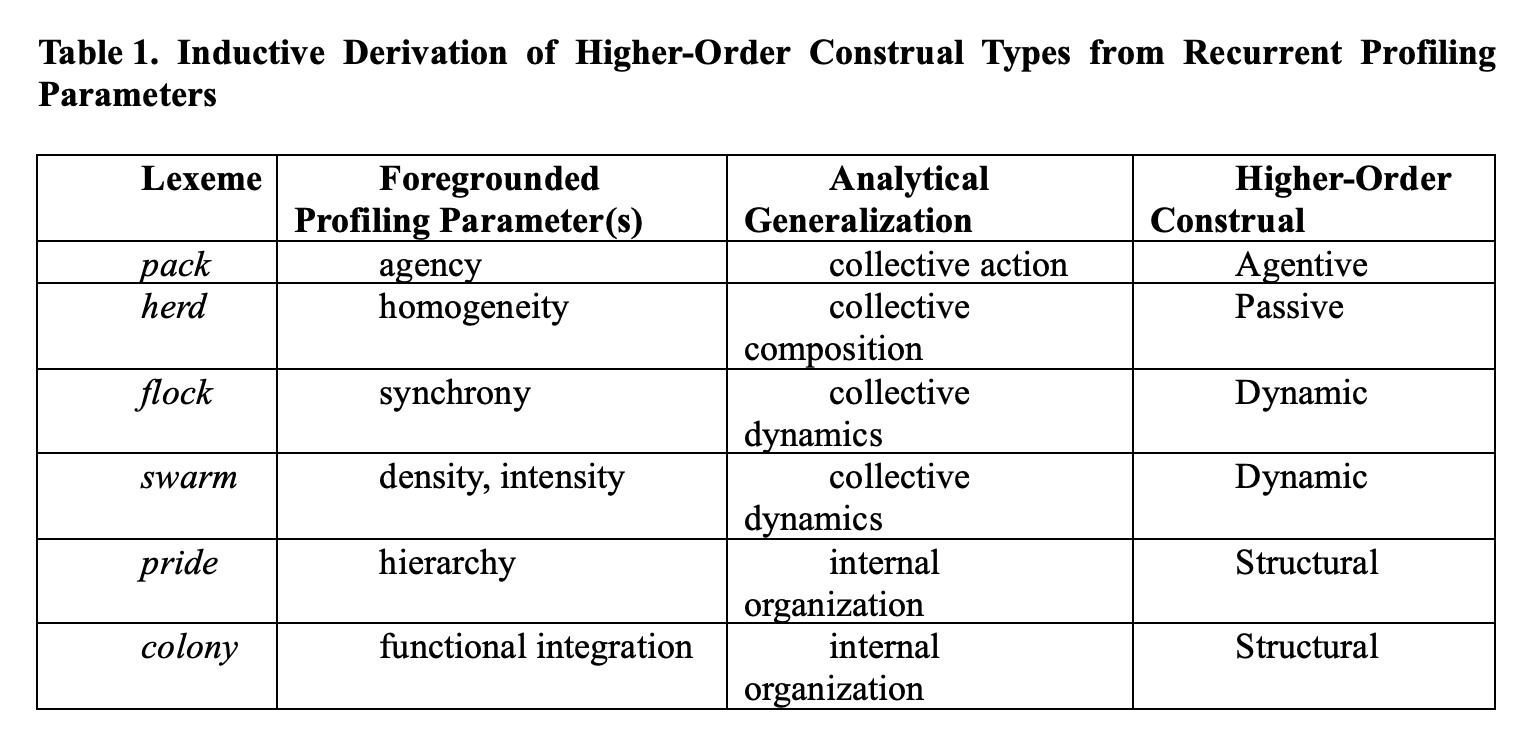
Table 1 summarizes inductive derivation of higher-order construal types from recurrent profiling parameters identified in the annotated corpus. Although each nomination foregrounds a distinct profiling parameter, several converge on broader dimensions of collective organization. These recurring patterns provide the basis for the four-type typology presented in Table 2. Selected corpus examples illustrating the analytical categories and recurrent profiling patterns underlying these higher-order construal types are provided in the Appendix.
The first macro-category comprises Agentive and Passive construals, represented by pack and herd respectively. Although both nominations conceptualize a plurality as a unified Gestalt through uniplexing, they differ substantially in the dimensions of collective organization they emphasize. Pack is prototypically associated with social predator groups acting as coordinated units and therefore highlights collective agency, coordination, and goal-directed action. These characteristics remain salient in metaphorically extended uses, where groups of people are frequently construed as unified social actors capable of collective action, often in ways perceived as threatening or antagonistic. Herd, by contrast, directs attention away from coordinated action and toward homogeneity, spatial cohesion, and reduced individuation. In metaphorically extended contexts, the nomination tends to background individual differences and highlight collective uniformity, thereby motivating interpretations associated with conformity, depersonalization, or reduced autonomy. Together, pack and herd represent two contrasting construals of collectivity: one centered on agency and coordinated action, the other on homogeneity and diminished individuality.
The second macro-category is represented by Dynamic construals, exemplified by flock and swarm. Unlike Agentive and Passive construals, these nominations conceptualize collectivity primarily through patterns of movement and interaction. Flock foregrounds synchrony and coordinated movement, whereas swarm emphasizes density/intensity, and potential uncontrollability of collective behavior. The distinction becomes particularly evident in metaphorically extended contexts. Expressions such as flock of followers highlight behavioral alignment and dependence, while swarmof drones and swarm of trolls foreground overwhelming multiplicity, dynamic expansion, and reduced controllability. Despite these differences, both nominations profile collective dynamics through patterns of movement and interaction. The comparative analysis of the annotated corpus indicates that synchrony and density/intensity function as lower-level profiling parameters within a broader Dynamic construal type.
The third macro-category comprises Structural construals, instantiated by pride and colony. In contrast to the preceding types, these nominations conceptualize collectivity primarily through internal organization and relatively stable relationships among group members. Pride emphasizes hierarchy, status, and kinship relations, characteristics that frequently remain salient in metaphorically extended uses, where the nomination is associated with prestige, exclusivity, and elevated social standing. Colony, by contrast, profiles functional integration, territorial embeddedness, and systemic interdependence. In both literal and metaphorically extended contexts, it tends to construe the collective as a highly integrated system whose members are connected through stable functional relations. Although pride and colony differ in their dominant profiling parameters, both instantiate Structural construals because they conceptualize collectivity through patterns of internal organization rather than through movement or agency.
The corpus analysis suggests that evaluative potential is not an inherent property of the analyzed lexical items but rather an emergent consequence of cognitive construal. Evaluative meanings become particularly salient in metaphorically extended uses, where characteristics associated with animal communities are projected onto social or technological entities. In such contexts, the foregrounding of particular dimensions of collective organization contributes to recurring evaluative tendencies. Agentive construals are frequently associated with aggression and hostility, Passive construals with conformity and depersonalization, Dynamic construals with dependence, threat, or chaos, and Structural construals with prestige, stability, or systemic cohesion. The findings suggest that animal community nominations function as mechanisms of cognitive and evaluative profiling, rather than as lexical items with inherently fixed evaluative meanings, thereby shaping the interpretation of collective entities across both literal and metaphorically extended uses.
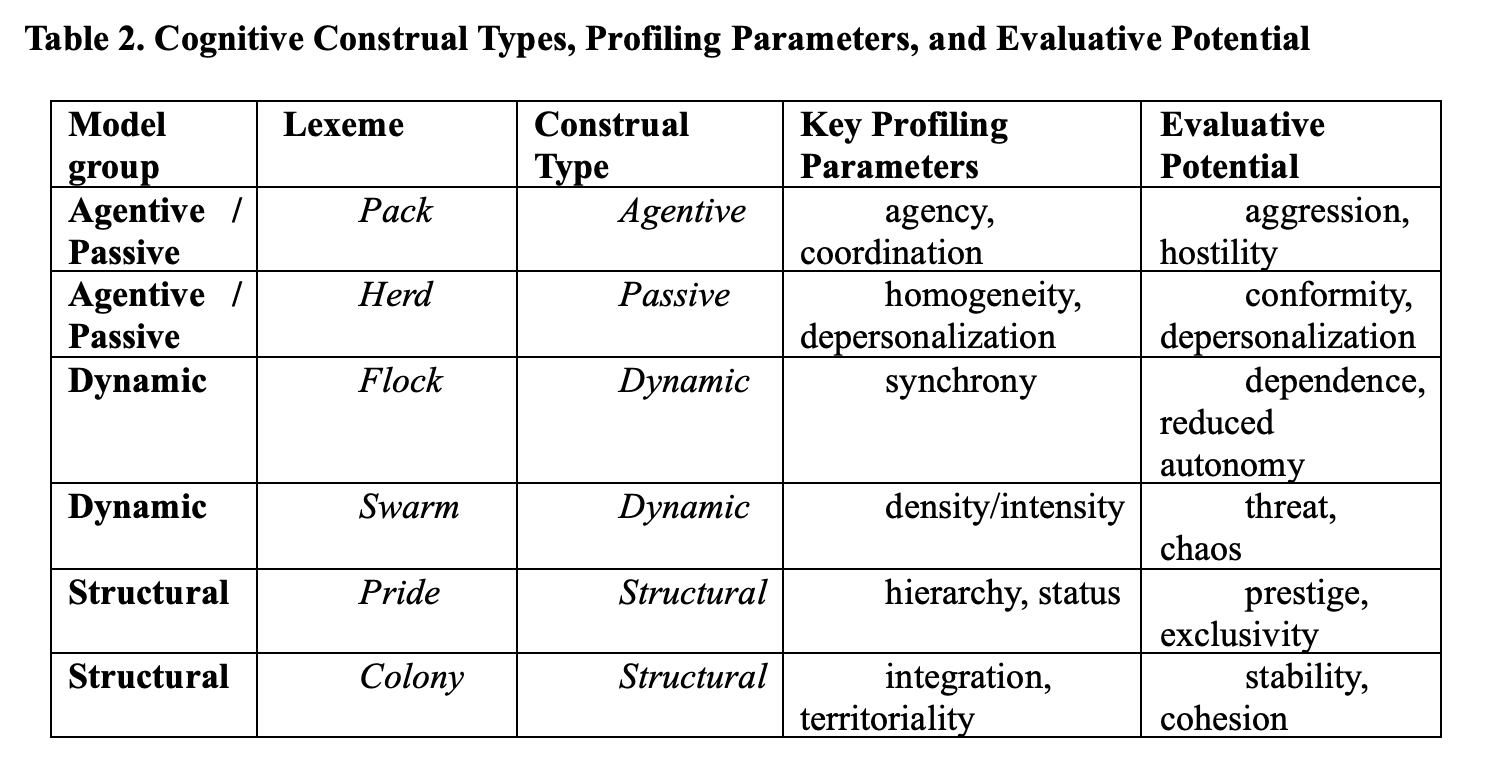
Table 2 summarizes how the four higher-order construal types identified in the annotated corpus are instantiated by the analyzed nominations and associated with recurrent profiling parameters and evaluative tendencies. The differences among these nominations reflect both their lexical meanings and the recurrent profiling patterns identified in the annotated corpus. Although all six nominations are grounded in the cognitive operation of uniplexing, which enables multiple entities to be conceptualized as a single Gestalt, the nature of this Gestalt varies according to the parameters that are foregrounded, including agency, synchrony, density, and social hierarchy.
Each nomination reflects a particular construal of collective entities derived from the recurrent profiling parameters identified during the comparative analysis of the annotated corpus. At a higher level of abstraction, these profiling parameters were grouped inductively into four higher-order construal types: Agentive, Passive, Dynamic, and Structural. The Dynamic construal type encompasses both flock and swarm because both nominations share a common focus on collective dynamics and patterns of movement and interaction. This higher-order grouping emerged inductively from the recurrent profiling parameters identified in the annotated corpus. Although the two nominations differ in the dominant profiling parameters they foreground, flock primarily profiles synchrony whereas swarm emphasizes density/intensity. Nevertheless, both construe collectivity through patterns of movement and interaction. Accordingly, synchrony, density/intensity are interpreted as lower-level profiling parameters subsumed within the broader Dynamic construal type rather than as independent higher-order construal types.
Within the proposed framework, the six analyzed nominations instantiate the four higher-order construal types derived from recurrent profiling parameters identified in the annotated corpus. Specifically, pack represents the Agentive construal, herd the Passive construal, flock and swarm the Dynamic construal, and pride together with colony the Structural construal. Figure 1 summarizes the relationships between the higher-order construal types and their dominant profiling parameters.
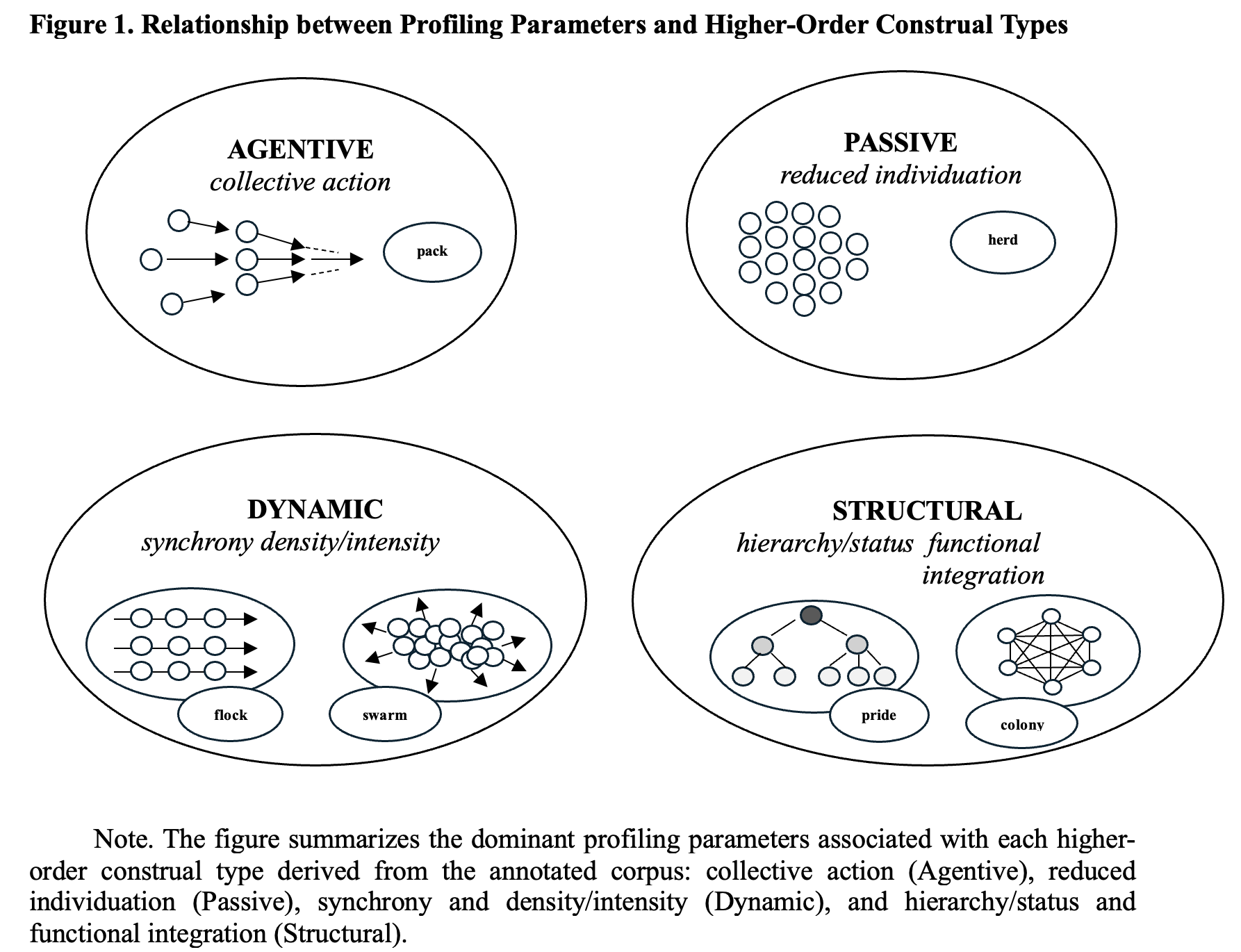
These distinctions among the four higher-order construal types become particularly evident in metaphorically extended uses, where cognitive characteristics associated with the biological source domain motivate evaluative interpretations in human, technological, and abstract target domains. Through these profiling operations, animal community nominations contribute to the conceptualization and categorization of collective entities across both Literal Core and Metaphorically Extended Uses by foregrounding different dimensions of collective organization. The proposed higher-order construal types therefore demonstrate that these nominations function as mechanisms of cognitive profiling that shape both the conceptualization of collective entities and their evaluative interpretation in discourse.
The differences summarized in Figure 1 become particularly apparent when the analyzed nominations are compared with neutral expressions of plurality. A comparison between the analyzed animal community nominations and neutral expressions of plurality further highlights differences in the construal of collectivity. For instance, the expression a pride of lions profiles social hierarchy and kinship relations, whereas the expression a group of lions provides a comparatively neutral representation of collective membership. Similarly, a herd of cattle evokes a high degree of conceptual integration and reduced individuation, while the plural noun cows preserves the perception of separate individual entities. The analyzed nominations therefore shift attention from individual members to the collective as a unified conceptual entity while simultaneously emphasizing specific properties of collective organization. These evaluative interpretations emerge from encyclopedic knowledge associated with the biological source domain and become particularly salient in metaphorically extended uses, where this knowledge contributes to the interpretation of human, technological, and abstract collectives.
Taken together, the findings indicate that animal community nominations function not simply as linguistic markers of plurality but as cognitive mechanisms for construing and profiling collective entities. The identified construal types differ in the dimensions of collective organization they profile, including agency, homogeneity, collective dynamics, and structural organization. Through these profiling operations, collective nominations contribute to both the conceptual representation and the evaluative interpretation of groups across literal and metaphorical contexts. The proposed typology further suggests that recurring evaluative meanings are systematically associated with specific construal types, providing a systematic connection between cognitive profiling and evaluative potential.
The Superordinate Expression a group of
For comparative purposes, group served as a neutral schematic reference category against which the six analyzed animal community nominations were compared. Unlike herd, pack, flock, swarm, pride, and colony, it does not itself profile particular dimensions of collective organization, such as agency, hierarchy, functional integration, or intensity. Instead, it provides a semantically underspecified conceptualization of plurality that enables the profiling properties of the analyzed nominations to become more apparent. Owing to its extreme frequency and semantic generality, this expression was not included in the quantitative corpus analysis, because its extreme frequency and semantic generality make it unsuitable for direct comparison with the six target nominations. Instead, it is treated as a reference category for cognitive-semantic comparison.
Comparison with the annotated corpus demonstrates that lexical choice itself functions as a mechanism of cognitive profiling. Whereas group evokes a general notion of collectivity without specifying its internal organization, the analyzed nominations systematically foreground distinct dimensions of collective organization. Thus, a herd of animals profiles homogeneity and reduced individuation, a pack of animals emphasizes coordinated agency, a flock of followers highlights behavioral alignment and dependence, a swarm of drones foregrounds intensity and dynamicity, a pride of lions profiles social hierarchy, and a colony of ants emphasizes functional integration. These semantic differences are grounded not only in lexical meaning but also in the encyclopedic knowledge associated with different models of collective organization.
The identified profiling patterns remain available in metaphorically extended uses, where characteristics associated with animal communities contribute to the conceptualization and interpretation of human, technological, and abstract collectives. Consequently, group represents collectivity at a maximally schematic level, whereas the analyzed nominations evoke increasingly specific construals of collective organization through distinct profiling patterns. These contrasts demonstrate that collective nominations differ not only in their referential scope but also in the cognitive construals they evoke.
To illustrate these differences in the construal of collectivity, Table 3 compares selected animal community nominations with the neutral schematic category group.
The neutral expressions in the Table 3 were selected according to the specific cognitive contrast being illustrated. While group serves as a neutral superordinate category, plural noun phrases and neutral quantificational expressions are used where necessary to demonstrate the cognitive operation of uniplexing and the additional profiling contributed by the selected nominations.
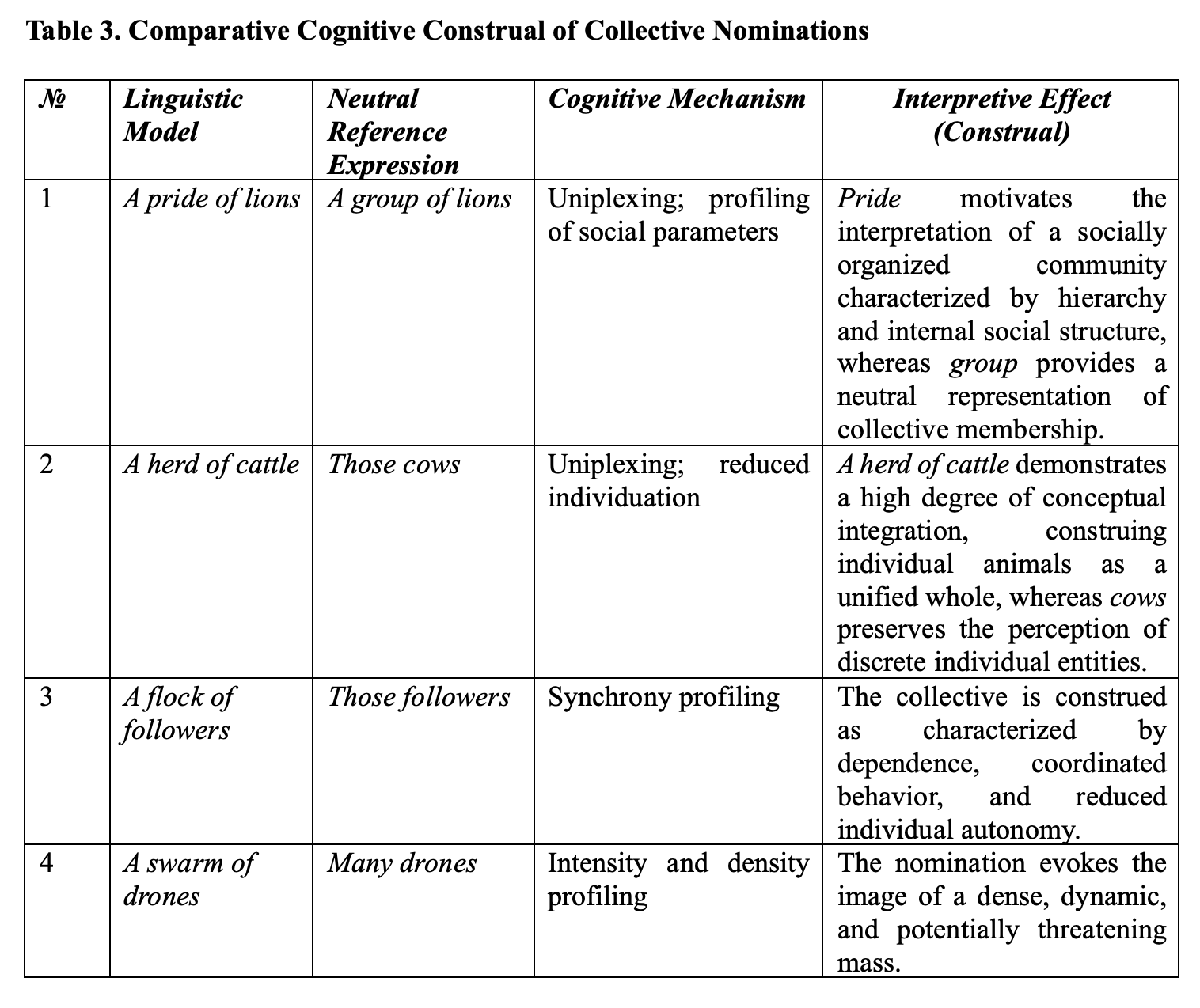
The examples presented in Table 3 demonstrate how the selected animal community nominations shape the cognitive profiling of collectivity in ways that differ from neutral expressions of plurality. Unlike neutral collective expressions such as group, many, or lexical items denoting individual entities, the analyzed nominations activate additional dimensions of construal beyond those encoded by neutral expressions of plurality, including social hierarchy, behavioral synchrony, interactional intensity, and reduced individuation. The choice of a collective nomination therefore influences not only how a plurality is represented linguistically but also how it is cognitively construed, giving rise to distinct models of collective organization in discourse. The observed interpretive differences are grounded not only in lexical meaning but also in encyclopedic knowledge linked to different models of collective organization. These contrasts further demonstrate that collective nominations function as mechanisms of cognitive profiling within the lexical-semantic field of animal community nominations, directing attention to particular dimensions of collective organization and motivating distinct interpretations of collective entities across both Literal Core and Metaphorically Extended Uses.
The comparative analysis further demonstrates that analyzed nominations differ systematically in the dimensions of collective organization they foreground. These differences are reflected not only in their construal patterns but also in their evaluative potential. The corpus data indicate recurrent associations between particular construal types and evaluative tendencies, suggesting that the analyzed nominations function as mechanisms of both cognitive and evaluative profiling. Rather than constituting isolated observations, these findings form an integrated explanatory framework of collective conceptualization. The proposed cognitive-semantic model synthesizes the relationships identified in the annotated corpus by integrating uniplexing, cognitive profiling, higher-order construal types, metaphorically extended uses, and evaluative potential into a unified explanatory model, as illustrated in Figure 2.
Figure 2 presents the integrated cognitive-semantic model proposed in the present study. Unlike tables 1 and 2, which summarize the empirical findings of the corpus analysis, the figure integrates these findings into a unified explanatory model linking uniplexing, cognitive profiling, higher-order construal types, metaphorically extended uses, and evaluative potential. The hierarchical structure reflects the transition from the superordinate level of categorization, represented by the neutral schematic category group, to the analyzed nominations. Within the framework of Cognitive Grammar, group functions as a maximally schematic reference point that neither imposes a particular construal nor foregrounds specific dimensions of collective organization.
The transition from neutral reference to evaluative interpretation is mediated by a sequence of cognitive operations. The first stage involves uniplexing, through which a plurality of entities is construed as a unified Gestalt. Once collectivity has been conceptualized as a single cognitive entity, cognitive profiling foregrounds particular dimensions of collective organization. Based on the recurrent profiling parameters identified in the annotated corpus, four higher-order construal types were derived inductively: Agentive, Passive, Dynamic, and Structural.
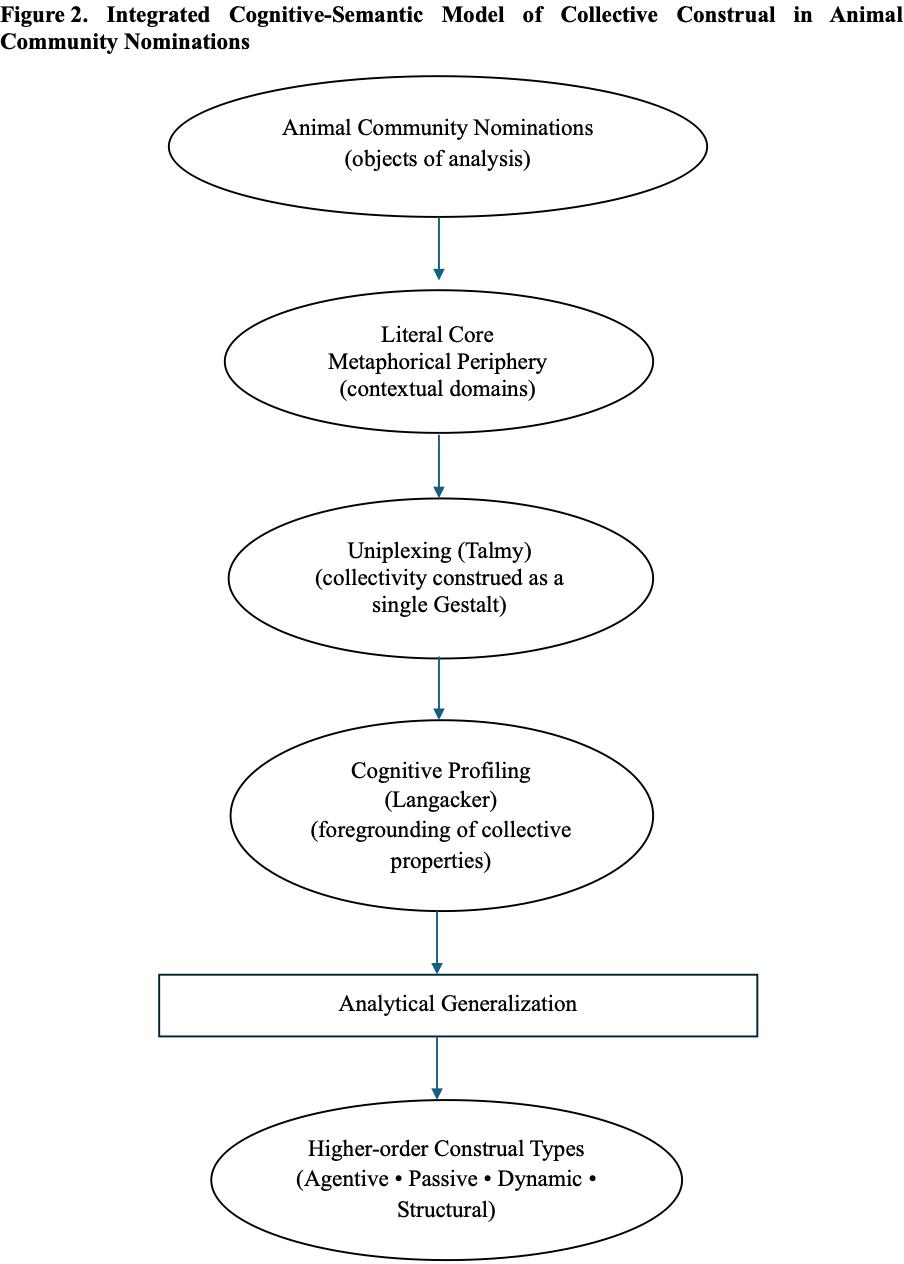
These categories constitute an analytical typology based on recurring profiling patterns observed in the corpus data. They should be understood as dominant profiling tendencies rather than rigid semantic classes. Individual nominations may foreground multiple dimensions simultaneously, although each nomination exhibits a dominant profiling tendency that motivates its classification within the proposed typology. Individual nominations instantiate these higher-order construal types by foregrounding dominant profiling parameters while simultaneously backgrounding alternative dimensions of collective organization – such as coordination (pack), homogeneity (herd), synchrony (flock), and density/intensity (swarm), and hierarchy or functional integration (pride, colony) – while backgrounding other features.
The model synthesizes the recurring profiling patterns identified in the corpus and provides a schematic representation of the relationship between cognitive profiling, construal, and evaluative potential. It further captures how biological prototypes in the Literal Core may provide source-domain knowledge for the conceptualization of social and technological entities in the Metaphorically Extended Uses. The analysis suggests that evaluative potential is not an inherent property of the lexical items themselves but emerges through the interaction of cognitive profiling, contextual interpretation, and encyclopedic knowledge associated with the source domain. Such evaluative meanings become particularly salient in metaphorically extended uses, where characteristics associated with animal communities are projected onto social or technological entities.
In these metaphorical uses, the relationship between construal and evaluation is characterized by recurring tendencies observed in the analyzed corpus. Agentive construals (pack) are frequently associated with interpretations of aggression and hostility. Passive construals (herd) are often linked to conformity and loss of individuality. Dynamic construals (flock, swarm) may motivate interpretations of dependency, threat, chaos, or intrusiveness. Structural construals (pride, colony) are commonly associated with prestige, stability, cohesion, or forms of social organization.
Taken together, the findings suggest a systematic relationship between uniplexing, cognitive profiling, construal types, and evaluative potential. Animal community nominations function not merely as markers of plurality but as mechanisms of cognitive and evaluative construal that shape the interpretation of collective entities across both literal and metaphorical domains.
Particularly noteworthy is the extension of swarm into the technological domain. Such extensions were observed in the corpus during the 2010 – 2019 period, particularly in expressions referring to drones, bots, autonomous systems, and online collectives. In expressions such as swarm of drones, swarm of bots, and swarm of trolls, the cognitive schema associated with insect swarms is projected onto autonomous or semi-autonomous technological entities. Core characteristics of the biological prototype – multiplicity, density/intensity of action – are retained; however, the resulting construal becomes more complex through the addition of algorithmic coordination. Unlike biological uses of swarm, which are commonly associated with disorder and limited controllability, technological uses often profile a combination of distributed agency and programmed synchrony. The metaphorical extension of swarm thus illustrates how a biological model of collectivity can be adapted to contemporary digital and technological forms of organization.
The analysis demonstrates the explanatory value of the proposed analytical framework. By integrating uniplexing, cognitive profiling, metaphorical extension, and evaluative potential within a unified analytical procedure, the framework makes it possible to explain recurrent construal patterns that cannot be fully accounted for when these mechanisms are examined separately. The resulting four-type analytical typology, derived inductively from recurrent profiling parameters identified in the annotated corpus, provides a systematic cognitive-semantic model for interpreting the organization of animal community nominations and their evaluative tendencies across both Literal and Metaphorical domains.
Discussion
The findings demonstrate that animal community nominations function as cognitive mechanisms of collective construal rather than as neutral markers of plurality. The proposed analytical framework explains this behavior by integrating uniplexing, cognitive profiling, metaphorically extended uses, and evaluative potential within a unified explanatory model. The findings indicate that the choice of nomination influences the conceptualization of a group, facilitating a shift from the perception of individual entities to their interpretation as a unified cognitive unit. In this sense, collective nominations function as mechanisms of conceptual structuring that provide alternative ways of construing collective entities in discourse.
The principal contribution of the present study lies in demonstrating that the interaction between uniplexing, cognitive profiling, metaphorical extension, and evaluative potential can be explained within a unified framework. Within this framework, cognitive profiling links the construal of collectivity established through uniplexing with the emergence of higher-order construal types, thereby providing the basis for interpreting their evaluative potential. More broadly, the proposed framework demonstrates how corpus-based cognitive-semantic analysis can move beyond the description of individual lexical items toward the identification of recurrent mechanisms underlying the conceptualization and evaluation of collectivity.
The results indicate that the Literal Core of the lexical-semantic field is anchored in the biological domain and can be interpreted as exhibiting a high degree of prototypicality. Metaphorically Extended Uses are organized relative to this prototypical foundation by preserving selected organizational characteristics of the biological source domain while projecting them onto human, technological, and abstract target domains. Compared with the other analyzed nominations, pride showed the smallest number of metaphorically extended uses among the six analyzed nominations. Most non-literal occurrences represented idiomatic expression (e.g. pride of place), which were excluded during corpus annotation according to the analytical criteria adopted in the present study. Consequently, only a small number of metaphorically extended uses remained eligible for analysis. The remaining metaphorically extended uses consistently preserved the source-domain concepts of social cohesion, hierarchical organization, and collective identity, suggesting that metaphorical extension of pride is considerably more restricted than that of the other analyzed nominations. The analysis of Metaphorically Extended Uses further indicates that the evaluative potential of the lexical-semantic field is shaped not only by universal cognitive mechanisms but also by culturally specific evaluative models embedded in a particular linguocultural context. In this respect, evaluative stereotypes and quasi-stereotypes can be regarded as mechanisms of interpretation reflected in actual language use (Fillmore, 1982; Teliya, 1996).
The role of culturally embedded evaluative models becomes particularly apparent when the English corpus data are considered from a broader cross-linguistic perspective. The ethnocultural specificity of secondary nomination is reflected in the variability of associative characteristics attributed to animal images across languages. For example, in Russian cultural conceptualization, the ram is conventionally associated with stupidity, whereas the donkey is associated with stubbornness. In Spanish, however, both characteristics are conventionally integrated into the image of burro. Although these examples fall outside the English corpus examined in this study, they illustrate the broader role of cultural conceptualization in shaping evaluative associations. Such differences demonstrate that animal-based associations are culturally specific and reflect distinct patterns of cultural conceptualization. These observations are consistent with Kövecses’s account of cultural variation in metaphorical conceptualization.
From this perspective, the evaluative potential of English collective nominations appears to emerge through the interaction of universal cognitive mechanisms, particularly uniplexing and cognitive profiling, with culturally entrenched evaluative models. Consequently, English collective nominations such as herd, pack, and swarm evoke evaluative interpretations that are grounded not only in lexical meaning but also in the encyclopedic knowledge associated with particular models of collective organization.
The findings are consistent with Langacker’s Cognitive Grammar, according to which linguistic expressions impose particular construals on the situations they represent (Langacker, 1987). This observation suggests that lexical choice itself functions as a cognitively meaningful act of categorization rather than as a purely referential selection. The comparison between the analyzed nominations and the superordinate expression a group of demonstrates that these forms are not interchangeable but systematically profile different dimensions of collective organization. Unlike the highly schematic lexeme group, the analyzed nominations selectively foreground organizational properties that guide both the conceptualization and subsequent evaluation of collective entities. These findings demonstrate that collective nominations function not merely as labels for groups but as mechanisms of selective cognitive profiling that shape the interpretation of collectivity and the evaluative perception of social actors. This interpretation is consistent with discourse-oriented approaches to metaphor and media discourse, which emphasize that linguistic choices contribute to the construction of evaluations and representations of social reality in authentic discourse contexts (Semino, 2008; Hart, 2014; 2021)
Beyond lexical categorization, the present findings also contribute to broader cognitive theories of collective representation. In this respect, the present findings are compatible with Tomasello’s (2019) account of collective intentionality. Although the present study does not investigate intentionality directly, the construal of multiple individuals as a unified collective Gestalt appears consistent with broader cognitive mechanisms through which groups are conceptualized as coherent social entities. Animal community nominations can therefore be understood not simply as labels for collective referents but as linguistic resources that facilitate the interpretation of groups in terms of social coordination, shared organization, and collective identity. While Tomasello’s account helps explain the conceptualization of collectivity as a coherent social entity, the evaluative interpretation of such collectives requires consideration of the metaphorical scenarios through which these conceptual structures are activated in discourse.
The evaluative potential of animal community nominations can be further explained through Musolff’s (2016) notion of metaphorical scenarios. Rather than functioning as simple cross-domain mappings between source and target domains, metaphorical extensions activate culturally shared scenarios associated with particular models of collective organization. Within these scenarios, nominations such as pack, herd, or swarm evoke recurring interpretative patterns associated with coordinated hunting, collective following, or mass movement, thereby shaping their evaluative interpretation in social and technological contexts. Through metaphorical extension, these conceptual structures are projected onto new target domains while remaining connected to the prototypical core of the category through shared organizational features. Consequently, collective entities may be construed as aggressive, passive, hierarchically organized, or functionally integrated, depending on the cognitive model activated in discourse. These findings further support the proposed analytical framework by demonstrating how cognitive profiling interacts with culturally shared metaphorical scenarios in guiding both the conceptualization and evaluative interpretation of collectivity.
Digital and Technological Extensions of Collective Construals
A significant finding emerging from the corpus analysis is the extension of animal community nominations beyond their biological origins into technological and digital domains. This tendency is clearly observable in the analyzed corpus data, where algorithmic and networked systems are frequently conceptualized through collective schemas. Expressions such as swarm of drones, swarm of bots, and swarm of trolls illustrate how traditional models of collectivity are applied to digital and networked environments.
Among the analyzed nominations, swarm showed a particularly salient extension into technological and digital domains in the analyzed corpus and therefore serves as an illustrative case of contemporary cross-domain extension. While its Literal Core is anchored in biological collectives, its Metaphorically Extended Uses extend across technological, digital, natural, and astronomical domains. This productivity reflects the schematic nature of the swarm model. Unlike nominations that profile more stable forms of collective organization (e.g., pride), swarm foregrounds dynamic properties such as multiplicity, density, and distributed coordination. These relatively schematic properties enable this construal to be projected onto a wide range of biological, technological, and other collective entities characterized by interactional intensity and rapid expansion.
A related pattern can also be observed in other biologically motivated collective schemas. Unlike the swarm model, which foregrounds movement and density, these extend biological models of social insects to collective decision-making, online communities, and artificial intelligence, illustrating how animal-based schemas increasingly structure the conceptualization of coordinated technological systems.
The technological extension of swarm is also associated with a diversity of evaluative tendencies. In the analyzed corpus, expressions such as swarm of trolls and swarm of drones frequently instantiate negative evaluative meanings that emerge through the interaction of cognitive profiling, contextual interpretation, and source-domain knowledge rather than from the lexeme itself. When characteristics such as density, multiplicity, and reduced controllability are projected onto technological entities, the resulting construal often contributes to interpretations of intrusiveness, disruption, or threat. However, recent developments in assistive technologies suggest that the same collective schema may also be associated with more positive evaluations. This observation suggests that evaluative potential is context-dependent rather than lexically fixed. For example, the SwarmFidget project employs coordinated groups of robots to support emotion regulation and attentional engagement in adults with ADHD (Pulatova & Kim, 2024), illustrating the ontological flexibility of the swarm schema and its capacity to conceptualize emerging forms of coordinated technological agency.
The findings indicate that animal community nominations remain productive cognitive resources for conceptualizing new forms of coordinated technological and digital organization, extending well beyond their original biological domain.
Beyond the present dataset, the proposed analytical framework provides a transferable analytical model for investigating additional animal community nominations and related lexical domains of collectivity. Future applications across different corpora, discourse types, and languages may further refine the proposed analytical typology and evaluate its broader explanatory potential.
Limitations
First, the study was based on a manually annotated qualitative corpus of 1,804 contexts. Although the annotated corpus was relatively large, the analysis itself remained qualitative and focused on identifying recurrent construal patterns rather than establishing statistically generalizable frequency distributions. Second, the empirical analysis was restricted to contemporary English-language data retrieved from the Corpus of Contemporary American English (COCA) and therefore does not necessarily capture patterns occurring in other varieties of English or historical stages of the language. Third, the study was limited to six analyzed animal community nominations retrieved through the syntactic pattern a X of Y. Consequently, the proposed analytical typology should be interpreted as an inductively derived explanatory model rather than as an exhaustive classification of all animal community nominations.
A further limitation concerns annotation reliability. Because all corpus instances were coded by a single annotator, formal inter-annotator agreement statistics were not available. Although explicit coding criteria and repeated examination of ambiguous cases were used to reduce interpretive subjectivity, future studies should validate the annotation scheme through independent double coding of a representative subsample and the calculation of inter-annotator agreement statistics.
These limitations do not diminish the contribution of the proposed framework but rather define the scope within which the present findings should be interpreted. Because the proposed analytical framework and typology were developed inductively from the analyzed corpus, their explanatory value has been demonstrated only within the scope of the present dataset. Further validation using independent datasets, additional animal community nominations, and other lexical domains will be necessary to evaluate the robustness and broader applicability of the proposed framework.
Future Research
The proposed analytical framework also opens several directions for future research. Future studies may extend the proposed framework to additional animal community nominations, other lexical-semantic fields, different discourse types, and cross-linguistic data. Such investigations would provide an opportunity to evaluate the transferability of the proposed analytical typology and determine whether similar construal patterns emerge across languages, discourse contexts, and lexical domains.
A particularly promising direction concerns the continuing metaphorical extension of animal community nominations into technological and digitally mediated forms of collectivity. Expressions such as swarm of drones, swarm of bots, hive mind, and coordinated AI system suggest that animal-based models of collective organization are increasingly employed to conceptualize emerging technological systems. Recent research on swarm user interfaces likewise indicates that biologically inspired collective behavior is increasingly being adopted as an engineering and design principle for digital and robotic systems (Zhang et al., 2026).
These developments also raise important questions regarding the evaluative consequences of technological metaphorical extension. Another important question concerns whether these emerging technological uses preserve the evaluative tendencies associated with their biological sourсe domains or give rise to new evaluative profiles shaped by contemporary technological discourse. Emerging research on Conversational Swarm Intelligence (Rosenberg et al., 2024) likewise suggests that swarm-based models are becoming increasingly relevant for describing collaborative forms of AI-mediated interaction, providing another potential domain in which the proposed analytical framework may be applied.
Such studies would also provide an opportunity to validate the proposed analytical framework and its analytical typology on independent datasets and determine the extent to which the identified construal patterns remain stable across different lexical domains and discourse types.
Conclusion
The present study has demonstrated that animal community nominations constitute a hierarchically organized lexical-semantic field with a prototypical structure, comprising a Literal Core anchored in biological reference and a Metaphorically Extended Uses extending into social and technological domains. The analysis further showed that collective nominations differ systematically in the dimensions of collective organization they foreground, giving rise to recurrent construal patterns and associated evaluative tendencies.
The application of this framework to the annotated corpus lies in the development of an integrated cognitive-semantic framework that explains how uniplexing, cognitive profiling, metaphorical extension, and evaluative potential interact in the conceptualization of animal community nominations. Application of this framework to contemporary corpus data yielded a four-type analytical typology (Agentive, Passive, Dynamic, and Structural), providing an explanatory model for recurrent construal patterns observed across the analyzed nominations. Rather than constituting an exhaustive classification of collective construals, this typology represents an analytical generalization of the dominant profiling tendencies identified in the analyzed corpus.
Beyond the specific findings of the present study, the results contribute to a broader understanding of collective conceptualization by demonstrating that collective nominations do not simply categorize groups but systematically shape their cognitive interpretation. Rather than functioning as neutral markers of plurality, analyzed animal community nominations foreground distinct dimensions of collective organization that guide subsequent evaluative construal. The findings further demonstrate that the interaction between uniplexing, cognitive profiling, metaphorical extension, and evaluative potential can be accounted for within a unified analytical model of animal community nominations. Taken together, the proposed framework offers a transferable and reproducible cognitive-semantic model for investigating collective construal across animal community nominations and related lexical domains, thereby extending the analytical potential of corpus-based cognitive-semantic research.
Statement on the Use of Generative AI: The authors declare that no generative artificial intelligence or AI-assisted technologies requiring disclosure under the Journal’s policy were used in conducting the research or preparing this manuscript.
Заявление об использовании генеративного ИИ: Авторы заявляют, что при проведении исследования и подготовке настоящей рукописи генеративный искусственный интеллект и ИИ-ассистированные технологии, подлежащие раскрытию в соответствии с политикой журнала, не использовались.
















Список литературы
Болдырев Н. Н. Когнитивная семантика: введение в когнитивную лингвистику. Тамбов : Изд-во ТГУ им. Г. Р. Державина, 2014.
Телия В. Н. Русская фразеология: семантический, прагматический и лингвокультурологический аспекты. М.: Школа «Языки русской культуры», 1996.
Зайнульдинов А. А., Quero Gervilla E. F. Лексикографическое описание эмоционально-оценочной лексики в русском и испанском языках // Вопросы языкознания. 2025. No 2. С. 96–110.
Corbett G. G. Number. Cambridge: Cambridge University Press, 2000.
Croft W., Cruse D. A. Cognitive Linguistics. Cambridge: Cambridge University Press, 2004.
Crystal D. The Story of English in 100 Words. London: Profile Books, 2011.
Davies M. The Corpus of Contemporary American English (COCA). 2008 – present. URL: https://www.english-corpora.org/coca/ (дата обращения: 10.07.2026)
de Vries H. Collective nouns // The Oxford Handbook of Grammatical Number / ed. by P. Cabredo Hofherr, J. Doetjes. Oxford : Oxford University Press, 2021. Pp. 257–274. DOI: 10.1093/oxfordhb/9780198795858.013.12.
Evans V., Green M. Cognitive Linguistics: An Introduction. Edinburgh: Edinburgh University Press, 2006.
Fillmore C. J. Frame Semantics // Linguistics in the Morning Calm. Seoul: Hanshin Publishing Company, 1982. Pp. 111–137.
Fillmore C. J., Atkins B. T. Toward a frame-based lexicon: the semantics of RISK and its neighbors // Frames, Fields, and Contrasts / ed. by A. Lehrer, E. F. Kittay. Hillsdale, NJ: Lawrence Erlbaum, 1992. Pp. 75–102.
Geeraerts D. Theories of Lexical Semantics. Oxford: Oxford University Press, 2009.
Hart C. Discourse, Grammar and Ideology: Functional and Cognitive Perspectives. London: Bloomsbury Academic, 2014.
Hart C., Marmol Queralto J. What can cognitive linguistics tell us about language-image relations? A multidimensional approach to intersemiotic convergence in multimodal texts // Cognitive Linguistics. 2021. Vol. 32. No. 4 Pp. 529–562. URL: https://doi.org/10.1515/cog-2021-0039
Ji J., Liang M. An animacy hierarchy within inanimate nouns: English corpus evidence from a prototypical perspective // Lingua. 2018. Vol. 205. Pp. 71–89.
Joosten F., De Sutter G., Drieghe D., Grondelaers S., Hartsuiker R. J., Speelman D. Dutch collective nouns and conceptual profiling // Linguistics. 2007. Vol. 45. No. 1. Pp. 85–132.
Kövecses Z. Metaphor in Culture: Universality and Variation. Cambridge: Cambridge University Press, 2005.
Lakoff G. Women, Fire, and Dangerous Things: What Categories Reveal about the Mind. Chicago: University of Chicago Press, 1987.
Lakoff G., Johnson M. Metaphors We Live By. Chicago: University of Chicago Press, 2003.
Langacker R. W. Foundations of Cognitive Grammar. Vol. 1: Theoretical Prerequisites. Stanford, CA: Stanford University Press, 1987.
Levin M. Agreement with Collective Nouns in English. Lund: Lund University, 2001.
Lipton J. An Exaltation of Larks, or The Venereal Game. Expanded 2nd ed. New York: Viking Press, 1977.
Musolff A. Political Metaphor Analysis: Discourse and Scenarios. London: Bloomsbury Academic, 2016.
Pulatova S., Kim L. H. Co-designing programmable fidgeting experience with swarm robots for adults with ADHD // Proceedings of the 26th International ACM SIGACCESS Conference on Computers and Accessibility (ASSETS ‘24). New York: ACM, 2024. Pp. 1–14. URL: https://doi.org/10.1145/3663548.3675614
Rosenberg L., Willcox G., Schumann H., Mani G. Towards Collective Superintelligence: Amplifying Group IQ using Conversational Swarms. arXiv preprint arXiv:2401.15109. 2024. URL: https://arxiv.org/abs/2401.15109 (дата обращения: 10.07.2026).
Rosch E. Principles of Categorization // Cognition and Categorization / ed. by E. Rosch, B. B. Lloyd. Hillsdale, NJ : Lawrence Erlbaum, 1978. Pp. 27–48.
Semino E. Metaphor in Discourse. Cambridge : Cambridge University Press, 2008.
Sibul V. Psycholinguistic analysis of lexical-semantic structure in linguistic consciousness of Russian, English and German native speakers // Training, Language and Culture. 2017. Vol. 1. No. 2. Pp. 54–70. URL: https://doi.org/10.29366/2017tlc.1.2.4
Steen G. J., Dorst A. G., Herrmann J. B., Kaal A., Krennmayr T., Pasma T. A Method for Linguistic Metaphor Identification: From MIP to MIPVU. Amsterdam: John Benjamins Publishing Company, 2010.
Talmy L. Toward a Cognitive Semantics. Vol. 1: Concept Structuring Systems. Cambridge, MA: MIT Press, 2000.
Taylor J. R. Linguistic Categorization. 3rd ed. Oxford: Oxford University Press, 2003.
Taylor J. R. Prototypes in Cognitive Linguistics. Oxford: Oxford University Press, 2018.
Tomasello M. Becoming Human: A Theory of Ontogeny. Cambridge, MA: Harvard University Press, 2019.
Tran T. T. O., Bui T. V. T. The semantic features of collective nouns in English // International Journal of TESOL & Education. 2021. Vol. 1. No. 3. Pp. 130–141.
Zhang X., Aggarwal V., Zhu A., Kim L. H. Feeling with Many: Rethinking Emotion Regulation with Swarm User Interfaces // Proceedings of the 2026 CHI Conference on Human Factors in Computing Systems (CHI ‘26). Barcelona, Spain, 13-17 April 2026. New York: ACM, 2026. Article 1440. Pp. 1–23. URL: https://doi.org/10.1145/3772318.3791599