
Spearman's rank distance as a tool for stylometric attribution: a comparative analysis on heterogeneous corpora
This paper presents an empirical comparison of a metric based on Spearman's rank correlation coefficient with traditional and relatively new distance measures (Burrows's Delta, Cosine Delta, Labbé distance, Soergel distance, and Jensen-Shannon divergence, the latter receiving particular attention) used in stylometric text attribution. The relevance of the study lies in the need to search for and identify a stylometric tool (a distance measure and its “settings”) that is robust to within-author variability and feature space sparsity. The research problem stems from methodological uncertainty in choosing an optimal distance measure for stylometric attribution. Despite the development of distance-based approaches, the effectiveness of metrics critically depends on corpus structure, the length of the analyzed fragments, and feature space parameters. In the absence of a single reliable metric for attributing complex text corpora, this study for the first time substantiates the use of Spearman's rank distance as a valid tool for stylometric analysis. The empirical basis of the study comprises four text corpora heterogeneous in terms of time, genre, and language (49 authors in total, 899 literary texts). The study included unified text preprocessing (tokenization, lowercasing, wordform-level analysis) and systematic parameter tuning for the six metrics. For each combination (author, metric, fragment length), the optimal configuration of parameters (number of frequent words; absence/presence of standardization) was determined, providing the maximum true positive rate in attribution using the k-NN method, k=1. The results show that Spearman's rank distance demonstrates the greatest robustness and universality, maintaining high accuracy under genre heterogeneity, variability in text length, and the presence of stylistic anomalies. It is established that Spearman's rank distance systematically outperforms frequency-based and entropy-based metrics in robustness under conditions of genre heterogeneity and can serve as a reliable tool for stylometric attribution.
Figures
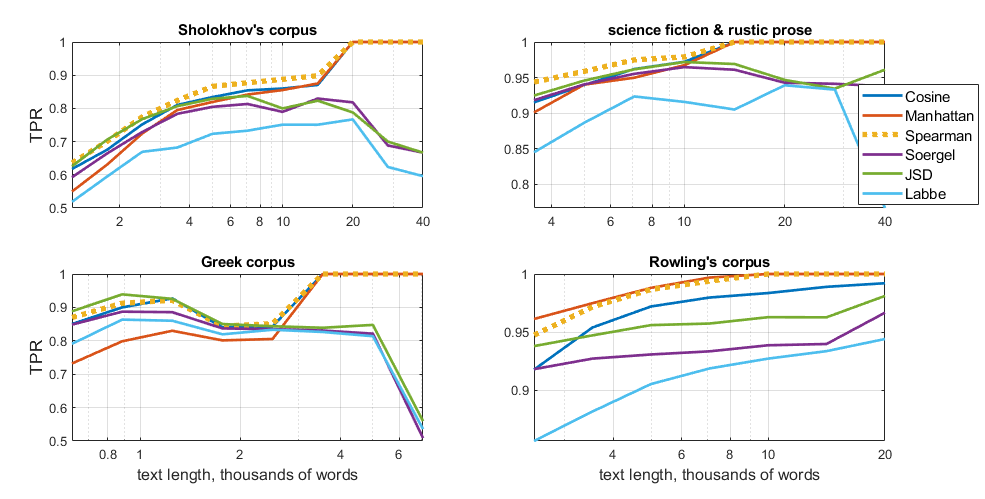
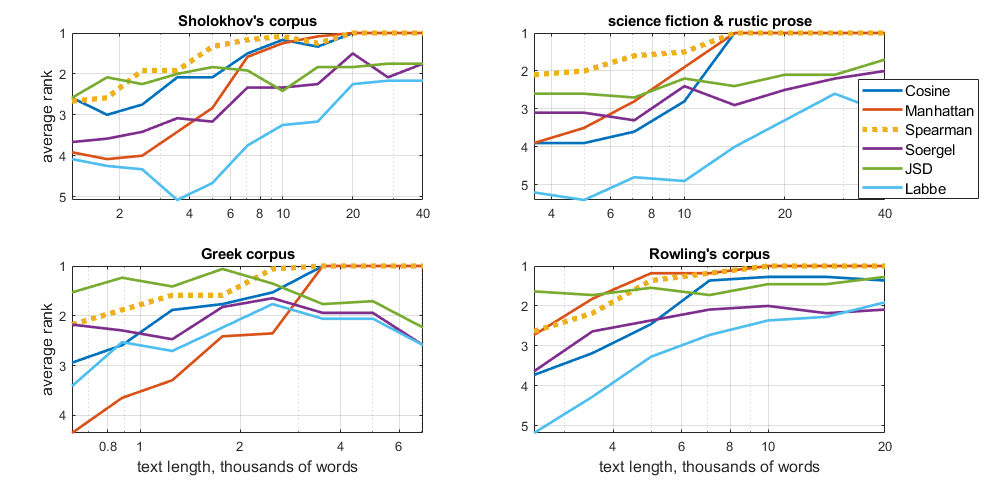
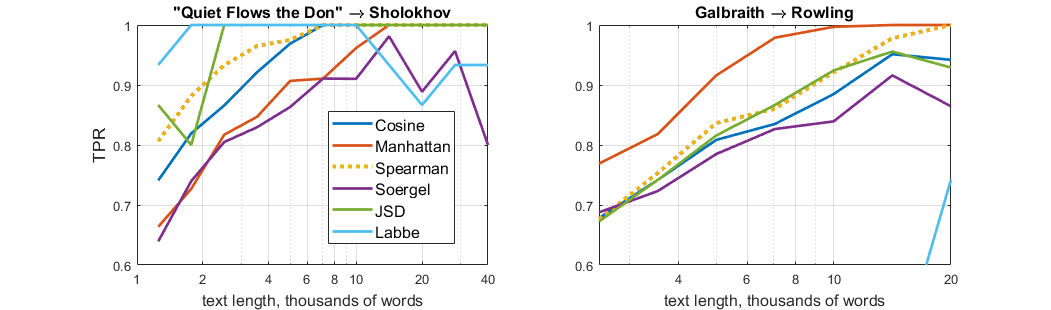
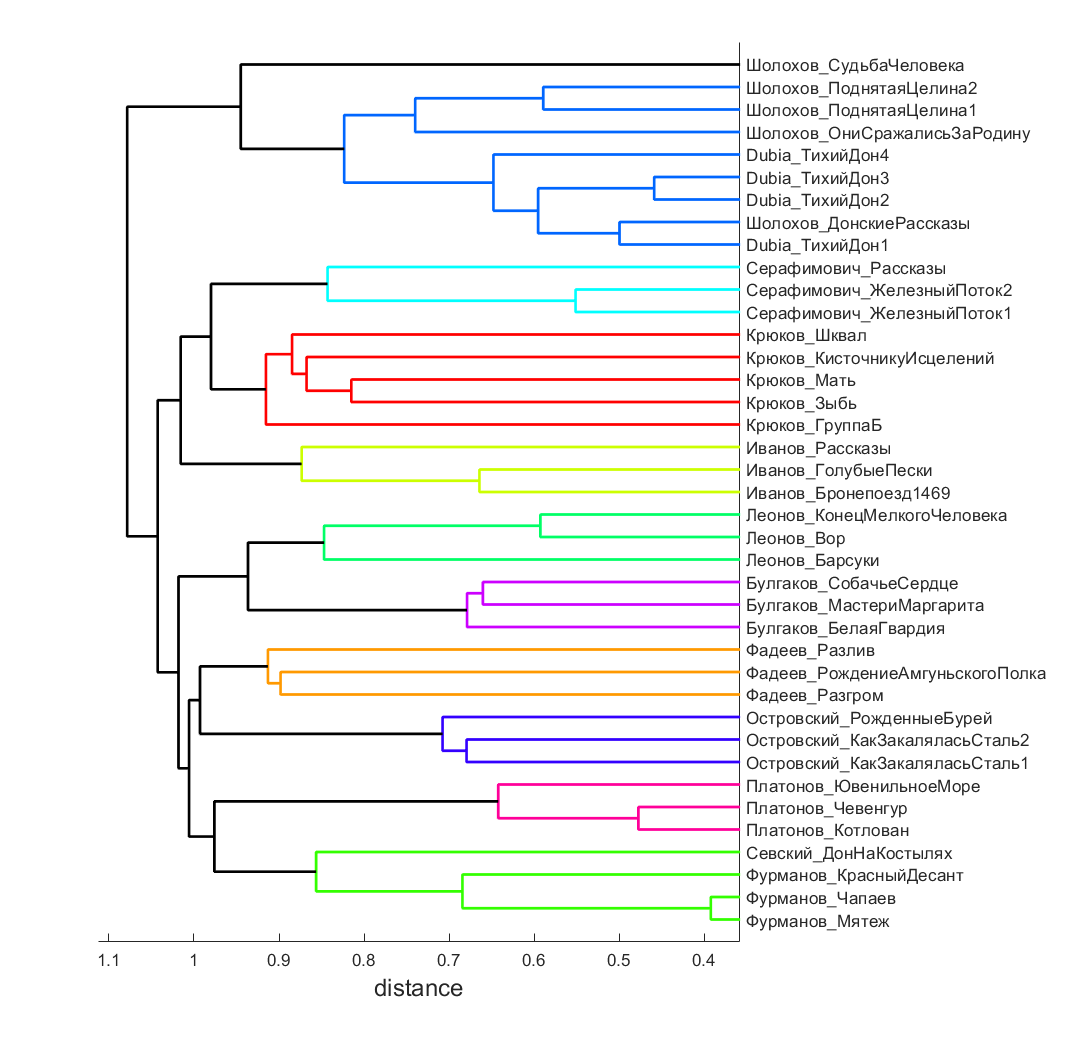
Bochkarev, V. V., Afanasev, A. S., Bakirov, R. A. (2026). Spearman’s rank distance as a tool for stylometric attribution: a comparative analysis on heterogeneous corpora, Research Result. Theoretical and Applied Linguistics, 12 (3), 52–79.
















While nobody left any comments to this publication.
You can be first.
Alieva, O. V. (2024). Distance measures for determining the authorship of ancient Greek texts, Tsifrovye gumanitarnye issledovaniya [Digital Humanities Research], 1 (1), 8–33. DOI: 10.31860/cgi-2024-1-8-33 (In Russian)
Dvinyatin, F. N., Kovalev, B. V. (2024). “Sirin is not inferior to Leonov”: the Delta method for stylometric analysis of Russian novels of the interwar period, Шаги / Steps [Shagi/Steps], 10 (3), 207–229. DOI: 10.22394/2412-9410-2024-10-2-207-229. (In Russian)
Martynenko, G. Ya. (2014). Stylometry: emergence and development in the context of interdisciplinary interaction. Part 1. First steps: 19th century, Strukturnaya i prikladnaya lingvistika [Structural and Applied Linguistics], 10, 3–23. (In Russian)
Martynenko, G. Ya. (2015). Stylometry: emergence and development in the context of interdisciplinary interaction. Part 2. First half of the 20th century: expansion of interdisciplinary contacts of stylometry, Strukturnaya i prikladnaya lingvistika [Structural and Applied Linguistics], 11, 9–28. (In Russian)
Maslinskiy, K. A. (2022). Refined digital textology: once again on the question of the authorship of the novel “And Quiet Flows the Don”, Russkaya literatura [Russian Literature], 1, 247–254. DOI: 10.31860/0131-6095-2022-1-247-254. (In Russian)
Staroverova, P. V. (2025). The Strugatskys separated: Stylometric identification of individual authorial fragments in a collective text, Tsifrovye gumanitarnye issledovaniya [Digital Humanities Research], 1, 24–39. DOI: 10.31860/cgi-2025-1-24-39. (In Russian)
Velikanova, N. P. and Orekhov, B. V. (2019). Digital textology: text attribution using the example of M. A. Sholokhov’s novel “And Quiet Flows the Don”, Mir Sholokhova [Sholokhov World], 1 (11), 70–82. (In Russian)
Arefin, A. S., Vimieiro, R., Riveros, C., Craig, H. and Moscato, P. (2014). An information theoretic clustering approach for unveiling authorship affinities in Shakespearean era plays and poems, PLoS One, 9 (10), e111445. DOI: 10.1371/journal.pone.0111445. (In English)
Argamon, S. (2008). Interpreting Burrows’ delta: Geometric and probabilistic foundations, Literary and Linguistic Computing, 23 (2), 131–147. DOI: 10.1093/llc/fqn003. (In English)
Bortolato, C. (2016). Intertextual Distance of Function Words as a Tool to Detect an Author’s Gender: A Corpus-Based Study on Contemporary Italian Literature, Glottometrics, 34, 28–43. (In English)
Burrows, J. (2002). ‘Delta’: a Measure of Stylistic Difference and a Guide to Likely Authorship, Literary and Linguistic Computing, 17 (3), 267–287. DOI: 10.1093/llc/17.3.267. (In English)
Endres, D. M. and Schindelin, J. E. (2003). A new metric for probability distributions, IEEE Transactions on Information Theory, 49 (7), 1858-1860. DOI: 10.1109/TIT.2003.813506. (In English)
Evert, S., Proisl, T., Jannidis, F., Reger, I., Pielström, S., Schöch, C. and Vitt, T. (2017). Understanding and explaining Delta measures for authorship attribution, Digital Scholarship in the Humanities, 32, 4–16. DOI: 10.1093/llc/fqx023. (In English)
Grieve, J. (2007). Quantitative authorship attribution: An evaluation of techniques, Literary and Linguistic Computing, 22 (3), 251–270. DOI: 10.1093/llc/fqm020. (In English)
Grzybek, P. (2014). The Emergence of Stylometry: Prolegomena to the History of Term and Concept, available at: http://www.peter-grzybek.eu/science/publications/2014/grzybek_2014_stylometry.pdf (Accessed 05.04.2026). (In English)
Hoover, D. (2002). Frequent word sequences and statistical stylistics, Literary and Linguistic Computing, 17 (2), 157-180. DOI: 10.1093/llc/17.2.157. (In English)
Hoover, D. (2004). Testing Burrows’s Delta, Literary and Linguistic Computing, 19 (4), 453–475. DOI: 10.1093/llc/19.4.453. (In English).
Jannidis, F., Pielström, S., Schöch, C. and Vitt, T. (2015). Improving Burrows’ Delta – An empirical evaluation of text distance measures, available at: https://www.researchgate.net/publication/280086768_Improving_Burrows’Delta-_An_empirical_evaluation_of_text_distance_measures (Accessed 5 April 2026). (In English)
Koppel, M., Schler, J. and Argamon, S. (2009). Computational methods in authorship attribution, Journal of the American Society for Information Science and Technology, 60 (1), 9–26. DOI: 10.1002/asi.20961. (In English)
Kocher, M. and Savoy, J. (2019). Evaluation of text representation schemes and distance measures for authorship linking, Digital Scholarship in the Humanities, 34 (1), 189–207. DOI: 10.1093/llc/fqy013. (In English)
Kovalev, B. V. (2024). From Classics to Digital Philology: On the Origin and Growth of Stylometry, Philologia Classica, 19 (2), 347–360. DOI: 10.21638/spbu20.2024.211. (In English)
Labbé, C. and Labbé, D. (2006). A Tool for Literary Studies: Intertextual Distance and Tree Classification, Literary and Linguistic Computing, 21 (3), 311–326. DOI: 10.1093/llc/fqi063. (In English)
Levy, A., Shalom, B. R. and Chalamish, M. (2025). A guide to similarity measures and their data science applications, J Big Data, 12, Art. 188. DOI: 10.1186/s40537-025-01227-1. (In English)
Lin, J. (1991). Divergence measures based on the Shannon entropy, IEEE Transactions on Information Theory, 37 (1), 145–151. DOI: 10.1109/18.61115. (In English)
Mikros, G., Sosoni, V., Manousakis, V., and Polychroniou, K. (2026). Burrows’ Delta as a Convergent Validator: Stylometric Analysis for Complementary Machine Translation Evaluation. Journal of Quantitative Linguistics, 1–29. DOI: 10.1080/09296174.2026.2612931. (In English)
Orekhov, B. V. (2024). Does Burrows’ Delta really confirm that Rowling and Galbraith are the same author?, available at: https://publications.hse.ru/pubs/share/direct/950068199.pdf (Accessed 5 April 2026). DOI: 10.48550/arXiv.2407.10301. (In English)
O’Sullivan, J. (2025). Stylometric comparisons of human versus AI-generated creative writing. Humanities and Social Sciences Communications, 12, 1708. DOI: 10.1057/s41599-025-05986-3. (In English)
Pronin, D. and Kazartsev, E. (2026). Rank-Turbulence Delta and Interpretable Approaches to Stylometric Delta Metrics, available at: https://arxiv.org/pdf/2604.19499 (Accessed 5 April 2026). (In English)
Rybicki, J. and Eder, M. (2011). Deeper Delta across genres and languages: do we really need the most frequent words?, Literary and Linguistic Computing, 26 (3), 315–321. DOI: 10.1093/llc/fqr031. (In English)
Savoy, J. (2020). Machine Learning Methods for Stylometry: Authorship Attribution and Author Profiling, Springer International Publishing, Cham, Switzerland. DOI: 10.1007/978-3-030-53360-1. (In English)
Skorinkin, D. and Orekhov, B. (2023). Hacking stylometry with multiple voices: Imaginary writers can override authorial signal in Delta. Digital Scholarship in the Humanities, 38 (3), 1247–1264. DOI: 10.1093/llc/fqad012. (In English)
Smith, P. and Aldridge, W. (2011). Improving Authorship Attribution. Optimizing Burrows’ Delta Method, Journal of Quantitative Linguistics, 18 (1), 63–88. DOI: 10.1080/09296174.2011.533591. (In English)
Spearman, C. (1904). The proof and measurement of association between two things, American Journal of Psychology, 15 (1), 72–101. DOI: 10.2307/1412159. (In English)
Stanikunas, D., Mandravickaite, J. and Krilavicius, T. (2017). Comparison of distance and similarity measures for stylometric analysis of Lithuanian texts, available at: https://portalcris.vdu.lt/server/api/core/bitstreams/423f881d-b231-4a02-b509-80fd53205028/content (Accessed 28 April 2026). (In English)
Willett, P., Barnard, J. and Downs, G. (1998). Chemical similarity searching, J Chem Inform Comput Sci, 38, 983–996. DOI: 10.1021/CI9800211. (In English)
The study was supported by the Russian Science Foundation grant No. 24-18-00570, https://rscf.ru/project/24-18-00570/.