

Move-Step Structures in English vs. Persian Research-Article Abstracts Across Three Disciplines (2022-2024)
Abstract
Researchers often have to develop abstracts in both English and their native language when intending to get their research articles (RAs) published in scholarly journals. Some, however, encounter challenges in this process, one of which is related to the rhetorical moves (RMs). This study endeavored to examine the RMs and steps of English and Persian RA abstracts recently published in top-tier journals across hard, medical, and soft disciplines. To this end, 150 English and 150 Persian abstracts from the disciplinary domains of Computers and Electrical Engineering (CEE), Psychiatry, and Applied Linguistics (AL), published in Scopus or Web of Science-indexed journals from 2022 to 2024, were selected, according to journal indexing, abstract policy, and availability. The corpus comprised primarily unstructured abstracts, with the exception of Psychiatry journals, which followed disciplinary conventions for structured formats. The abstracts were analyzed adopting Hyland's (2000) five-move framework. The findings suggested that the Product, Purpose, and Method moves were the most frequent in the abstracts (89.33%, 82.66%, and 81.66%, respectively). The most common RM pattern was the five-move organization of Introduction-Purpose-Method-Product-Conclusion (38.33%) in the RA abstracts. Inferential analyses revealed that the probability of observing the full pattern was over 0.70 in Psychiatry but only 0.20 in CEE, with Persian abstracts showing greater structural diversity. They also demonstrated that the Conclusion move was significantly more prevalent in Psychiatry abstracts than in CEE, and in English AL abstracts than in their Persian counterparts. Furthermore, the outcomes indicated that the abstracts typically contained an average of 5.86 steps, with the Purpose step being the most recurrent (16.76%), followed by the Product and Instrument steps (16.3% and 14.6%, respectively). Statistical modeling of steps identified significant language-discipline interactions, with the Definition and Conclusion steps showing the most pronounced variation. Additionally, it was found that the step pattern of the Prominence-Gap-Purpose-Participant-Instrument-Product-Implication was the most frequently used in abstract development. This study’s findings may give valuable insights into the patterns of English and Persian abstracts in various fields of study, which can be beneficial for English for Academic Purposes and academic writing courses.
Keywords: Hyland move model, Step patterns, Dual moves, Cross-linguistic abstract structure, Disciplinary variation
Introduction
Research articles (RAs) constitute the primary medium through which scientific knowledge is disseminated and disciplinary interaction is sustained within academic communities (Tankó, 2017). Researchers from various disciplines in different languages have been striving to carry out and publish research for knowledge development. Central to this communicative process is the abstract, which functions as a structured summary of the study and enables readers and journal editors to make preliminary evaluative decisions regarding relevance and contribution (Bhatia, 1993; Lorés, 2004). As Doró (2013) notes, abstracts render research accessible to a broader readership, while simultaneously performing a “gatekeeping function” by encouraging or discouraging further engagement with the full text (Porush, 1995: 76).
Despite the centrality of abstracts in academic publishing, constructing this section appropriately poses challenges for many researchers, whether writing in a first or second language (Johns, 1992; Ventola, 1994). These challenges stem from factors such as poor general and academic writing skills in the first or second language, limited genre awareness, unfamiliarity with disciplinary conventions, and difficulty recognizing rhetorical variation across fields. Among the structural features of RA abstracts, rhetorical moves (RMs) play a central role in shaping organization and communicative function. Deviations from conventional move patterns may result in abstracts that diverge from disciplinary expectations, potentially affecting textual coherence and evaluative reception. Consequently, the organization of abstracts in terms of RMs has become a central concern in genre-analytic research, motivating extensive empirical investigations across languages, disciplines, and academic contexts (e.g., Amnuai, 2019; Khany and Malmir, 2020; Marefat et al., 2021; Zand-Moghadam and Zhaleh, 2022, to name just a few).
Existing cross-linguistic studies of RA abstracts have typically focused on a single discipline using limited corpora and relied primarily on move-level analysis, limiting their ability to capture fine-grained rhetorical variation across epistemic contexts. Conversely, step-level investigations have tended to examine either one language or one disciplinary domain, leaving the interaction between language and discipline underexplored. To date, no study has systematically examined step-level rhetorical variation across multiple disciplines and languages within a balanced design using recent, comparable journal corpora and employing inferential tests. The present study addressed this gap by adopting a balanced cross-linguistic (English-Persian) and cross-disciplinary (Computers and Electrical Engineering – CEE, Psychiatry, and Applied Linguistics – AL) design, integrating move- and step-level analysis, and applying explicit inferential testing to a controlled corpus of abstracts published between 2022 and 2024. On this basis, and in order to operationalize these analytical objectives, the study formulated the following research questions:
Research Question One: What are the frequent RMs in the English and Persian RA abstracts from Scopus or Web of Science-indexed journals across the various areas of CEE, Psychiatry, and AL published from 2022 to 2024?
Research Question Two: What are the frequent steps of RMs used in the RA abstracts in English and Persian from Scopus or Web of Science-indexed journals across the distinct fields of CEE, Psychiatry, and AL published from 2022 to 2024?
Research Question Three: What are the common RM patterns among the three diverse domains of CEE, Psychiatry, and AL RA abstracts in English and Persian journals indexed in Scopus or Web of Science, published between 2022 and 2024?
The hypotheses of the present study are grounded in genre-based views of academic discourse, which conceptualize RA abstracts as sites where disciplinary epistemologies and rhetorical conventions intersect (Hyland, 2000; Swales, 2004). Disciplines differ in how knowledge is produced, validated, and communicated, and these differences are reflected in the rhetorical structuring of abstracts. Fields such as Psychiatry, which rely on empirical validation involving human participants and standardized reporting norms, are therefore expected to exhibit higher degrees of move conventionalization and more explicit realization of Method- and Conclusion-related steps. By contrast, engineering-oriented disciplines such as CEE, which prioritize problem-solution logics and technological contribution, may place comparatively less rhetorical emphasis on evaluative or inferential concluding functions. AL, positioned between hard and soft sciences, is expected to display greater rhetorical flexibility, particularly at the step and move-pattern levels.
In addition to disciplinary influences, cross-linguistic variation is expected to shape abstract organization. English and Persian academic writing operate within partially distinct institutional, rhetorical, and educational contexts, which may affect how research significance, methodological detail, and contribution are rhetorically compressed or elaborated in abstracts. These differences are treated not as deficiencies, but as conventionalized preferences in abstract construction. Accordingly, the hypotheses predict systematic Language × Discipline effects in move presence, step realization, and move-pattern selection, rather than uniform variation attributable to language or discipline alone. Particularly, the following hypotheses were proposed.
Hypothesis One: The Conclusion move appears significantly more frequently in Psychiatry abstracts than in CEE and AL abstracts, reflecting the discipline’s emphasis on outcome evaluation and clinical relevance, and is more prevalent in English than in Persian abstracts.
Hypothesis Two: Step realizations within the Method move differ systematically by discipline, with Instrument steps occurring more frequently in CEE abstracts and Participant steps occurring more frequently in Psychiatry and AL abstracts.
Hypothesis Three: Persian abstracts contain a higher proportion of Definition steps and a lower proportion of Gap steps than English abstracts, reflecting language-specific rhetorical preferences in establishing research significance.
Literature Review
Move Analysis in RA Abstracts
RA abstracts have long been recognized as a highly conventionalized academic genre, characterized by recurring rhetorical functions that enable writers to present complex studies concisely and persuasively (Doró, 2013; Lorés, 2004). Genre-analytic research has consistently shown that abstracts tend to follow a limited set of macro-structural patterns, typically realized through a sequence of RMs such as contextualizing the research, stating its purpose, outlining methodological procedures, reporting findings, and drawing conclusions (Pho, 2008; Santos, 1996). Across disciplines, these core functions appear relatively stable, suggesting that abstracts serve a shared communicative purpose within academic publishing.
At the same time, the relative prominence and optionality of individual moves are not uniform across research contexts. While studies in AL and related fields have consistently reported high frequencies of Purpose, Method, and Product moves, the Introduction and Conclusion moves are often optional or variably realized (Santos, 1996; Tseng, 2011). In contrast, research in scientific and medical domains tends to exhibit more complete move realizations, particularly where methodological transparency and outcome evaluation are central to disciplinary standards of knowledge validation (Ramadhini et al., 2021; Samraj, 2005). These findings suggest that, despite a shared communicative core, abstract structure is shaped by contextual factors that extend beyond genre conventions.
Cross-Disciplinary Variation
Building on this observation, disciplinary variation has emerged as a key explanatory factor in abstract organization. Comparative genre studies have shown that even closely related fields may differ systematically in how they prioritize rhetorical functions and sequence moves (Samraj, 2005; Suntara and Usaha, 2013). Disciplines grounded in experimental and empirical traditions typically foreground methodological detail and result reporting, whereas fields with interpretive or applied orientations allocate greater rhetorical space to contextualization or implications (Nagano, 2015). From this perspective, disciplinary affiliation does not merely modulate move frequency but reflects deeper epistemological orientations that shape how research is framed, justified, and evaluated in abstract form.
Such differences are not simply stylistic but reflect how disciplines construct and legitimate knowledge. In engineering-related fields, for instance, abstracts often emphasize problem specification, instrumental design, and product outcomes, aligning with a problem–solution epistemology. In contrast, medical and clinical disciplines frequently foreground participant characteristics, procedures, and evaluative conclusions, reflecting their reliance on human-subject research and evidence-based practice. AL, as a hybrid field, often exhibits rhetorical flexibility, combining empirical reporting with contextual and pedagogical framing (Pho, 2008). These disciplinary tendencies highlight the importance of analyzing abstract rhetoric in relation to domain-specific communicative priorities. Supporting this view, Tseng (2011), in a cross-disciplinary analysis of abstracts from applied sciences and humanities, found that experimental disciplines exhibited significantly higher frequencies of Method and Result moves, whereas soft disciplines showed greater variability in Introduction and Conclusion moves. Similarly, Doró (2013) reported that disciplinary membership accounted for substantial variation in move sequencing and optionality in abstracts, suggesting that abstract organization is closely aligned with discipline-specific norms of knowledge presentation.
Cross-Linguistic Variation
In addition to disciplinary influences, language-specific rhetorical conventions play a significant role in shaping abstract structure. Cross-linguistic studies comparing English with other languages have shown that writers may differ in how explicitly they articulate research gaps, define key concepts, or evaluate findings, even when targeting international journals (Johns, 1992; Karimah et al., 2023; Li, 2020). For example, abstracts written in languages other than English have been found to rely more heavily on definitional framing or implicit contextualization, while English abstracts often prioritize explicit gap articulation and outcome evaluation.
Comparative research on English and Persian academic writing consistently reports systematic differences in rhetorical preferences, particularly in the realization of introductory and concluding functions. Across disciplines, Persian abstracts have been shown to rely more heavily on definitional framing and general macro-moves, while English abstracts tend to foreground explicit problematization, methodological specification, and result reporting (Ghasempour and Farnia, 2017; Marefat et al., 2021; Marefat and Mohammadzadeh, 2013; Zand-Vakili and Fard Kashani, 2012). Importantly, these studies converge in showing that such differences persist even in abstracts published in indexed journals, suggesting that language-specific rhetorical conventions are not fully neutralized by globalized publishing norms.
Step-Level Analyses
While move-level analyses have provided valuable insights into abstract macro-structure, they often obscure finer-grained rhetorical distinctions within moves. Step-level analysis addresses this limitation by identifying more specific communicative functions, such as defining concepts, specifying participants, describing instruments, or articulating implications. Studies employing step-level frameworks have shown that steps within the same move can vary substantially in frequency and function across disciplines (Khany and Malmir, 2020; Li, 2020). In a qualitative, cross-disciplinary study, Relawati and Basthomi (2021) investigated the moves and steps of 48 abstracts published in a journal. The findings revealed that most abstracts used Move 3 (Method, 46 abstracts), Move 4 (Product, 44 abstracts), and Move 2 (Purpose, 40 abstracts). In their corpus, authors most frequently applied Step 1 within Move 2 (Purpose), Step 1 within Move 4 (Product),
and Step 3 within Move 3 (Procedure). These patterns suggest that step-level realizations provide critical insight into how rhetorical functions are operationalized within moves, thereby motivating the present study’s focus on step-level variation across both disciplinary and linguistic contexts.
However, step-level research remains comparatively limited in scope. Most studies focus on a single language or a single disciplinary domain, which restricts their ability to account for interaction effects between language and discipline. Consequently, it is still unclear whether observed step distributions are driven primarily by disciplinary epistemologies, linguistic conventions, or their combined influence. Moreover, few studies have integrated step-level analysis with probabilistic or inferential methods capable of testing such interactions explicitly.
Summary and Research Gap
To synthesize the existing literature and clearly position the current study, Table 1 provides a summary of key previous research, highlighting the corpora, foci, findings, and limitations.
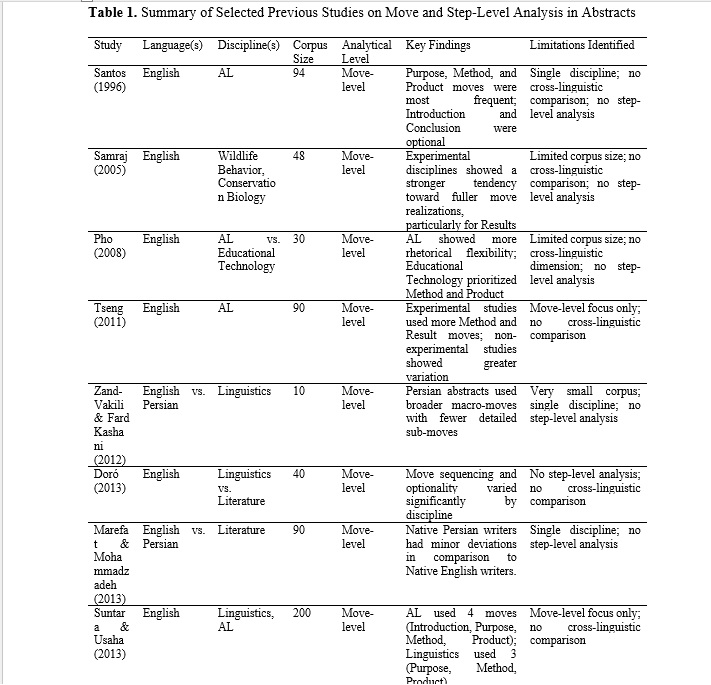
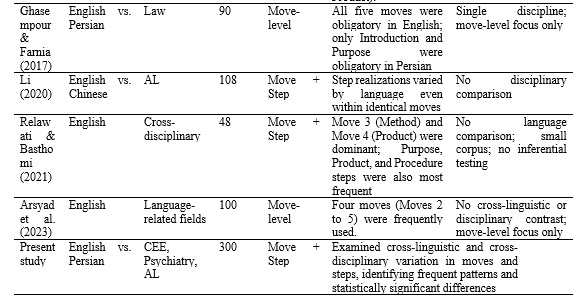
In sum, existing research has established that RA abstracts exhibit both cross-disciplinary and cross-linguistic variation in rhetorical organization. Move-level analyses have identified relatively stable macro-structures, while step-level studies have revealed finer-grained functional variation. However, as shown in Table 1, previous research has either examined move-level variation across disciplines or languages or step-level realizations within a single language or discipline, leaving the interaction between language and discipline at the step level largely unexplored. In other words, cross-linguistic studies rarely operate at the step level, and step-level studies seldom adopt a balanced cross-disciplinary design.
To address this gap, the present study adopted a genre-analytic framework capable of capturing both stable macro-structural patterns and finer-grained rhetorical variation. Specifically, it employed a move-step model that allows systematic comparison across languages and disciplines while remaining sensitive to the epistemological assumptions embedded in abstract writing. The following section outlines the theoretical framework underpinning the analysis and explains how the selected model operationalizes RMs and steps for cross-linguistic and cross-disciplinary comparison.
Theoretical Framework
Move analysis provides a functional approach to genre investigation by examining how texts are organized into recurrent rhetorical units that fulfill specific communicative purposes (Swales, 2004, 2019). Since its initial application to RA introductions (Swales, 1981), move analysis has been extended to a range of academic genres, including abstracts, leading to the development of several influential analytic models (Bhatia, 1993; Santos, 1996). These models converge in treating abstracts as functionally structured summaries, but differ in their treatment of purpose statements, methodological detail, and evaluative conclusions, differences that have direct implications for cross-disciplinary and cross-linguistic comparison.
Hyland’s Move-Step Model as an Analytic Lens
This study adopted Hyland’s (2000) five-move model, Introduction, Purpose, Method, Product, and Conclusion, as its primary analytic framework. Unlike earlier models (e.g., Swales’ CARS model), Hyland’s framework was specifically designed to capture the functional organization of abstracts across disciplines. Its emphasis on communicative purpose rather than surface linguistic form makes it particularly suitable for comparative genre analysis.
In this framework, each move represents a distinct rhetorical function, which may be realized through one or more steps. Steps are treated as sub-move units that operationalize how a move’s communicative goal is achieved in discourse. For example, the Method move may be realized through steps specifying participants, instruments, procedures, or data sources. This step-level granularity enables a more precise examination of how rhetorical functions are distributed within abstracts and how they vary across languages and disciplines.
Interpreting Disciplinary Epistemology through Step Bundles
Rather than treating moves and steps as purely formal features, this study interpreted recurrent step combinations as indicators of underlying disciplinary epistemologies. For instance, frequent clustering of Participant and Evaluation steps may signal a discipline’s emphasis on empirical validation and human-subject relevance, whereas repeated Instrument–Product pairings may reflect a problem–solution orientation typical of engineering research. At the same time, the framework acknowledges its limitations: move-step analysis cannot capture all dimensions of rhetorical meaning, such as stance, evaluative intensity, or interpersonal positioning, which fall outside the scope of the present study.
By employing Hyland’s model as an analytic lens rather than a prescriptive template, the study aimed to balance methodological rigor with theoretical sensitivity, allowing for systematic comparison while recognizing the contextual constraints of abstract writing.
Methodology
Research Design
This study employed a corpus-based, cross-linguistic, and cross-disciplinary genre-analytic design to examine rhetorical move-step realizations in RA abstracts. The design integrated qualitative rhetorical coding with quantitative inferential statistics to investigate systematic variation in abstract structure as a function of language (English vs. Persian), discipline (CEE, Psychiatry, AL), and their interaction. This mixed analytic approach allows both fine-grained functional interpretation and statistically grounded comparison across groups.
Corpus Compilation
The corpus comprised 300 RA abstracts, including 150 English and 150 Persian texts. For each language, 50 abstracts were sampled from each of the three disciplinary domains (CEE, Psychiatry, AL), yielding a fully balanced design (Language × Discipline). This balance ensured that no single language or field disproportionately influenced the observed rhetorical patterns.
The selection of disciplines was theoretically motivated. Following Hyland’s (2000) characterization of disciplinary knowledge as existing along a continuum rather than a rigid hard-soft dichotomy, the three domains were chosen to represent distinct epistemological orientations: CEE (engineering-oriented, problem-solution driven), Psychiatry (medical, empirically evaluative), and AL (social science-oriented and interpretive). This configuration enabled systematic investigation of disciplinary effects while avoiding oversimplified binary classifications.
All abstracts were drawn from peer-reviewed journals indexed in Scopus or Web of Science and published between 2022 and 2024, ensuring temporal consistency and alignment with current abstract-writing conventions.
Journal Selection and Quality Control
To ensure cross-linguistic and cross-disciplinary comparability, journals were selected based on explicit and verifiable criteria rather than evaluative labels such as “high-quality” or “high-credit.” Specifically, inclusion required:
- Indexing tier: Journals had to be indexed in Scopus or Web of Science at the time of data collection. Persian-language journals were additionally required to be indexed in ISC and Scopus to ensure international visibility.
- Disciplinary scope: Clear alignment with one of the three target disciplines, as indicated in the journal’s stated aims and scope.
- Abstract policy: Mandatory inclusion of an abstract for all empirical RAs.
- Author guidelines: Availability of explicit abstract-writing guidelines, including scope and length expectations.
- Publication window: Articles published between January 1, 2022, and December 31, 2024, to minimize diachronic variation.
- Language: Abstracts written exclusively in English or Persian.
These criteria were applied uniformly across languages to minimize systemic bias arising from journal prestige, editorial practices, or abstract conventions.
Corpus Selection Procedure
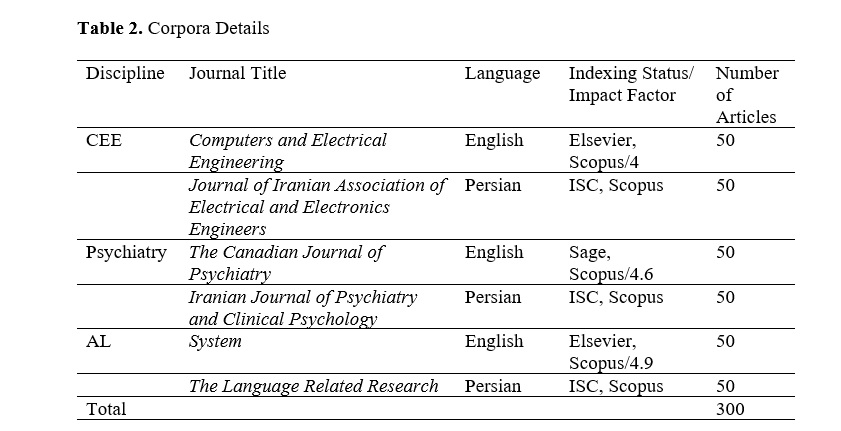
Abstract selection followed a PRISMA-style screening process to enhance transparency and replicability. During the identification stage, 366 abstracts were retrieved from six journals. During screening, 66 records were excluded because they were non-empirical articles, conference abstracts, review papers, or fell outside the specified publication window or word-length range. The final corpus consisted of 300 abstracts (150 English, 150 Persian), evenly distributed across the three disciplines. Detailed corpus characteristics, including journal titles, indexing status, and article counts, are reported in Table 2.
Abstract Format Considerations
The corpus consisted predominantly of unstructured abstracts. However, in the Psychiatry sub-corpus, structured abstracts (e.g., Objective, Methods, Results, Conclusion) were common. To avoid systematic bias, section headings were not treated as coding units. Instead, RMs and steps were identified solely on the basis of semantic content, regardless of typographic structure.
Thus, a sentence appearing under a heading such as Conclusion was not automatically coded as a Conclusion move unless it fulfilled the functional criteria defined in the analytical framework. This procedure ensured functional equivalence across structured and unstructured abstracts. The potential facilitative effect of structured formats on the explicit realization of certain moves, particularly evaluative Conclusion steps, is addressed in the Discussion and Limitations sections.
Analytical Framework
Rhetorical analysis in the present study was conducted using Hyland’s (2000) five-move model, comprising Introduction, Purpose, Method, Product, and Conclusion. This framework was selected because it was explicitly developed for RA abstracts and is designed to capture their functional organization across disciplinary contexts. Compared with earlier models, Hyland’s framework offers greater analytical coverage and flexibility: Swales’ (1990) CARS model does not explicitly accommodate a distinct Purpose move, Bhatia’s (1993) model does not account for niche-establishing or gap-related functions, and Santos’s (1996) model was derived from a relatively small, single-discipline corpus. By contrast, Hyland’s model was constructed on the basis of a large, multi-disciplinary dataset (800 abstracts across eight fields), making it suitable for cross-disciplinary and cross-linguistic comparison. As noted by Suntara and Usaha (2013), this model has demonstrated strong explanatory power in capturing abstract rhetorical structure.
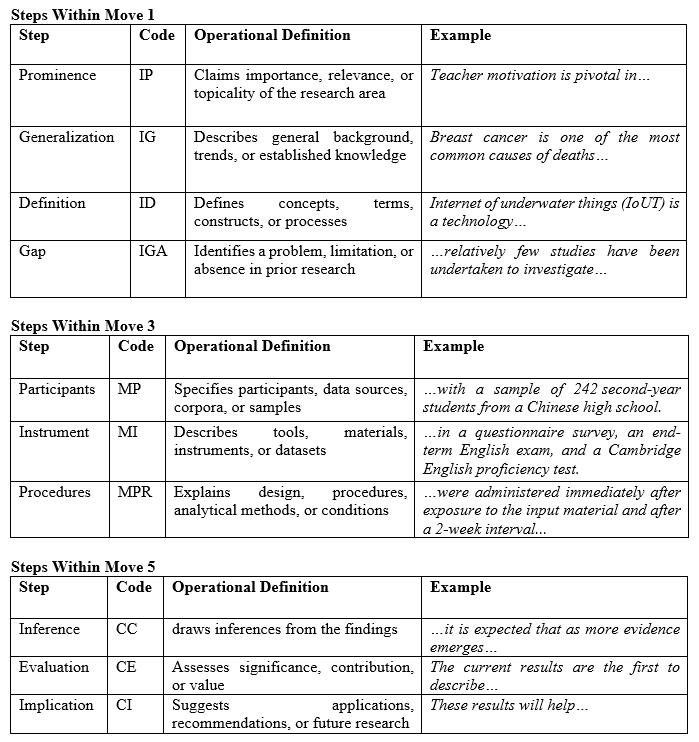
Within this framework, each move represents a distinct communicative function and may be realized through one or more steps. In the present study, moves and steps were operationalized following Hyland’s original definitions. Detailed step descriptions, coding criteria, and borderline examples (e.g., Definition vs. Generalization; Introduction vs. Purpose) are provided in Appendix A to ensure transparency and replicability.
Unit of Analysis and Treatment of Dual Moves
In the present study, the unit of analysis was the clause or clause complex conveying a single dominant rhetorical function. Sentence boundaries were not treated as decisive, as a single sentence may realize multiple rhetorical functions, while a single function may extend across multiple clauses. This clause-based approach is consistent with prior genre-analytic research and allows more precise identification of rhetorical functions in compressed abstract discourse.
In cases where a single textual segment simultaneously fulfilled two distinct rhetorical functions, dual moves (DMs) were assigned (e.g., stating the objective while providing information about designs). To ensure analytical consistency and prevent inflation of move counts, DMs were treated according to the following protocol:
- For move presence/absence analysis: An abstract containing a DM was considered to possess each of its constituent moves. For instance, an abstract with a Purpose + Method DM was counted as having both Purpose and Method moves present. This approach prioritizes rhetorical function over syntactic packaging.
- For total move instance counts: In calculating total move occurrences, each DM was counted as one move instance to avoid double-counting. This conservative approach ensures that overall move density calculations are not artificially inflated.
- For inferential statistical tests: DMs were included as follows: In Fisher's exact tests for move presence, constituent moves within DMs contributed to the presence counts as described in point 1. Moreover, DMs themselves were analyzed as a separate categorical variable to examine rhetorical compression patterns.
Coding Procedure
Coding followed a multi-stage, replicable workflow:
- Training and calibration: The primary coder studied Hyland’s move-step taxonomy and conducted pilot coding on a subset of abstracts to establish decision rules.
- Primary coding: All abstracts were manually coded for moves and steps at the clause level. For analytical consistency, each move and step was assigned a standardized alphanumeric code during annotation. Moves were labeled using initial letters (e.g., Introduction = I, Purpose = P, Method = M, Product = PR, Conclusion = C), and steps were coded using move-specific extensions. Clauses realizing two rhetorical functions simultaneously were coded as DM. The complete coding scheme, including all move- and step-level symbols and illustrative examples, is provided in Appendix A.
- Reliability check: Two coders independently coded 30% of the corpus.
- Verification and adjudication: Ambiguous cases were revisited, discussed with expert coders, and resolved through consensus.
- Final coding lock: The dataset was finalized prior to inferential analyses.
Reliability
To establish inter-coder reliability, two expert coders independently reviewed 30% of the corpus (15% English and 15% Persian abstracts within each discipline). Agreement was calculated using Cohen’s Kappa (κ). The results indicated substantial agreement for both moves (κ = .81, 95% CI [.76, .86]) and steps (κ = .76, 95% CI [.70, .82]). Discrepancies were resolved through discussion prior to final analysis.
Data Analysis
Following coding, frequencies and percentages of moves and steps were calculated. Inferential analyses were conducted to evaluate cross-linguistic and cross-disciplinary differences as follows.
- Research Question One: Presence–absence contrasts for key moves (Introduction, Method, Conclusion) were tested using Fisher’s exact tests, with odds ratios (ORs) and 95% confidence intervals (CIs).
- Research Question 2: Step-level variation was examined using chi-square tests of independence conducted on contingency tables crossing step realization with Language and Discipline. Cramér’s V was reported to indicate effect size.
- Research Question 3: Abstract move-pattern preferences were analyzed by calculating predicted probabilities from observed pattern frequencies within each Language × Discipline group, with 95% CIs estimated using standard approximation methods.
Together, these analyses enabled systematic testing of rhetorical variation across languages, disciplines, and analytic levels.
Results
Move Presence and Absence Across Disciplines and Languages
The study’s first research question sought to probe into the RMs used in the English and Persian abstracts of the RAs in the three diverse areas of CEE, Psychiatry, and AL published in peer-reviewed journals indexed in Scopus or Web of Science between 2022 and 2024. Utilizing Hyland’s (2000) five-move framework, the frequency and distribution of RMs were first examined across disciplines and languages (Table 3).
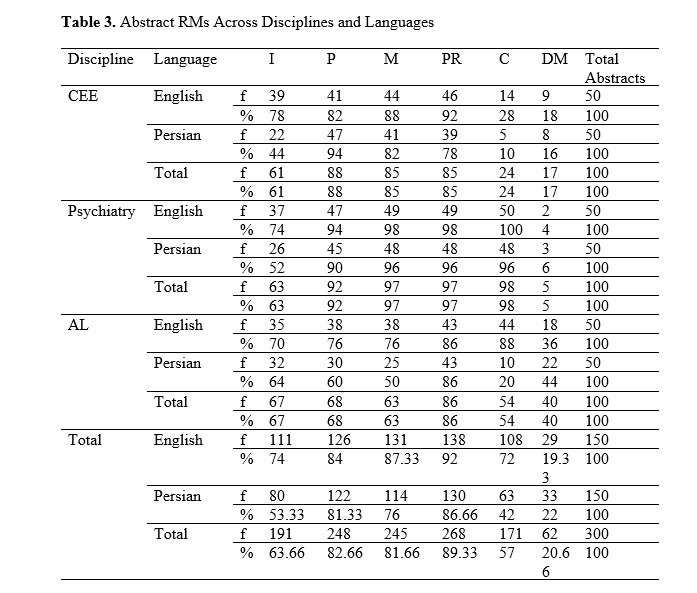
As Table 3 displays, all of the RMs presented in Hyland’s (2000) framework were found across the six corpora. It also indicates that the Product, Purpose, and Method moves were the most frequent ones (i.e., 89.33%, 82.66%, and 81.66%, respectively) in the English and Persian abstracts of the three areas of CEE, Psychiatry, and AL. Only 57% of the papers contained the move of Conclusion in their abstracts. That was the least recurrent RM in the whole corpus. The Introduction move was present in 63.66% of the corpus, indicating that the Introduction move was not consistently realized across abstracts.
Disciplinary Contrasts in Move Presence
From a cross-disciplinary perspective, a marked difference among the three disciplines was observed in using the Conclusion move, which appeared differently in the RA abstracts from quantitative and qualitative aspects. This move was compulsory and more common in the Psychiatry abstracts, compared to those of CEE and AL. While almost all Psychiatry abstracts (98%) ended with the fifth move (Conclusion), only 24% of the CEE abstracts contained this move, although the CEE journals have similar word limit policies and explicitly require authors to state the purpose of their research, principal results, and major conclusions (see their Author Guidelines sections). Psychiatry abstracts showed near-categorical realization of the Conclusion move, coinciding with the widespread use of structured abstract formats in this discipline. Abstracts of AL were somewhere between these two, manifesting 54% of the occurrence of Move 5. To statistically test these contrasts, Fisher’s exact tests were conducted, yielding the following outcomes shown in Table 4.
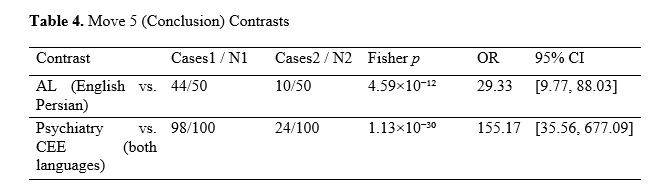
Table 4 indicates that in AL, the Conclusion move appeared in 44/50 English abstracts (88%) but only 10/50 Persian abstracts (20%). A Fisher's exact test confirmed a highly significant language effect in AL (p = 4.59×10⁻¹²). The odds of an AL abstract in English containing a Conclusion move were about 29 times the odds for an AL abstract in Persian (OR = 29.33, 95% CI [9.77, 88.03]). Comparing disciplines (combined languages) revealed that Psychiatry abstracts almost always included a Conclusion move (98/100) while CEE abstracts rarely did so (24/100); this difference was extreme (p < .0001; OR ≈ 155.17, 95% CI [35.56, 677.09]). These contrasts quantify and confirm the patterns described above, supporting the first hypothesis: Psychiatry, within this corpus, favors Conclusion moves, whereas CEE and Persian abstracts are far less likely to include them.
Another set of contrasts pertained to the Method move, existing in almost all the Psychiatry abstracts (97%). However, several abstracts in the other two disciplines were observed without using this move. To assess such disciplinary variation in the use of this move, the researcher compared its presence across CEE (85/100), Psychiatry (97/100), and AL (63/100) abstracts. Table 5 displays the results.
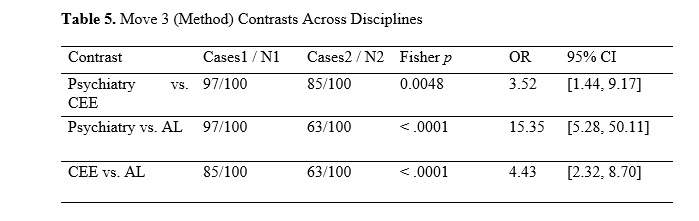
As shown in Table 5, pairwise Fisher tests confirmed that Psychiatry employed Move 3 significantly more than both CEE (p = 0.0048; OR = 3.52, 95% CI [1.44, 9.17]) and AL (p < 0.0001; OR = 15.35, 95% CI [5.28, 50.11]). CEE also exceeded AL in Method-move use (p < 0.0001; OR = 4.43, 95% CI [2.32, 8.70]). These contrasts reinforce the pattern that Psychiatry abstracts most consistently elaborate methodological details, AL abstracts least often do so, and CEE abstracts occupy an intermediate position.
A further cross-disciplinary contrast was attributed to the use of DMs. While it was common to include more than one move in a single segment in the AL abstracts (40%), rarely did the CEE and Psychiatry abstracts embed moves in one segment (17% and 5%, respectively). The most frequent embedded moves (i.e., 20) occurred between the moves of Introduction and Purpose or Purpose and Method in AL. To statistically test these contrasts, Fisher’s exact tests were conducted, suggesting the following results (Table 6).
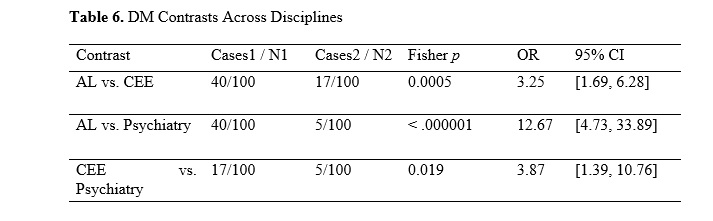
As shown in Table 6, DM usage differed significantly across disciplines. Fisher’s exact tests revealed that AL abstracts were significantly more likely to contain embedded rhetorical functions than those in CEE (OR = 3.25, 95% CI [1.69, 6.28], p = .0005). An even stronger contrast was observed between AL and Psychiatry, where AL abstracts were over twelve times more likely to employ DMs (OR = 12.67, 95% CI [4.73, 33.89], p < .000001). In contrast, DM usage was relatively rare in Psychiatry abstracts (5%), indicating a strong preference for functionally discrete clause-level realizations. These results provide inferential confirmation that rhetorical compression through DMs is discipline-sensitive rather than incidental.
Cross-Linguistic Contrasts in Move Presence
From a cross-linguistic perspective, the English abstracts were longer than their Persian counterparts, containing more moves in general (i.e., English abstracts: 585 moves; Persian abstracts: 476 moves). More particularly, the English abstracts comprised the Conclusion section more than the Persian ones. The most considerable difference between these two languages was found in the English and Persian AL abstracts concerning this section. While most of the English AL abstracts (88%) contained this mandatory move, just 20% of the Persian AL abstracts presented the Conclusion move. Additionally, only three English CEE abstracts lacked the Product move, while 11 Persian abstracts in this major did not employ this move. Another distinction between the abstracts in the two languages was discovered regarding the occurrence of the Introduction move. In comparison to Persian, the English abstracts used the Introduction move, mainly focusing on prominence and gap, more frequently. To evaluate cross-linguistic differences in the use of Move 1 (Introduction), the researcher compared its presence across all abstracts in English (111/150) and Persian (80/150) (see Table 7).

Based on Table 7, a Fisher's exact test revealed a statistically significant difference (p = 0.00012). The odds that an English abstract included the Introduction move were approximately twice those for a Persian abstract (OR = 2.38, 95% CI [1.48, 3.82]). This result confirms that English abstracts more consistently foreground backgrounding and contextualization than their Persian counterparts, which included Move 1 less often across all three disciplines.
Step-Level Distributions Across Disciplines and Languages
The next research question of the study focused on the frequent steps of RMs of the English and Persian RA abstracts from high-quality journals of the three distinct domains of CEE, Psychiatry, and AL from 2022 to 2024. Adopting Hyland’s (2000) framework for the RM organization of abstracts, the researcher estimated each step’s frequency and percentage in the abstracts of the three fields in the two languages. (Table 8).
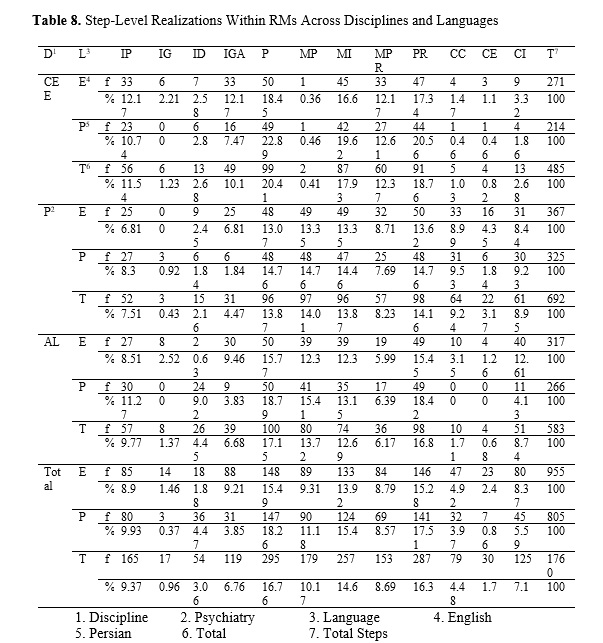
Overall, as Table 8 demonstrates, 1760 steps were observed in 300 RA abstracts across the three majors of CEE, Psychiatry, and AL in English and Persian with a mean of 5.86. It can be claimed that every abstract, of any field in any language, was, on average, comprised of about six steps. While the Purpose step was the most frequent (16.76%), followed by the Product and Instrument steps (16.3% and 14.6%, respectively), the Generalization, Evaluations, and Definition steps were the least commonly used ones by the authors (0.96%, 1.7%, and 3.06%, respectively).
Disciplinary Variation in Step Distributions
Psychiatry abstracts employed the most steps (692), followed by AL (583) and CEE (485). This indicates that while the average Psychiatry abstract used 6.92 steps, the CEE one used 4.85 steps. Similar to the previous comparisons, AL fell between the two majors with a mean of 5.83. While the most frequent step pattern in the CEE abstracts was Prominence-Gap-Purpose-Instrument-Procedure-Product, the Prominence-Gap-Purpose-Participant-Instrument-Procedure-Product-Conclusion-Implication pattern was the most common one in the abstracts of Psychiatry. In the AL abstracts, the Prominence-Gap-Purpose-Participant-Instrument-Product-Implication pattern was the most favorable one. It can be seen that their first three common steps were almost the same (Prominence, Gap, Purpose).
Cross-Linguistic Variation in Step Distributions
English abstracts generally took more steps than the Persian ones (i.e., 955 and 805 steps, respectively). The most regular step sequence for the abstracts in English was the Prominence-Gap-Purpose-Participant-Instrument-Procedure-Implication, but in Persian, the Prominence-Purpose-Participant-Instrument-Product step pattern was used the most. Four major divergences are observable between the two languages. First, the frequency of the Gap step varied noticeably from English to Persian. While this step comprised 9.21% of the total steps in the English abstracts, only 3.85% of the Persian steps were for presenting the Gap. Second, the Persian authors used fewer Conclusion-related steps (10.42%) than their English counterparts (15.69%). More specifically, implementing the Evaluation step by English and Persian researchers was different. The English abstracts presented the evaluation of their findings in the last move more than their Persian counterparts (2.4% and 0.86%, respectively). Third, unlike the English abstracts, some Persian abstracts began with definitions. According to Table 8, the Definition step was more favored by the Persian authors in comparison to their English counterparts (4.47% vs. 1.88%, respectively). The Persian authors tended to define new emerging things or concepts, which are mainly derived from other languages such as English or Arabic, in the abstract section to ease comprehension and avoid any confusion. Finally, no research questions or hypotheses were directly mentioned in the English abstracts; however, some Persian abstracts did this within the Purpose step.
To analyze the step-level data, a series of chi-square tests of independence were conducted for each step to examine the language and discipline interaction, yielding the following results in Table 9.
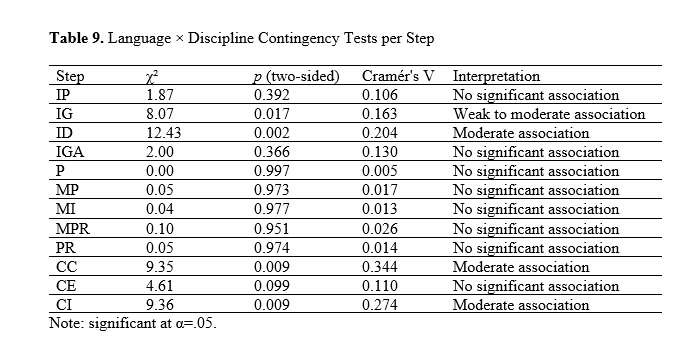
Analyses of Language × Discipline associations at the step level, as displayed in Table 9, revealed that most steps did not differ significantly across groups. Steps IP, IGA, P, MP, MI, MPR, PR, and CE showed no statistically significant associations, with χ² values near zero and very small effect sizes (Cramér's V < .15), indicating that their distributions were largely stable across languages and disciplines. Three steps demonstrated meaningful variation. Step IG exhibited a weak-to-moderate association (χ² = 8.07, p = .017, V = .163), suggesting modest but detectable differences across Language × Discipline combinations. More substantial patterns emerged for Steps ID and CC, which showed significant associations with moderate effect sizes (ID: χ² = 12.43, p = .002, V = .204; CC: χ² = 9.35, p = .009, V = .344), indicating that their usage varies systematically by linguistic and disciplinary context. Step CI also showed a moderate association (χ² = 9.36, p = .009, V = .274), pointing to similar cross-group variation. Taken together, these findings suggested that while most steps in Hyland's model function relatively consistently across English and Persian abstracts and across the three disciplines, a subset, particularly IG, ID, CC, and CI, reflects meaningful cross-linguistic or cross-disciplinary rhetorical differences.
Move-Pattern Preferences and Probabilities
The study’s final research question attempted to identify the most conventional RM sequences of the RA abstracts from distinguished journals within the three distinct fields of CEE, Psychiatry, and AL in English and Persian from 2022 to 2024. To address this question, the researcher extracted and examined the patterns of abstracts one by one, following Hyland’s (2000) framework for RM patterns (Table 10).
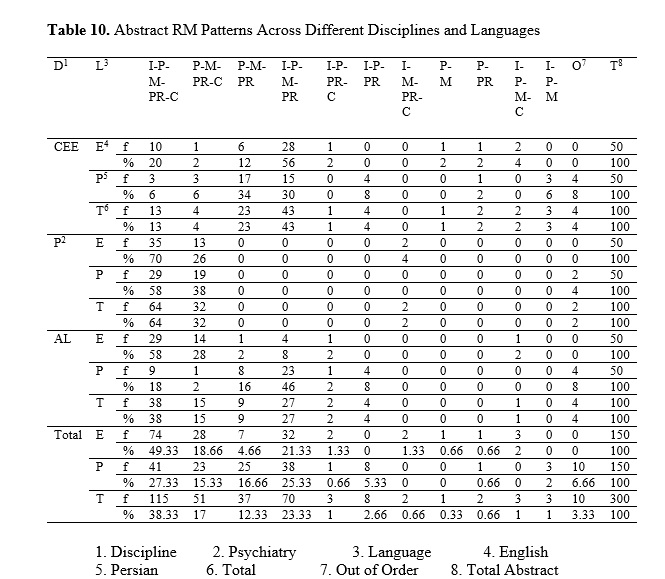
Analysis of the abstracts suggested the existence of 11 move patterns, four of which most frequently appeared in the corpora. Only a few abstracts (10 out of 300, 3.33%) did not follow any particular move patterns and were considered out-of-order abstracts. As illustrated in Table 10, the authors employed the pattern of five moves, Introduction-Purpose-Method-Product-Conclusion, in their abstracts as the most frequently used one (38.33%). The next three commonly used patterns were Introduction-Purpose-Method-Product (23.33%), Purpose-Method-Product-Conclusion (17%), and Purpose-Method-Product (12.33%).
Disciplinary Variation in Move Sequences
The majority of the Psychiatry abstracts followed the most standard patterns; around 96% used either the Introduction-Purpose-Method-Product-Conclusion (64%) or Purpose-Method-Product-Conclusion (32%) pattern. Moreover, there was a substantial difference between the CEE and Psychiatry abstracts concerning their RM patterns. While the most regular sequence in the former major was Introduction-Purpose-Method-Product (43%), no single abstract was found in the latter implementing this pattern. The AL abstracts fell somewhere between the two again, using this pattern as the second most common pattern (27%). However, the five-move order, with 38% frequency, was the most preferred move pattern among AL researchers. Overall, the Psychiatry abstracts had the most standard and uniform move patterns with only a few minor deviations.
Cross-Linguistic Variation in Move Sequences
Purpose-Method-Product was the most common pattern among the Persian abstracts of CEE, accounting for 34%. A perceptible difference between the abstract move patterns in English and Persian was that there were no non-canonical sequences in English, whereas 10 (6.66%) Persian abstracts deviated from canonical move sequencing, including partial or atypical move realizations. For example, some Persian abstracts used only one or two moves, some had only an introduction instead of an abstract, and others used moves in the non-canonical positions. A recurrent deviation involved the realization of the Purpose move prior to the Introduction move. Some Persian abstracts were organized in more than one paragraph. Another difference was seen in the length of Move 4, as Persian Product moves were generally shorter than their English counterparts. There was more discrepancy among the Persian abstracts, particularly in the field of AL, compared to the English abstracts regarding their RM patterns.
To quantify move pattern differences, predicted probabilities were computed directly from observed proportions, with 95% CIs based on normal approximation. Table 11 shows the predicted probabilities of common move patterns by language and discipline.
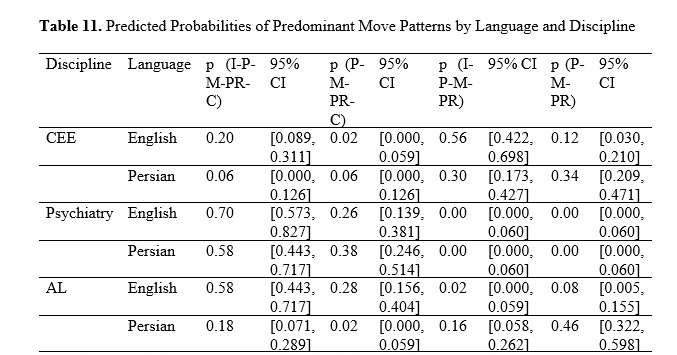
As illustrated in Table 11, across all disciplines, the four predominant move patterns showed clear and interpretable differences by language. Psychiatry displayed the highest degree of pattern standardization: English abstracts in this corpus favored the canonical I-P-M-PR-C pattern (p = .70, 95% CI [.57, .83]), with Persian abstracts showing a similarly strong preference (p = .58, 95% CI [.44, .72]). In CEE, English abstracts showed more dispersion across patterns, with I-P-M-PR dominating (p = .56) and I-P-M-PR-C occurring less frequently (p = .20). Persian CEE abstracts showed a more balanced distribution, with I-P-M-PR (p = .30) and P-M-PR (p = .34) both common.
In AL, English abstracts showed a strong preference for I-P-M-PR-C (p = .58), while Persian abstracts distributed more broadly across patterns, most notably P-M-PR (p = .46, 95% CI [.32, .60]). Zero-frequency patterns (primarily in Psychiatry and AL) had appropriately narrow CIs, indicating rare usage (0-0.06).
Overall, the predicted probabilities and their CIs demonstrate substantial Language × Discipline variation in pattern selection, with Psychiatry showing the highest conventionalization and AL displaying considerable cross-linguistic divergence.
Discussion
This study yielded three principal findings within the examined corpus. First, the presence and distribution of RMs varied systematically by discipline and language, with Psychiatry abstracts exhibiting the highest concentration of canonical move realizations and CEE abstracts showing greater dispersion. Second, step-level analysis revealed fine-grained rhetorical variation that was not visible at the move level, particularly in the realization of Introduction-, Method-, and Conclusion-related steps. Third, predicted move-pattern probabilities demonstrated clear Language × Discipline interactions, most prominently in AL, where cross-linguistic divergence was more pronounced than in the other two disciplines.
At the move level, the findings broadly corroborate earlier genre-analytic research (Pho, 2008; Santos, 1996; Zand-Moghadam and Meihami, 2016; Zand-Moghadam and Zhaleh, 2022). Across languages and disciplines, the Purpose, Method, and Product moves were the most frequently realized, confirming their central role in abstract construction. In contrast, the Introduction and Conclusion moves occurred less consistently, indicating greater flexibility in their deployment. These distributions align with previous reports that abstracts prioritize research aims, procedures, and outcomes while varying in the extent to which backgrounding or evaluative commentary is included.
The prominence of the Product move is consistent with the communicative function of abstracts as concise reports of research outcomes. This tendency is further supported by the near-categorical realization of Product-related steps across disciplines. Similarly, the frequent inclusion of Purpose and Method moves reflects both epistemic expectations and institutional requirements for clarity in research aims and procedures. The comparatively lower frequency of the Conclusion move, particularly outside Psychiatry, suggests that evaluative or inferential commentary may be perceived as less essential at the abstract stage, a pattern previously noted in comparable corpora (Al-Khasawneh, 2017; Amnuai, 2019; Suntara and Usaha, 2013).
Disciplinary contrasts were especially salient in the realization of the Method move. Psychiatry abstracts employed this move significantly more often than those in CEE and Applied Linguistics, a pattern confirmed by large odds ratios in pairwise comparisons. This finding is consistent with the epistemological orientation of medical research, where participant characteristics, instruments, and procedures are central to evidential credibility. At the step level, the frequent realization of Participant and Procedure steps in Psychiatry abstracts further supports this interpretation, whereas CEE abstracts relied more heavily on Instrument-related steps, reflecting the technological focus of that discipline.
Marked disciplinary differences were also observed in the realization of Conclusion-related steps. Within this corpus, Psychiatry abstracts frequently included both evaluative and implicational elements (e.g., This is a field that still requires development... or Future studies will need to confirm whether...), whereas AL abstracts tended to merge conclusions with implications (e.g., The implications of this research may inform ...), often omitting explicit evaluation. CEE abstracts minimized evaluative commentary to an even greater extent. These differences correspond to the moderate Language × Discipline associations observed for Conclusion and Implication steps and suggest discipline-sensitive preferences in how claims are extended beyond immediate results.
Cross-linguistic variation further nuanced these patterns. English abstracts generally realized moves and steps in more discrete and segmented ways, whereas Persian abstracts more frequently combined rhetorical functions within single segments. For example, Purpose statements in Persian abstracts were sometimes distributed across multiple sentences or integrated with methodological information. This tendency is illustrated by the following translated excerpt:
Therefore, this research aims to investigate how proverbs are listed in Persian dictionaries, especially in Persian proverb dictionaries, using a cognitive semantics approach. The purpose of this research is to present proverbs in a novel, non-linear, and non-alphabetic way with a scientific basis and based on theory in cultures.
It is worth noting that these patterns point to language-specific rhetorical preferences rather than differences in abstract quality.
Step-level analysis provided insights that were obscured at the move level. Across the corpus, Purpose, Product, and Instrument steps were the most frequent, reflecting the centrality of research aims, outcomes, and tools in abstract discourse. This distribution is partly attributable to the structural properties of Hyland’s (2000) model, in which certain moves (Purpose and Product moves) consist of a single step. Accordingly, once such moves are selected, step realization becomes structurally obligatory. This methodological feature constitutes an analytical boundary that must be considered when interpreting step frequencies.
By contrast, steps within the Introduction move showed greater variability. Authors primarily relied on Prominence and Gap steps to contextualize their studies, while Generalization and Definition steps were rare. This pattern suggests a preference for problematization over broad general claims within the spatial constraints of abstracts. Definition steps occurred mainly in studies addressing emerging technologies or novel constructs, where terminological clarification was necessary (e.g., Internet of Underwater Things (IoUT) is a technology…).
The findings also revealed that the number of the Prominence step was almost equal to the number of the Gap step, mostly because the authors tended to initiate their abstracts by stating the significance of the topic and consecutively presenting the existing limitation. However, the way they implemented this pattern was quite different across the majors. The CEE abstracts used the Gap step distinctly from the other two disciplines. While in the CEE abstracts, this step was utilized to point out challenges or limitations with a particular device, technology, method, etc., followed by proposing a novel alternative; the Psychiatry and AL abstracts used this step to address a gap or lack of research in the literature. The move marker ‘however’ was the most common word to connect the Prominence step to the Gap one in the corpora.
Although there was no considerable difference among the three disciplines in the frequency of the Purpose step, this step was presented differently. While in CEE, expressions such as we propose or we introduce a method were often used, in Psychiatry and AL, expressions like the study aimed to explore or investigate were often used. Furthermore, based on the examples above, personal pronouns, namely I or we, appeared more often in CEE compared to Psychiatry and AL when stating the purpose of the research.
Disciplinary variation at the step level was particularly evident in the Method move. Psychiatry and AL abstracts frequently employed the Participant step, reflecting the importance of individual and contextual variables in medical and social research. In contrast, this step was largely replaced by the Instrument step in CEE abstracts, where human participants are often irrelevant. The Procedure step appeared mainly in experimental studies, suggesting that methodological design influences step selection.
Regarding move sequencing, the results align with earlier studies (Amnuai, 2019; Zand-Moghadam and Zhaleh, 2022) in identifying the Introduction–Purpose–Method–Product–Conclusion pattern as the most frequently observed canonical sequence within Hyland’s framework. When considering the first move optional and the rest obligatory, just the Introduction-Purpose-Method-Product-Conclusion and Purpose-Method-Product-Conclusion organizations, among others, should be treated as standard. Consequently, the results showed that almost half of the abstracts (i.e., 166 abstracts, 55.33%) used the moves in a standard way, 115 of which were completely in line with the five-move pattern recommended by Hyland (2000). It supports the idea that some researchers regard all five moves of this model as pivotal for writing a standard RA abstract. However, substantial variation was also observed, particularly in CEE and Persian AL abstracts, where shorter or partial sequences were common. These findings indicate that while canonical patterns are prevalent, especially in Psychiatry, alternative configurations remain acceptable within the examined journals.
Finally, while the observed patterns align with disciplinary epistemologies, several alternative explanations and confounding factors must be acknowledged. One important factor is abstract format: structured abstracts, which were common in the Psychiatry sub-corpus, likely facilitate explicit realization of Conclusion-related steps. Journal policies regarding abstract length and required components may also constrain rhetorical choices. These institutional factors caution against attributing all observed variation solely to disciplinary norms. Accordingly, the interpretations offered here are bounded by the corpus design, which comprises six journals across a three-year window, and should be generalized with care.
Conclusion and Implications
This study examined RA abstracts from cross-disciplinary and cross-linguistic perspectives, analyzing move-level, step-level, and move-pattern distributions in 300 English and Persian abstracts drawn from high-impact journals in CEE, Psychiatry, and AL. The findings support the analytical utility of Hyland’s (2000) model while extending it through a finer-grained step-level analysis and probabilistic patterning. Together, these layers of analysis provide a more nuanced account of abstract rhetoric than move-level analysis alone.
From a theoretical perspective, the study offers evidence that disciplinary variation in abstract writing is manifested not only in the presence or absence of RMs but also in the internal configuration and frequency of steps within those moves. Within the present corpus, Psychiatry abstracts showed a higher concentration of Participant- and Conclusion-related steps, consistent with the empirical and human-subject orientation of medical research. In contrast, CEE abstracts foregrounded Purpose and Instrument steps, reflecting a problem–solution and technology-driven research paradigm. AL abstracts displayed greater variability, particularly across languages, indicating a less rigid conventionalization of abstract structure in this discipline. These findings suggest that disciplinary epistemologies are reflected in recurring rhetorical tendencies rather than fixed or universal patterns.
Cross-linguistic variation further qualified these disciplinary tendencies. Differences in the realization of Definition and Gap steps between English and Persian abstracts point to language-specific rhetorical conventions that persist even in internationally indexed journals. Such variation should not be interpreted as a deficit in abstract quality but rather as evidence of alternative rhetorical strategies shaped by academic writing traditions and linguistic norms.
The findings also carry implications for academic writing instruction and English for Academic Purposes (EAP) pedagogy. Rather than prescribing uniform abstract templates, instruction may benefit from emphasizing discipline-sensitive rhetorical options and highlighting areas of flexibility and constraint within specific publication contexts. Awareness of common move sequences and step realizations in target journals can help writers make informed rhetorical choices when preparing abstracts for submission. In particular, Psychiatry abstract writers should employ the full I-P-M-PR-C pattern, ensuring detailed Participant and Conclusion/Implication steps. Writers in CEE should focus on the I-P-M-PR pattern, emphasizing the Purpose and Instrument steps; the Conclusion move is often optional. While the I-P-M-PR-C pattern is common in AL, authors should be aware of cross-linguistic differences; Persian abstracts may more frequently use the P-M-PR pattern and include Definition steps.
Students, graduates and researchers who are interested in publishing their research articles (RAs) in scholarly journals need to be aware of the typical structure of articles in their specific disciplines in English and their first language, as used by professional researchers in reputable journals. By familiarizing themselves with these conventions, they can become active members of their professional discourse communities, increasing the likelihood of their manuscripts being approved for publication in decent journals. On the other side, those who are concerned with studying scientific articles can benefit more from these sources if they gain an understanding of the various genres within a specific discipline in both English and their native language.
Like any other investigation, the present research faced several limitations. First, the corpus was limited to six journals across a three-year publication window, and the findings should therefore be interpreted as reflecting localized practices rather than universal disciplinary conventions. Further studies are required to collect more data from various journals of different disciplines in different languages during different periods. Second, while journal selection was based on explicit criteria, potential selection bias exists as the corpus was limited to reputable, indexed journals. The findings may not generalize to journals of lower tiers or different indexing status. Third, the study did not control the length and type of abstracts and journals' guidelines for abstract writing. While the study aimed for methodological consistency by focusing primarily on unstructured abstracts, the inclusion of structured abstracts in the Psychiatry discipline represents a potential limitation. The explicit headings in structured abstracts (e.g., Objective) may influence authors' inclusion of specific moves more systematically compared to unstructured formats. Although the analysis focused on rhetorical content rather than structural format, future research could specifically investigate how abstract structure (structured vs. unstructured) interacts with RM realization across different disciplines and languages. Fourth, this research utilized only Hyland's (2000) framework as an instrument for analyzing the data. Nonetheless, various models have been suggested in the literature for this goal. Future studies can be conducted using other well-established models to investigate the RMs of abstracts. Fifth, only RMs and steps of RA abstracts were examined in this paper. Other aspects of abstract writing remained unexplored. Thus, more research is required to look into such aspects as lexical and syntactic structures and punctuation of RA abstracts. Research, for instance, can be done to explore the frequent move makers of RA abstracts. This inquiry sought to delve into the RMs of only the abstract section of articles. Additional research is also necessary to explore the RMs in other parts of papers, such as the introduction, literature review, research methods, etc., as these sections are also worth examining. Finally, the relationship between the RMs and other internal textual features like formulaic language, thematicity, nominalization, or other in-clause features like projected clauses can be explored by future studies.
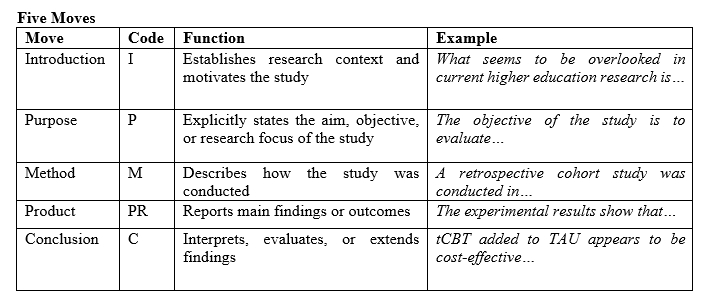
A.1 Move and Step Definitions
The study adopted Hyland’s (2000) five-move model, operationalized as follows:
A.2 Borderline Cases and Decision Rules
Because abstract discourse is compressed, certain distinctions require explicit decision rules.
Definition (ID) vs. Generalization (IG)
Rules:
- Code as Generalization (IG) if the clause describes accepted knowledge or background without specifying meaning.
- Code as Definition (ID) if the clause explicitly explains what a term, construct, or process means.
Examples:
(ID) Fibromyalgia syndrome (FMS) is a chronic musculoskeletal pain syndrome characterized by extensive pain, tender points, fatigue, and sleep disturbance, with unknown etiology.
(IG) Breast cancer is one of the most common causes of deaths.
Introduction (I) vs. Purpose (P)
Rules:
- Code as Purpose (P) only if authorial intent is explicitly stated.
- Topic statements without intent markers remain Introduction.
Examples:
(I) Fibromyalgia syndrome (FMS) is a chronic musculoskeletal pain syndrome…(P) This study aims to investigate the effect of…
A.3 Coding Workflow Summary
- Training and Calibration: Familiarization with move-step definitions and pilot coding. Discussion of borderline cases and refinement of decision rules.
- Primary Coding: Clause-level coding of all abstracts.
- Dual-Move Identification: Coding clauses with two rhetorical functions as DMs.
- Reliability Check: Independent coding of 30% of the corpus.
- Adjudication: Resolution of disagreements through consensus.
- Final Coding Lock: Dataset finalized prior to inferential analyses.
Thanks
The author would like to acknowledge the significant contributions of colleagues and experts in the fields of Computers and Electrical Engineering, Psychiatry, and Applied Linguistics to this study.
















Reference lists
Al-Khasawneh, F. M. (2017). A genre analysis of research article abstracts written by native and non-native speakers of English, Journal of Applied Linguistics and Language Research, 4(1), 1–13.
Amnuai, W. (2019). Analyses of rhetorical moves and linguistic realizations in accounting research article abstracts published in international and Thai-based journals, SAGE Open, 9 (1), 1–9. https://doi.org/10.1177/2158244018822384
Arsyad, S., Pratiwi, V. A., An-Nashir, A. A., Erviona, L. and Marjelina, O. (2023). The rhetorical structure and research gap strategies in journal article abstracts in language-related fields published in high-impact international journals, LEARN Journal: Language Education and Acquisition Research Network, 16(1), 703–725.
Bhatia, V. K. (1993). Analyzing genre: Language use in professional settings. Longman.
Doró, K. (2013). The rhetoric structure of research article abstracts in English studies journals, Prague Journal of English Studies, 2 (1), 119–139. https://doi.org/10.2478/pjes-2014-0013
Ghasempour, B. and Farnia, M. (2017). Contrastive move analysis: Persian and English research article abstracts in law, Journal of Teaching English for Specific and Academic Purposes, 5 (4), 739–753. https://doi.org/10.22190/JTESAP1704739G
Hyland, K. (2000). Disciplinary discourses: Social interactions in academic writing. Longman.
Johns, T. (1992). It is presented initially: Linear dislocation and inter-language strategies in Brazilian academic abstracts in English and Portuguese, Ilha do Desterro, 27 (1), 9–32.
Karimah, N. A., Munir, A. and Anam, S. (2023). Comparative study: Rhetorical moves of research article abstracts written by American and Indonesian authors, PRASASTI: Journal of Linguistics, 8 (2), 245–257. https://doi.org/10.26714/lensa.13.1.2023.82-94
Khany, R. and Malmir, B. (2020). A move-marker list: A study of rhetorical move-lexis linguistic realizations of research article abstracts in social and behavioural sciences, RELC Journal, 51 (3), 381–396. https://doi.org/10.1177/0033688219833131
Li, X. (2020). Mediating cross-cultural differences in research article rhetorical moves in academic translation: A pilot corpus-based study of abstracts, Lingua, 238, 1–11. https://doi.org/10.1016/j.lingua.2020.102795
Lorés, R. (2004). On RA abstracts: From rhetorical structure to thematic organization. English for Specific Purposes, 23(3), 280–302. https://doi.org/10.1016/j.esp.2003.06.001
Marefat, F., Farahanynia, M., Bolouri, M., Chamani, F. and Soleimani, T. (2021). Generic structure of literature reviews in research articles: Iranian and international journals (Research paper), Iranian Journal of English for Academic Purposes, 10 (3), 33–50. https://dorl.net/dor/20.1001.1.24763187.2021.10.3.3.1
Marefat, H. and Mohammadzadeh, S. (2013). Genre analysis of literature research article abstracts: A cross-linguistic, cross-cultural study, Applied Research on English Language, 2(2), 37–50.
Nagano, L. R. (2015). Research article titles and disciplinary conventions: A corpus study of eight disciplines, Journal of Academic Writing, 5(1), 133–144. https://doi.org/10.18552/joaw.v5i1.168
Pho, P. D. (2008). Research article abstracts in applied linguistics and educational technology: A study of linguistic realizations of rhetorical structure and authorial stance, Discourse Studies, 10(2), 231–250. https://doi.org/10.1177/1461445607087010
Porush, D. A. (1995). A short guide to writing about science. Harper Collins College Publisher.
Ramadhini, T. M., Wahyuni, I. T., Ramadhani, N. T., Kurniawan, E., Gunawan, W. and Muniroh, R. D. D. A. (2021, April). The rhetorical moves of abstracts written by the authors in the field of hard sciences, in Thirteenth Conference on Applied Linguistics (CONAPLIN 2020), 587–592. Atlantis Press. https://doi.org/10.2991/assehr.k.210427.089
Relawati, M. and Basthomi, Y. (2021). The common move and step in research article abstracts [Unpublished doctoral dissertation]. State University of Malang.
Samraj, B. (2005). An exploration of a genre set: Research article abstracts and introductions in two disciplines, English for Specific Purposes, 24 (2), 141–156. https://doi.org/10.1016/j.esp.2002.10.001
Santos, M. (1996). The text organization of research papers abstracts in applied linguistics, Text, 16 (4), 481–499. https://doi.org/10.1515/text.1.1996.16.4.481
Suntara, W. and Usaha, S. (2013). Research article abstracts in two related disciplines: Rhetorical variation between linguistics and applied linguistics, English Language Teaching, 6 (2), 84–99. https://doi.org/10.5539/elt.v6n2p84
Swales, J. M. (1981). Aspects of article introductions, The University of Aston, Language Studies Unit.
Swales, J. M. (1990). Genre analysis, Cambridge University Press.
Swales, J. M. (2004). Research genres: Explorations and applications, Cambridge University Press. https://doi.org/10.1017/CBO9781139524827
Swales, J. M. (2019). The futures of EAP genre studies: A personal viewpoint, Journal of English for Academic Purposes, 38, 75–82. https://doi.org/10.1016/j.jeap.2019.01.003
Tankó, G. (2017). Literary research article abstracts: An analysis of rhetorical moves and their linguistic realizations, Journal of English for Academic Purposes, 27, 42–55. https://doi.org/10.1016/j.jeap.2017.04.003
Tseng, F. (2011). Analyses of move structure and verb tense of research article abstracts in applied linguistics journals. International Journal of English Linguistics, 1 (2), 27–39. https://doi.org/10.5539/ijel.v1n2p27
Ventola, E. (1994). Abstracts as an object of linguistic study. In S. Cmejrkova, F. Danes and E. Havlova (Eds.), Proceedings of the conference on writing vs. speaking: Language, text, discourse, communication (pp. 333–52). Gunter Narr Verlag.
Zand-Moghadam, A. and Meihami, H. (2016). A rhetorical move analysis of TEFL thesis abstracts: The case of Allameh Tabataba’i University, Issues in Language Teaching, 5 (1), 1–23. https://doi.org/10.22054/ilt.2016.7714
Zand-Moghadam, A. and Zhaleh, K. (2022). Comparative rhetorical move analysis of qualitative, quantitative, and mixed methods research article abstracts in Iranian vs. international applied linguistics journals. Journal of Modern Research in EnglishLanguage Studies, 9 (3), 25–47. https://doi.org/10.30479/jmrels.2022.16708.2009
Zand-Vakili, E. and Fard Kashani, A. (2012). The contrastive move analysis: An investigation of Persian and English research articles’ abstract and introduction parts. Mediterranean Journal of Social Sciences, 3 (2), 129–137. https://doi.org/10.5901/mjss.2012.v3n2.129
Corpus Material
Computers and Electrical Engineering. (2022–2024). Elsevier.
Journal of Iranian Association of Electrical and Electronics Engineers. (2022–2024). ISC, Scopus.
The Canadian Journal of Psychiatry. (2022–2024). Sage.
Iranian Journal of Psychiatry and Clinical Psychology. (2022–2024). ISC, Scopus.
System. (2022–2024). Elsevier.
The Language Related Research. (2022–2024). ISC, Scopus.