

The Chinese mythological archetypes of images in Rebecca Kuang’s novel The Poppy War
Abstract
The article focuses on the study of Chinese mythological archetypes in R. F. Kuang’s trilogy The Poppy War, that contribute to a deeper understanding of the cultural and psychological aspects of the novels. The Poppy War, as a good example of the contemporary fantasy genre, is understudied in the context of Jungian analysis. The problem arises from the need to reveal the integration of mythological archetypes in the narrative’s structure and the archetype’s nominations impact on the characters’ storyline interpretation. The research is carried out using Jungian hermeneutics, analytical psychology, and the interpretative strategies of E. M. Meletinsky and E. Neumann. The authors come to the conclusion that key Chinese mythological archetypes such as the Dragon, the Phoenix, Sun Wukong, Zhu Bajie and Nüwa play a significant role in shaping the characters and the plot of the trilogy. Particular attention is given to the main character, Fang Runin, whose evolution personifies the Phoenix archetype. The heroine, rejecting femininity, follows the path of the Warrior, her journey is characterized by the search and interaction with such archetypes as the Shadow and the Animus leading to her personal transformation. Thus, the traditional Chinese mythological archetypes behave simultaneously as the Shadow and the Animus in the character’s psyche, creating a specific combination and shaping the narrative. The integration of mythological elements in The Poppy War gives the trilogy a deep symbolic richness and multi-layeredness that proves that the archetypal components of traditional Chinese culture and the Chinese heroic archetype influence modernity.
Introduction
The structure and key aspects of Chinese universe and mind-set are based on well-known archetypes, which are deeply entrenched in literature. The framework of the epic trilogy of R. F. Kuang The Poppy War implicates the cultural archetypes implemented in the novel’s images. The usage of identifiable and specific characters’ set of traits makes this fantasy narrative artform globally widespread and understandable.
The aim of the study is to analyze the main features of the integration of the mythic archetypes in the modern literary text. The results of the research contribute to the Chinese socio-cultural-specific conceptual representations in the context of the theory of the archetypes.
The characteristics of the integration of archetypes in the contemporary fantasy novel structure in the creation of an artistic image and its impact on the characters perception and interpretation has not been sufficiently studied, particularly using the Jungians analyses approach.
The mythological archetypes of the Mother, the Orphan, the Shadow, the Anima and the Animus are schemes, implications and opportunities for literary images. R. F. Kuang uses these forms to create the characters in accordance with Chinese mythological tradition. The main novels’ characters have distinct features of pre-images of the Dragon, the Phoenix, Sun Wukong (Monkey King) and Zhu Bajie (Pigsy).
The archetypes of the Phoenix and the Dragon symbolize the Chinese concepts of Yang and Yin in the main characters Fang Runin and Yin Nezha opposition.
The ideas of K. G. Jung formulated in The Archetypes and the Collective Unconscious set the methodological ground of the research. The founder of the analytical psychology develops the theory of the collective unconscious, which he describes as a deeper common layer of the psyche that is “not a personal acquisition but is inborn” (Jung, 1980: 3). Archetypes are universal psychic structures and archaic heritage. The insight in Jungian narrative of unconscious gives us opportunity to interpret archetype as realized with symbols and images forms that become deeply rooted in cultural patterns of myths and fairy-tales (Alekseeva, 2006: 9).
K. G. Jung uses the term “individuation” which is defined as the process of personal self-development and self-awareness based on the combinations of humans conscious and unconscious aspects (Jung, 1980: 490). Archetypes imprint the thoughts and behavior of the people and understanding of its structures contribute to personality growth and psychotherapeutics.
Jung’s followers study the development of the human conscious through the prism of Jungians psychology, mythology and symbols, systematizing the archetype theory. One more consideration is given to the Shadow archetype, the person’s unconscious features. The primary function of this archetype is “to destroy” the Hero’s Journey (Voytilla, 1999: 107). Although the Shadow’s integration with conscious identity, with the ego is the essential path towards wholeness and self-actualization and only those, who deal with their own shadow can do something real for the world (Casement, 2026: 30).
E. M. Meletinsky investigates the ideas of collective unconscious and focuses on the significance of the relationship of inner world of a man and the environment and states that the external world creates the grounds for describing purely internal conflicts. From this point of view, the connections and confrontations between personality and society appear to be more relevant than the relationship between the conscious and unconscious principles in the soul (Meletinsky, 2001: 73).
An archetype, as a rule, is a certain conditional invariant in an endless series of images integrated into certain narrative plots (Sannikov, 2018: 65). An archetype is a “language” in which the “content” of an artistic message is conveyed. The author writes in a certain way, but often does not realize what is happening, since archetypes are fundamentally outside the sphere of consciousness and the author’s purposeful will (Tun, 2022: 53).
E. Neumann explains the way archetypes influence the personality growth. Analyzing myths and legends of different cultures, he reveals the common archetypical motifs and symbols, which reflect the stages of conscious development. This development is similar to the way the humankind moves from mythological to rational thinking. In this movement, the hero myth phase is “a radical shift” with its focus on the man instead of the universe and so “the hero is the archetypal forerunner of mankind in general” and “the stages of the hero myth have become constituent elements in the personal development” (Neumann, 2014: 131). In the hero’s transformation, the stage of separation from the Mother is significant. This separation can be seen in the scenes of struggling with parents or fighting the Dragon.
According to J. Cambell, the main task of the Hero is “to give battle to the nursery demons and break through to the undistorted, direct experience and assimilation of the archetypal images" (Campbell, 2004: 15). If we deal with the mythological Hero his standard path can be seen as the formula “represented in the rites of passage: separation – initiation – return: which might be named the nuclear unit of the monomyth” (Campbell, 2004: 27).
Thus, the universal monomyth is the Hero journey as symbolic personal growth. The main stages of the journey are structured in the research of V. Propp. Based on the study of various folklore genres, he distinguishes nine stages of the process: departure, the Hero’s testing, the Hero’s reactions of the future donor, acquisition of the magical agent, getting of an object of search, direct combat of the Hero and the Villain, the Villain defeat, liquidation of lack or misfortune and returning of the Hero [Propp, 2009: 24]. V. Propp treats these actions as functions. Not only folk tales but also all literary fairy tales comply with these common rules or functions progression although not all of them have the full range of Propp’s functions (Alekseeva, 2008: 89).
M. Murdock undertakes rethinking of the traditional mythological structure of the Hero’s journey in the context of female experience. The author creates an alternative model that takes into account the unique challenges and transformations that women face in their life journeys, emphasizes the importance of the feminine aspects of the psyche, and offers a path to personal and spiritual growth through awareness and integration of the various aspects of female personality (Murdock, 2020).
The special interest to the Heroine archetype is proven by further works of M. Tatar who revises the concept of female heroism, rooted in foundational texts. The examination of the images of the female characters in mythology and folklore can give deep understanding of the way the archetypes form and reflect cultural ideas about women and their role in society. M. Tatar examines numerous heroines’ archetypes from classic fairy-tale princesses to modern pop culture characters, representing their self-realization stages. The early canon reveals women’s silence, the lack of self-actualization through language, and in some way, the narratives’ heroines are socially marginalized and exploited (Tatar, 2021: 7). The time moves on and modern heroines in fiction and culture are “crazy fighters for the idea” (Lisbeth Salander, the heroine of “Millennium” by S. Larsson), “resourceful avengers” (Mildred Hayes, the character of “Three Billboards on the Ebbing, Missouri Border”), killers (the girl from “Hannah. Perfect Weapon”, ‘warrior women’ (Arya Stark from the HBO series “Game of Thrones”), etc.
Main part
The purpose of the study is to specify the manifestations of mythological archetypes integration in the structure of the narration in the trilogy The Poppy War and characters’ development.
Materials and Methods
The research is implemented on the basis of the award-winning contemporary writer R. F. Kuang’s trilogy The Poppy War (2018), The Dragon Republic (2019) and The Burning God (2020). The choice of the material is imposed by the fact that the novels represent the modern perception of social-cultural elements of China reflecting the specific syncretic synergy of the shamanism, mythology, Taoism and Old Chinese traditions of fortune telling.
Jungian hermeneutics provides the framework for our interpretation of the novels’ texts, enabling us to understand the symbolic language of the unconscious as it manifests in the narrative.
C. P. Estes’s “Wild Woman” manifestation of the archetypes in contemporary women characters has provided additional analytical tools for interpreting the characters and The Poppy War narrative.
The qualitative description method that is used allows to eliminate the deep archetypes structures and characteristics regarding the context.
Results and Discussion
The image of the main character of The Poppy War Fang Runin is based on the key Chinese archetype of the Phoenix.
In ancient Egypt and Greece, the Phoenix was associated with the Sun and was a bird of the Sun (Geng, 2020: 130). M. Wang states that in China the first references to the Phoenix are recorded in the Book of History in the 10th century BC. The creature “with a rooster’s head, a snake’s neck, a swallow’s crop, a turtle’s back, a fish’s tail” serves as a totem and acquires a mythological nature. Absorbed with characteristics of various animals, it becomes associated with the moral system of Chinese society. The patterns in the form of the hieroglyph on different parts of the bird’s body are interpreted as "virtue" (on the head), "obedience" (on the wings), "justice" (on the back), "trust" (on the stomach) and "humanity" (on the chest) (Wang, 2020: 8). It is believed that the Phoenix, with its image extracted from different animals, plants or organisms, must have been an abstract symbol of primitive people expressing their lives (Xinyu and Muhsin, 2020: 13). Nowadays, the Phoenix serves as a sort of Chinese ethnic cultural marker – “to metaphorize and symbolize personal fates and ethnic identity” (Miao and Shi, 2023: 2).
The plot of The Poppy War correlates to the main functions of any fairy tale. The modeling of the tale’s structure proposes an algorithm that determines the hidden logic inherent in individual variants of the phenomenon (Alekseeva, 2008: 87). All the tales begin with an initial situation, which is not a function, but has an important morphological meaning. Fang Runin (Rin) is an orphan; she is brought up in the Fan family of opium traders. The supposed ‘low’, unpromising heroine gradually reveals her heroic essence, triumphs over enemies and rivals. To prevent Rin’s adoptive parents from marrying her a rich merchant three times her age, the girl passes the difficult exam and enters the most prestigious educational institution in the Nikan Empire – the military academy in Sinegard. At the military academy, Rin is immediately disliked by a young man from a wealthy family, the son of the governor of the Dragon Province Nezha. During a fight with him, Rin first feels a strong internal heat, she is close to die but her future mentor Jiang helps her. Master Jiang chooses the girl as his cadet and begins to teach her shamanism and dealing with the Phoenix God. Soon war breaks out between Nikan and the Mugen Federation, and the understudied students of the military academy are forced to fight. Rin with the support of the Phoenix fights selflessly, but she is betrayed by Nezha.
The girl wakes up in the prison, chained to the wall. Her friend, Kitay tries to help her and unable to unlock the shackles on her right hand with a key, he has to break the bones of her hand, which later leads to the amputation of her right hand.
Fang Runin becomes a channel for the Phoenix, the deity of fire, but in doing so, she loses her subjectivity, dissolving into the destructive will of myth. The girl’s initiation occurs not through spiritual maturity, but through physical and moral suffering. Her transformation is not an exaltation, but an absorption into myth (Ivanova, 2025: 22).
The heroine’s hands amputation is an archetypal element of the plot. A hand cutting is a bloody sacrifice, which in ancient times meant a complete descent into the underworld. When a woman’s hands are cut off, it means she is cut off from self-consolation, from instant self-healing and therefore unable to do anything but follow her eternal path. According to C. P. Estes, true self and inner strength are achieved when contemporary women reconnect with their innate, instinctual “wild” nature (Estes, 1996: 359). In the same way, Fang Runin follows her way, takes responsibility for the decisions. Her firmness does not disappear throughout the novel, she goes forward, never softens, and blazes with rage towards her enemies.
Thus, the process of individuation for Fang Runin unfolds through several key stages rooted in archetypes and mythological imagery. Rin’s individuation begins in her childhood with her orphaned status. The hero's lowly position is always given a social colouring, usually within the family. Examples include orphans, younger sons, younger daughters and stepdaughters (persecuted by an evil stepmother). This is important for the construction of the narrative. The archetypal image of an orphan is a harmonizing principle in a literary fairy tale (Zhanysbekova and Safronova, 2024: 172). The Orphan becomes the epicenter of a vision, suggesting that only through the inherent goodness, love, and gratitude true harmony can be restored. Thus, the Orphan archetype functions not merely as a signifier of hardship, but as a potent symbol of moral and spiritual regeneration.
The Poppy War presents Rin as an embodiment of the Orphan Child archetype, marked by the pain of her early life. This vulnerable status becomes the key to her future as a world-saving figure. The Orphan archetype, in this context, is not simply a figure of pity, but rather a powerful symbol of moral authority and the potential for transformative change arising from unexpected sources.
Rin has experienced pain and trauma since birth. This trauma accompanies the girl throughout her individuation. The heroine faces cruel and malevolent guardians who intend to marry her off to an elderly, wealthy merchant, a local import inspector specializing in pig ears and shark fins. The conflict with the Fangs and her decision to enter the military academy symbolize her struggle for freedom and self-realization. She undergoes numerous trials and overcomes internal and external obstacles, a classic stage in the mythological ‘Hero’s Journey’ as described by Joseph Campbell.
At Sinegard, she struggles to shed her past in Tikany village in Rooster Province, fights her strong southern accent, and dons the persona of the top student, thus encountering the Persona archetype. Rin’s individuation is also linked to the Phoenix archetype, which becomes the Shadow side of the heroine. The Phoenix is associated with the trauma of the entire Nikanese people, oppressed by both the Mugenese and the Hesperians.
Another archetype of great interest is the Warrioress. We agree with I. M. Djakonov that some scholars underscore the necessity of differentiating, within mythology and the pantheon, the function of the Resident (Mother, Spouse) from the function of the Maiden which must be understood not merely as ‘Virgin’, but more broadly as ‘Warrioress’ who generates the impulse for aggression and overcoming of the obstacles (Djakonov, 1990: 89).
Fang Runin as the Warrioress is notably unattractive. E. A. Kulikov, rethinking the social pressures of the modern East, observes that Rin is significantly darker-skinned than the average Nikan, who typically possesses the white, porcelain complexion so highly valued in Asian society. Dark skin here signifies an ordinary country woman, spending her days in agricultural labor outside (Kulikov, 2022: 415). When Rin experiences menarche, she opts for a potion that eradicates her uterus, being aware that this choice precludes marriage and motherhood. In “killing the woman inside”, she becomes unattractive to men.
Deep inside Rin may yearn for affection, but she is a warrior. The girl often appears unkempt, even dirty, with short, disheveled hair. The archetypical Sinegardian beauty, Venka, Rin’s classmate, laugh at the village girl who has never learned the art of feminine wiles. Rin dreams of Nezha’s kiss, but receives a knife in her back instead.
Rin is incapable of integrating her Shadow in the form of the Phoenix: on the one hand, she experiences immense joy in accessing the powers of this god who burns everything in its pathConversely, Rin is not in control of the Phoenix; rather, the Shadow controls her, causing her to burn with anger and hatred towards her country's enemies. This renders her incapable of feeling empathy or compassion for the Mugenese civilians killed by the Phoenix.
Regarding the figure of the Animus in the heroine’s life, she possesses not one, but three: the spirit Altan, the aristocrat Nezha, and the minister’s son, Kitay. Altan functions, especially after his death, as Rin’s alter ego, yet this ‘second self’ is often brutally critical of the girl, constantly belittling her. Only closer to the finale this Alter Ego begins to offer support.
Nezha, also a trickster hero associated with the Dragon, embodies Rin’s mythological betrothed. However, within the context of the trilogy, the characters are perpetually engaged in rivalry and struggle. This antagonism ultimately culminates in the heroine’s suicide.
The third Animus, Rin and Nezha’s fellow student Kitay, becomes the heroine’s ‘anchor twin’. He is an intellectual, capable of understanding the emotions of others, physically and spiritually weaker than Rin. He draws closer to Rin than any other male characters, understanding her pain and sufferings, rescuing her in moments of crisis, crafting her wings. As her ‘anchor twin’, he perishes at the same time as Rin.
Given that the novel concludes with the Hesperians’ victory over the Nikanese and Nezha’s mourning over the deaths of Rin and Kitay – rather than a triumph over external and internal enemies and the marriage of the Dragon and the Phoenix – we can decide that the heroine failed to integrate either her Shadow or the images of the Animus. She fails to achieve harmony with the Anima and the Great Mother, and thus, she is unable to gain her Selfhood.
The trinity of images in R. F. Kuang’s novels is associated with A. Rubanov’s novel Finist – the Bright Falcon, written in a genre that can be categorized as Slavic fantasy. Finist is the Slavic equivalent of the Phoenix, while the Falcon, in Slavic epic tradition, is likened to a bird and fires of heaven, which dies or falls asleep for the winter, and then returns to life again.
Three distinct characters, three Ivans, narrate the story of the girl Marya, who falls in love with Finist: the first is the mocker (buffoon) Ivan Koren, the second is the master of making leather armor Ivan Remen, the third comes from the same family of werewolf-birdmen as Finist and his name is Ivan Solovei, or Solovei the Whistler-Robber. All three narrators fall in love with Marya and help her reach her beloved, and on this arduous journey, as expected, she must wear out a pair of iron boots, knock down an iron staff, and gnaw iron bread. The bird-man Ivan Solovei explains that it is not Marya’s external beauty that attracted him: “beauty, as I have been convinced many times, comes primarily from the inner light, from the gaze, from the outgoing strength, from the way a person holds herself” (Rubanov, 2020: 462).
The Finist the Bright Falcon plays a passive role both in literary and folk fairy tales. In the Russian fairy tale from the collection of A. N. Afanasyev, the Falcon, once wounded by knives in his attempt to fly through Marya’s window, ceases to return to her. All the burdens of searching for a loved one and active actions for three years fall on the shoulders of a fragile girl. Therefore, Marya transcends typical notions of the Beauty and embodies the archetypal figure of the Warrioress driven by internal strength and purpose.
However, in the contrast with Rin, who is stabbed in the back by her beloved shaman-Dragon, Marya is not betrayed by any of the men she meets on her way: neither Finist, the Bright Falcon, nor Ivan Kozhedub, nor Ivan Skomorokh, nor Ivan-Solovei.
Let us focus on the archetypal figure of Nezha, who, in R. F. Kuang’s narrative, functions as a ‘vessel for the dragon’ (Zagrebelnaja, 2022: 305). In Chinese traditional culture, although being not a native Chinese god as he first appears in the Buddhist sutras of India, Nezha is the most influential mythical character (Xuezheng at al., 2020: 161). The Eastern Dragon is not the cruel “monster of mediaeval imagination, but the genius of strength and goodness” (Williams, 2012: 145). E. Werner, in his book Myths and Legends of China, calls this archetype the Third Prince No Cha and states that all circumstances of his birth are unknown. He is the third son of Li Ching and Yin Shih and he is born as “a ball of flesh” that is cut by his father sword. According to the legend, his face is strikingly white, a gold ‘the horizon of Heaven and Earth’ bracelet is on his right wrist, and “… he wore a pair of red silk trousers, from which proceeded rays of dazzling golden light” (Werner, 2007: 270). Being the chosen one of the Gods, he kills the third son of the Dragon King Lung Wang.
In ThePoppy War, Nezha is represented as the second son of Yin Vashra, the governor of the Dragon Province. Nezha is Rin’s course mate at the Sinegard Military Academy, and they develop an ambivalent love-hate relationship. The characters are portrayed as engaged in fierce, potentially lethal conflict. The description of Nezha’s physical attributes highlights his exceptional beauty, noting his “large, almond-shaped eyes and sculpted mouth that looked good even twisted into a sneer," as well as his "porcelain white" skin and long, silky hair (Kuang, 2018: 41). Beyond these physical contrasts, the social stratification is revealed: “…expelling Nezha would have been troublesome and politically contentious. He mattered. She did not.” (Kuang, 2018: 86). The Sinegardian noble is the son of a Warlord and is opposed to Rin's position as a country girl with no social standing or connections.
No Cha in Chinese myths kills the Dragon, on the contrary, in the novel, the Dragon inhabits Nezha’s body, inflicting pain while simultaneously bestowing a form of immortality and rapid wound healing. Nezha allowed the Dragon (his Shadow self) to reside within his unconscious, and he is terrified of it. As a vessel for the Dragon spirit, Nezha can create barriers from water, effectively trapping enemy missiles, and command rainfall, making the divine Phoenix God’s fire ineffectual against Dragon Nezha’s water-based powers.
Another difference is the use of golden bracelets as a magical means. In contrast to the mythical No Cha, aided by a golden bracelet in coping with enemies, in Kuang’s novel, Nezha is fitted with golden bracelets by the Hesperians, who use them to inflict torment through electric shocks. With each movement of Nezha, the golden bracelets hum, and the skin on his wrists and ankles darkens. When he is tortured with electric discharges, he loses his connection to the Dragon spirit within.
The killing of the Dragon (the Firedrake) by the Hero in his journey is a common motif in folk narratives. I. G. Pendikova highlights that “the cultural hero triumphs over the Firedrake, signifying both his own triumph, the transcendence of his personal Shadow, and a broader cultural victory over chaos” (Pendikova, 2008: 34).
Killing the Dragon within oneself is not only a literal act, but also a metaphorical one, symbolizing the overcoming of the internal obstacles and personal transformation. This process of self-awareness and self-acceptance can be dangerous and difficult. True and lasting change requires a personal ongoing effort. As the hero of E. L. Shvarts’s play ‘The Dragon’, Lancelot, defeating the Dragon, says “The work ahead is meticulous. Worse than embroidery. In each of them [the inhabitants of the city], we will have to kill the dragon” (Shvarts, 2019: 97).
Focusing on the transformations of the Dragon archetype in the works of contemporary writers based on Shvarts’s play, researchers note that the most frightening thing is not the monster Dragon itself, but what happens to people after many years under its rule (Gribina, 2021: 23). The impact of tyranny on the human spirit is more devastating than the initial act of oppression. The Burgomaster says of the townspeople that they have been raised to "carry anyone who cares to take the reins" (Shvarts, 2019: 56). People are not merely tools of the Dragon’s will, like a knife in the hands of a criminal. The Dragon inside them has not perished and the evil has remained. Lancelot realizes that the people themselves, though physically free from the Dragon, are still burdened by its power. Citizens are shaped by its influence and by the system that allows the Dragon to survive.
The dragon-killer hero, Lancelot is ambivalent. The hero who has saved the city from the Dragon twice before, plans to use the same tactics as the despot he killed: the first (the Dragon) scarred the souls of the citizens, the second (Lancelot) aims to ‘re-educate’ them (Shvets, 2018: 283). Violence only gives more violence, and freedom, as it is seen in killing inner darkness, cannot exist in a society accustomed to a thousand years of slavery.
In Chinese mythology, the Dragon is the husband of the Phoenix, but Nezha (the Dragon) in Kuang’s novels betrays Rin (the Phoenix). He does not even fight her face to face, but wounds her meanly, at the moment when she is dreaming of love.
As Yang for Yin, Kuang’s portrayal of Nezha is considered as an archetype of Animus – an element of the female unconscious responsible for the image of a man in the psyche of a woman. In the stories of literary heroines, the positive animus finds its artistic expression in the images of a noble prince, an enchanted fiancé, the heroine’s lover, in union with whom she finds happiness. The negative influence of the animus on the female psyche finds its expression in the tragic aspects of women’s stories. Such an animus is often embodied in the images of robbers, murderers, evil advisors, etc. (Turysheva, 2012: 57). Rin, who does not accept her feminine principle, fights with her Animus in the person of Nezha, and, by rejecting this hypostasis of her unconscious, she suffers wounds.
Minor characters of the trilogy, the mercenary shamans Suni and Baji, are charismatic images that also originate from Chinese mythology.
Suni is rumored to be the offspring of a human and a monkey, and he is able to communicate with Monkey God. In the text he is described as a huge man with youthful features and with an unusual amount of golden hair, walking in a strange manner: “…with an odd lope, like an ape`s walk, like he’d rather be swinging through a tree instead of moving ponderously over land (Kuang, 2018: 291). Suni’s prototype is the image of Sun Wukong – the Monkey King from Wu Cheng-en’s novel Journey to the West (Cheng’en, 2013), a figure some scholars link to the Indian epic’s Hanuman (Rogachev, 1984: 20). However, unlike Wu Cheng’en’s Sun Wukong – a knowledgeable, powerful, and transformative ally to the Buddhist monk Tripitaka – Kuang’s Suni is largely withdrawn, considered insane, and plagued by inner voices. He is happy only in the moments of battles: “That was some ancient entity, malevolent and gleeful, ecstatic to be given free rein to break men’s bodies like toys” (Kuang, 2018: 308–309). In the novel, the character of Suni, the warrior, represents a specific manifestation of madness.
Baji is another precedent character, based on Zhu Bajie from Wu Cheng’en’s Journey to the West. Like the other pilgrims, he committed crimes in a previous life and was punished by Heaven. He underwent ascetic practices in the hope of achieving salvation (Liu and Li, 2013: 1245). After drinking too much at a feast, he behaves indecently with celestial maidens. As a result, he is exiled to Earth, where he is supposed to take the form of a newborn baby. However, he ends up in the womb of a pig by mistake. His main character traits are rudeness, laziness, lust and ignorance.
While in Wu Cheng’en’s novel, Zhu Bajie is the bearer of the comic element, constantly getting into difficult situations from which he cannot get out without the help of Sun Wukong, in R. F. Kuang’s narratives, Baji is ‘a thickly built mercenary type with a loud booming voice. Despite his considerable girth he was somewhat handsome, in a coarse, dark sort of way…” (Kuang, 2018: 287). He is Rin’s right hand, her constant interlocutor and advisor.
Both Suni and Baji are clear demonstrations of the trickster persona. The trickster figure embodies the notion of archaic, primordial tribal spirits (Szyjewski, 2020: 171). The term trickster is usually treated as “a collective shadow figure” and combines all the Shadow’s attributes (Akhmetshin and Gorbatov, 2015: 82). The trickster as a collective shadow figure combines all the inferior traits in people. The individual and collective shadows are an integral component of the personality. According to the scholars studying the Shadow’s transformation based on Jung analyses, a collective image can be formed from person’s shadow with a corresponding projection on other social groups (Vavilova, 2008: 242). Suni and Baji are subordinates of Rin, and so her image begins to appear less clear as the image of the homeland’s protector rises to the image of the mythological holy man – the Tang Dynasty monk Tripitaka from Journey to the West. The researcher of Chinese mythology, T. T. Lju, notes that “his (Tripitaka’s) companions become his own human shortcomings: will and ambitions, represented by the Monkey (Sun Wukong), as well as greed, debauch, and other appetites, personified by the Pig (Zhu Bajie)” (Lju, 2022: 147). Thus, the mad Suni and the cruel Baji represent the shadow sides of the main character Rin’s unconscious.
Su Daji (the Vipress), the Empress of Nikan, a shaman connected to the Mother Goddess Nüwa, serves as a good example for character’s archetypal analysis. According to Chinese legends, Nüwa created people from yellow earth and “had the head of a human and the body of a snake” (Tuniyan et al., 2022: 9). This image evokes associations with Medusa Gorgon as the Empress Su Daji has the same ability of tough glance with “eyes, deep pools of black, eyes that made her (Rin) feel as she were suffocating … but if this was drowning then Rin didn’t want air, didn't need it so long as she could keep gazing into those glittering obsidian wells. She couldn’t look away. She couldn’t even imagine looking away” (Kuang, 2018: 180).
Female monsters (Medusa, Sphinx, Echidna, Chimera) from ancient Greece mythology are later generalized in the image of the Great Mother, and is echoed in the later descriptions of the Amazons.
Su Daji goes through many trials, being a child who grows up during the war in the environment of abuse, violence and hunger. Now, having become the ruler of Nikan, she adheres to the philosophy that ‘the end justifies the means’. In the novel, Su Daji appears to the main character more as a ‘terrible mother’ because she hands Rin over to the Mugenese, which results in the death of Altan Trengsin, and then uses her power to resurrect the Dragon Emperor Yin Rige. Realizing that cruel and uncontrollable forces of nature have been resurrected, which will equally kill both Nikan’s citizens and their foreign conquerors, Rin decides to burn the Vipress Su Daji and her mentor. This act presents an embodiment of the destructive side of the Mother archetype.
A particularly nuanced aspect of Kuang’s books lies in the portrayal of the trickster archetype and the relationship to divinity. The novel treats the traditional heroic archetype in a new way. The main characters are tricksters, given their shamanistic connection to the Nikanese pantheon. The usage of opium to access the divine connections leads to characters madness and further imprisonment in the Stone Mountains. The gods they appeal to do not obey the people with whom they communicate, the gods are prone to commit uncontrollable, destructive actions and do not think about the fate of the people inhabiting Nikan. The Nikanese gods are presented as unreliable and even destructive forces in some cases and so the single Hesperian god often wins. Unlike the traditional relationship between gods and mortals, these deities are unbound by any responsibility to their followers.
Conclusions
Thus, R. F. Kuang’s The Poppy War can be regarded as a perfect example of contemporary mythopoeic fiction. The author integrates traditional Chinese mythology and Jungian archetypes to construct a narrative rich in symbolic resonance. As this study has demonstrated, figures such as the Dragon, the Phoenix, Sun Wukong, Zhu Bajie and Nüwa play an integral role in shaping the characters and storyline.
R. F. Kuang does not simply borrow these figures; she reimagines and reviews them through distinctly modern points.
Similar to Jung’s archetypes, the images in the narrative are dynamic: they acquire specificity, power and, ultimately, awareness when confronted with empirical facts (new experiences), transforming the characters. The Shadow archetype as a kind of “prototype” turns into a motif.
The analysis shows that the role of Fang Runin’s Shadow is distributed by three characters: the Phoenix, Baji and Suni. Baji and Suni die in the second part of the trilogy at the hands of the Hesperians, but the Phoenix, however, remains with Rin until her death, suggesting a more integrated form of the Shadow.
Characters’ archetypal analysis reveals the complex inner world of the characters and their symbolic roles within the narrative. The heroine’s main archetypes’ representations are given in Table.
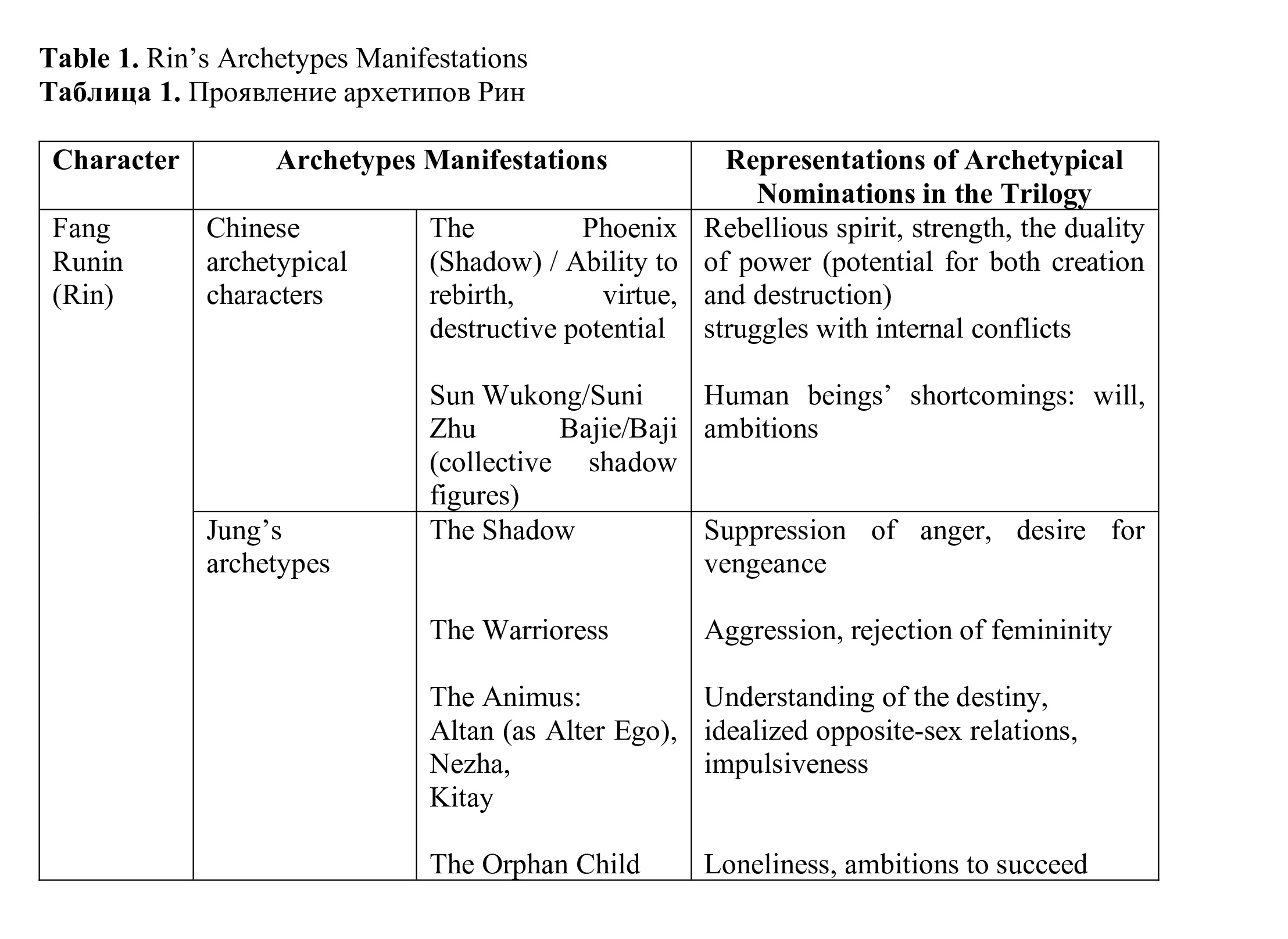
The integration of mythological elements into the novels allows the readers not only to immerse themselves in a fascinating plot, but also to reflect on the deep psychological and cultural aspects that the author proposes. The archetypes described by Jung and his followers serve as an important tool for analyzing and interpreting a literary work, revealing universal human experiences and aspirations. Studying The Poppy War trilogy through the prism of mythological archetypes contributes to a deeper understanding of the text and gives new possibilities for interpreting Chinese mythology and culture in the context of modern literature.
















Reference lists
Corpus materials
Rubanov, А. V. (2020). Finist – jasnyj sokol [Finist – the Bright Falcon], Editorial AST, Moscow, Russia. (In Russian)
Tunyan, Ch., Fanfan, H and Sinie, Ya. (2022). Mify i legendy Kitaja [Myths and legends of China], International Publishing Company “Shans”, Moscow, Russia. (In Russian)
Cheng’en, W. (2013). Journey to the West. Asiapac Books Pte Ltd. (In English)
Kuang, R. F. (2018). The Poppy War. HarperCollins, London, UK. (In English)
Kuang, R. F. (2019). The Dragon Republic. HarperCollins, USA. (In English)
Kuang, R. F. (2020). The Burning God. HarperCollins, UK. (In English)
Shvarts, E. (2019). The Dragon. Broadway Play Publishing INC. (In English)
References
Akhmetshin, А. R. and Gorbatov, A. V. (2015). Atributivnye priznaki arhetipa trikstera [Attributive features of the trickster archetype], Vestnik Kemerovskogo gosudarstvennogo universiteta kultury i iskusstv, Kemerovo, Russia, 81–85. (In Russian)
Alekseeva, O. P. (2006). Virtualnaya bytiнnost skazki v kulture [The virtual entity of a fairy tale in culture], Ph.D. Thesis, Rostov-on-Don, Russia. (In Russian)
Alekseeva, O. P. (2008). Strukturalny podkhod v issledovanii realnogo i virtualnogo mira skazki [The structural approach in the study of the real and virtual fairy tale world], Humanities Issues, 2 (35), 86–91. (In Russian)
Campbell, J. (2004). The Hero with a Thousand Faces, Princeton University Press, USA. (In English)
Casement, A. (2026). Integrating Shadow: Authentic Being in the World. Karnac Books. https://doi.org/10.2307/jj.33326005(In English)
Dyakonov, I. M. (1990). Arkhaicheskie mify Vostoka i Zapada [The archaic myths of the East and West], Nauka, Glavnaya redakciya vostochnoy literatury, Moscow, Russia. (In Russian)
Estes, C. P. (1996). Women Who Run with the Wolves: Myths and Stories of the Wild Woman Archetype, Ballantine Books, New York, USA. (In English)
Geng, Y. (2020). Osobennosti mifologizirovannogo obraza Feniksa v kulture raznyh stran [Literature of different cultures: reflection of ‘Phoenix’ mythological image], Libri Magistri, 4 (14), 128–137. (In Russian)
Gribina, L. V. (2021). Transformatsiya arkhetipa drakona v proizvedeniyah E. L. Shvartsa i sovremennyh pisateley [Transformation of the Dragon archetype in the works of E. L. Schwartz and modern writers], in Proc. of the Russian scientific conference “Evgeny Schwartz and the problems of development of Russian literature of the 20th century”, Adyghe State University, Maykop, Russia, 21–25. (In Russian)
Ivanova, O. I. (2025). Obrazy shamanok stikhii ognya v tsiklah romanov A. V. Borisovoy «Zemlya udaganok» i R. F. Kuang «Opiumnaya voyna» [Images of female shamans of the element of fire in the cycles of novels “The Land of the Udagans” by A. V. Borisova and “The Poppy War” by R. F. Kuang], Issues of National Literature, (2), 15–28. https://doi.org/10.25587/2782-6635-2025-2-15-28(In Russian)
Jung, C. G. (1980). The archetypes and the collective unconscious, Princeton University Press, USA. (In English)
Kulikov, E. A. (2022).Vostok realny i vymyshlenny v romane R. Kuang «Opiumnaya voyna» [The East, real and fictional, in R. Kuang’s Novel "The Poppy War"], The world of science, culture and education, Russia, 6 (97), 413–417. (In Russian)
Liu, Y. and Li W. (2013). A Comparison of the Themes of The Journey to the West and The Pilgrim’s Progress, Theory and Practice in Language Studies, 3 (7), 1243–1249. (In English)
Lju, T. T. (2022). The Chinese Myths: A Guide to the Gods and Legends, Thames & Hudson Ltd, London, UK. (In English)
Meletinsky, Е. M. (2001). Literaturnye arkhetipy i universalii [Literary archetypes and universals], Russian State University for the Humanities, Moscow, Russia. (In Russian)
Miao W. and Shi H. (2023). From National Memory to Self-Referential Symbol: The Rebirth of the Phoenix Metaphors among Chinese Immigrant Women, SAGE Open, 13 (1), 1–17. https://doi.org/10.1177/21582440221099 (In English)
Murdock, M. (2020). The Heroines Journey: Woman's Quest for Wholeness, Shambhala, USA. (In English)
Neumann, E. (2014). The Origins and History of Consciousness, Princeton University Press, USA. (In English)
Pendikova, I. G. (2008) .Akrhetip i simvol v reklame [Archetype and symbol in advertising], JuNITI-DANA, Moscow, Russia. (In Russian)
Propp, V. (2009). Morphology of the Folktale, University of Texas Press, Austin. (In English)
Rogachev, A. P. (1984). U Chjen’jen’ i ego roman "Puteshestvie na Zapad"[Wu Cheng’en and his novel "Journey to the West"], Nauka, Moscow, Russia. (In Russian)
Sannikov, S. V. (2018). Obraz, ideologiya, arkhetip: metodologicheskie aspekty izucheniya reprezentatsii vlasti [Image, ideology, archetype: methodological aspects of studying the representation of power], METOD: Moscow Annual Publications of Works of Social Sciences, 8, 61–81. (In Russian)
Shvets, A. O. (2018). Ambivalentnost kulturnogo geroya v piese E. L. Shvartsa «Drakon» i v ekranizatsii M. A. Zakharova «Ubit drakona» [The ambivalence of the cultural hero in the play by E. L. Schwartz "The Dragon" and in the film adaptation by M. A. Zakharov "To Kill the Dragon"], in Proc. of the III International scientific conference “Donetsk Readings 2018: Education, Science, Innovation, Culture and Challenges of Modernity”, Donetsk National University, Donetsk, 282–284. (In Russian)
Szyjewski, A. (2020). In the Shadow of Trickster. Research fields and controversies in the discourse on the trickster complex in the studies of myth, Studia Religiologica, 53 (3), 163–179. (In English)
Tatar, M. (2021). The Heroin with 1,001 Faces, Liveright Publishing Corporation, New York, USA. (In English)
Tun, B. (2022). Funktsiya arkhetipa teni v literature (Istinny i falshivy tsar obezyan v ‘Puteshestvii na zapad’ U Chjen-jenya, ‘Ten H. G. Andersena i ‘Nos’ N. V. Gogolya) [The function of the Shadow archetype in literature (The true and false monkey king in Wu Cheng-en's ‘Journey to the West’, H. G. Andersen’s ‘Shadow’ and N. V. Gogol’s ‘The Nose’)], Vestnik VGU, Series: Philology. Journalism, 3, 52–57. (In Russian)
Turysheva, O. N. (2012). Teoriya i metodologiya zarubezhnogo literaturovedeniya [The theory and methodology of foreign literary studies]. Moscow: Flinta: Nauka (In Russian)
Vavilova, Е. U. (2008). Transformatsiya teni (kollektivnoe bessoznatelnoe kak sfera dialektiki dobra i zla) [The transformation of the shadow (collective unconscious as an area of dialectic of good and evil)], Vestnik KGU, Russia, 241–244. (In Russian)
Voytilla, S. (1999). Myth and the Movies: Discovering the Mythic Structure of 50 Unforgettable Films, Michael Wiese Productions, Studio City, USA. (In English)
Wang, М. (2020). Evolyutsiya predstavleniy o fenikse v Kitaiskoy yazykovoy kartine mira [The evolution of Phoenix concept in Chinese language picture of the world], Voprosy sovremennoy lingvistiki, 4, 6–11. (In Russian)
Werner, E. (2007). Mify i legendy Kitaya [Myths and legends of China], ZAO Tsentrpoligraf, Moscow. (In Russian)
Williams, C. A. S. (2012). Chinese Symbolism and Art Motifs: A Comprehensive Handbook on Symbolism in Chinese Art Through the Ages, Tuttle Publishing, USA. (In English)
Xinyu Y. and Muhsin A. (2020). Comparative Study on Myth between Chinese and Arabic: Phoenix as an Example, International Journal of Humanities, Philosophy and Language, 3 (10), 12–17. https://doi.org/10.35631/IJHPL.310002(In English)
Xuezheng S., Li J., Zhang Y., Liu S., Hong J. and Lee J. (2020) Devil or God: Image Transformation of Chinese Mythology Character “Nezha”(1927–2019), Cartoon and Animation Studies, 58, 159–200. (In English)
Zagrebelnaya, M. S. (2022). Elementy kitaiskoy mifologii v proizvedenii Rebekki Kuang «Opiumnaya voyna» [The elements of Chinese mythology in the work of Rebekka Kuang ‘The Poppy war’], Modern Science, 1 (2), 303–307. (In Russian)
Zhanysbekova E. Т. and Safronova L. V. (2024). Archetypal images of a literary fairy tale, Eurasian Journal of Philology Science and Education, 196 (4), 168–177. https://doi.org/10.26577/EJPh.2024.v196.i4.ph15(InEnglish)