

Discourse-Organizing Metadiscourse in ELF Academic Speech: A Corpus Study Across Speech Events
Abstract
This corpus-based study examines how English as a Lingua Franca (ELF) speakers utilize metadiscourse (MD) features to structure and regulate the flow of academic spoken discourse across various speech events. It adopts Ädel’s (2022) move-based taxonomy as a framework for a genre-comparative analysis of real-time ELF academic speech events from the ELFA corpus, encompassing various types, including doctoral defense discussions, conference presentations, conference discussions, lecture discussions, and seminars. The study is grounded in a reflexive approach, treating metadiscourse as ‘discourse about ongoing discourse’ (Ädel, 2006). It focuses on discourse organizing MD features such as announcing and concluding topics, endophoric marking, enumerating, previewing, reviewing, and contextualizing. A corpus-based qualitative and quantitative analysis has been adopted, utilizing the UAM Corpus Tool for qualitative coding identifying contextualized MD functions and quantitative analysis comparing their normalized frequencies across seven event types. Our findings show substantial variation across speech events, although the strength of this variation differs by function. Lectures and presentation events show relatively high rates of prospective resources, particularly topic announcement and previewing. Previewing is relatively infrequent overall but strongly differentiated across events; Reviewing is more frequent overall but does not meet the Bonferroni-adjusted significance threshold for cross-event variation. Doctoral Defense Discussions display a hybrid profile; despite their interactive format, they have the highest normalized rate of Enumerating and substantial rates of Endophoric Marking and Contextualizing, while topic announcements and closures are comparatively rare. We argue that these patterns suggest that prospective and retrospective discourse-management resources respond differently to the structural and interactional demands of academic speech events. The results may be helpful to those working to improve the discourse management skills of students in English for Academic Purposes (EAP) settings, as well as academics involved in international conferences and research.
Keywords: English as a Lingua Franca, Metadiscourse, Academic speech events, Discourse management, Corpus analysis, Spoken academic discourse
1. Introduction
English serves as a bridge for communication among speakers of different linguistic backgrounds, playing a significant role in the academic world and higher education worldwide. It is a language spoken by individuals with diverse mother tongues (Mauranen, 2009), and a greater number of individuals adopt English as a foreign or second language than as their native tongue (Graddol, 2006). This has resulted in substantial structural and communicative variability in English as a Lingua Franca (ELF) interactions, where linguistic features and pragmatic norms are dynamically negotiated in real time to secure mutual intelligibility (Cogo and Dewey, 2012; Seidlhofer, 2011). As the universal language of communication and higher education, it attracts many researchers who seek to understand how speakers manage the flow of conversations in various academic spoken genres such as lectures, seminars, presentations, and discussions. Each of these genres has its distinct style and purpose, which influences how people organize their discourse and interact with their audience.
Given the increasing prevalence of English-medium programs and the extensive scholarly attention to academic English, it is of great importance to examine how these academic genres contribute to effective communication in the context of academic English as a Lingua Franca. Metadiscourse is a resource that speakers draw upon to manage the flow of discourse in these academic genres. It enables speakers to convey their messages with clarity while also facilitating listeners’ ability to indicate their understanding (Warren, 2006: 55). This may mean that managing discourse flow is vital in a spoken environment, where understanding and real-time interaction are needed, aligning with principles of interactional pragmatics and ELF accommodation theory (Bell, 1984; Cogo and Dewey, 2012). Despite growing interest in spoken ELF contexts, much of the previous research has focused on written academic texts, and relatively few studies have examined MD features across multiple spoken genres. This limits our understanding of how these features function in various academic settings. By examining the role of MD features in organizing discourse flow in different academic contexts, the goal of this present study is to advance the expanding field of ELF research.
Although scholarly interest in spoken metadiscourse (MD) has grown in recent years, particularly with foundational studies on academic lectures (e.g., Ädel, 2010; Mauranen, 2001, 2010), empirical research remains heavily skewed toward written academic texts or isolated spoken genres like student presentations (Ädel, 2022) and EMI lectures (Molino, 2018). Consequently, there is a lack of systematic and cross-event functional comparison of how discourse-organizing MD features adapt to different academic spoken genres in English as a Lingua Franca (ELF) settings. Knowing that speakers utilize MD to manage talk is no longer sufficient; we must understand how these features function across speech events with varying degrees of structure and interactivity ranging from monologic lectures to highly interactive doctoral defenses. This research gap necessitates a context-sensitive, move-based analysis that moves beyond surface-level marker counts to examine how metadiscursive features function within their real-time sequential contexts. This study addresses this need by adopting Ädel's (2022) move-based taxonomy to analyze seven distinct academic speech event types in the ELFA corpus. Our purpose is to systematically map how these discourse-organizing moves (i.e., specifically topic management, phorics, and contextualizing) are deployed to navigate different communicative demands. To guide this line of inquiry, we attempt to address the following research questions:
RQ1: How frequently do discourse-organizing metadiscourse features occur across different academic speech event types in spoken ELF interactions?
RQ2: Are the observed frequency distributions of metadiscourse categories statistically distinguishable across the seven academic speech event types?
RQ3: In what ways do these metadiscursive patterns and functions vary across the seven speech event types in the ELFA corpus?
2. Literature Review
2.1. The Role of English as a Lingua Franca in Academic Communication
English has been recognized as a leading language in both global communication and higher learning. It effectively functions as a lingua franca. Defined as a language widely shared across various cultures and communities, it facilitates international communication within diverse social and educational settings (McArthur, 2002). When its role in education is examined, its usage is expanding not only in academic publishing but also as a primary medium of instruction. Graddol (2006) states that around 2 to 3 million students study abroad each year, with over half of these enrolled in English-medium programs. Approximately two-thirds of the top 100 universities are situated in countries where English is the predominant language of communication in the educational context. This has led to an increase in the number of universities worldwide that have adopted English as their primary language for teaching. Gnutzmann and Intemann (2008) draw attention to this issue by pointing out that ‘‘publish or perish’’ no longer accurately reflects the current state of academic reality. ‘Publish in English or perish’ would be a better phrase, as more and more publications now require submissions in English. However, as the number of English speakers is skyrocketing around the world, ELF faces the challenge of developing more rapidly than established native varieties of the language (Gnutzmann and Intemann, 2008). In support of this notion, Dewey (2009) argues that English should not be viewed as a rigid collection of standardized forms but rather as an adaptable tool that can be employed in various ways based on context and goal. Therefore, it can be said that the development of international standards is a challenge due to the rapid changes in the ELF field, and to satisfy the demands of users worldwide, ongoing research and modification are required.
Early English for Academic Purposes corpora first focused on studying the language of native speakers as a model for English L2 speakers. However, within a short period, the increasing focus on ELF research has shifted the perspective to effective communication strategies among speakers from diverse linguistic backgrounds (Mauranen, 2010). ELF research, for instance, acknowledges that English L2 speakers usually adapt English to meet their communication requirements (Aertselaer and Dafouz-Milne, 2008; Mauranen, 1993). This leads to language variations that may differ from the traditional grammar or style of native speakers, which indicates the developing nature of ELF. This flexibility is central to managing academic flow in ELF settings where speakers employ techniques such as rephrasing, topic negotiation, and discourse reflexivity (Mauranen, 2007).
Early work in pragmatics, such as House (1996, 2010) and Mauranen (2007), examined how ELF speakers adapt through convergent accommodation strategies in intercultural interactions. Cogo and Dewey (2012) further explored pragmatic adaptation and negotiation of meaning among ELF speakers. In the area of phonology, Jenkins (2009) provides a summary of the phonological characteristics that enhance intelligibility in ELF communication. She also explores the conflicting and varying perspectives that EFL teachers often have about ELF accents.
Björkman (2011) discusses how ELF influences communication and teaching in higher education contexts. She argues that EAP programs should adapt their teaching and tests to help learners for effective communication in diverse contexts. Within English Language Teaching (ELT), Sifakis (2014) proposes a framework for developing ELF-aware teachers. His research reveals that ELF has significant implications for teachers, particularly in terms of their perspectives on language norms, the roles of native and L2 speakers, and the purpose of teacher feedback in language teaching. Vettorel (2018) furthermore examines how World Englishes and ELF affect English Language Teaching. She demonstrates the importance of communicative strategies in ELF interactions, where speakers create and negotiate meaning through their interactions with each other. She emphasizes that to develop learners’ communicative competence, ELT materials should include activities that raise awareness and practice specific communicative strategies.
With these different perspectives in mind, this corpus-based study aims to add to the expanding body of research on ELF by focusing on how ELF speakers manage the flow of discourse in academic speech events. Therefore, it seeks to examine the adaptive, strategic, and context-dependent nature of ELF communication across various genres.
2.2. Shifting Focus to Spoken Academic English: Insights from Corpus-Based ELF Research
While research has been conducted in various areas, the majority of these studies have focused on written contexts. This focus is seen as a direct consequence of academic English research, which, for various reasons, has primarily focused on written communication (Mauranen et al., 2010). The dominance of written language may be due to the large number of available texts, its common usage in academic and professional settings, and the challenges of analyzing spoken language. However, the spread of English as a lingua franca in academia has also led to the need to research English in the spoken field, where the dynamics of communication differ considerably from those in written discourse (Kaur, 2009; Mauranen, 2005, 2006a; Pickering, 2006; Seidlhofer, 2004).
The importance of speech in academic settings started to be more widely recognized with the development of electronic corpora on academic speech in the late 1990s (Mauranen, 2010). Some of the first major corpora, which include the speech of EAP users, such as MICASE and T2K-SWAL in the USA and the BASE corpus in the UK, led the way for the study of speech in academic contexts. In recent years, frameworks such as English as a Lingua Franca in Academic Settings (ELFA), which investigates communication between English L2 researchers in academic contexts (Jenkins, 2013), have gained importance since their establishment in 2001.
A significant development in this field is the ELFA corpus project, which collected a corpus of spoken English from international degree programs at the University of Tampere in Finland (Mauranen, 2005, 2006a; Mauranen and Ranta, 2008). This corpus has provided authentic data from various academic speech events. To understand how spoken English is used in contemporary academic contexts, it is essential to analyze a corpus from real English as a Lingua Franca settings. That is why numerous studies have employed corpus methodology in their research, providing valuable insights into ELF communication patterns (Björkman, 2009; Cogo and Dewey, 2012; Jokić, 2017; Kaur, 2009; Mauranen, 2005, 2006b, 2007). Therefore, this study focuses on a spoken corpus to investigate the strategies that academic ELF speakers adopt to manage flow, taking into account the developing nature of ELF and the limited research on spoken contexts. The aim is to investigate how academics organize their discourse in various academic settings, including seminars, lectures, and discussions.
2.3. The Role of Metadiscourse in the Management of Flow: Functions and Implications in Academic Communication
Metadiscourse plays an interpersonal role in managing discourse flow in both spoken and written academic contexts. This has led to considerable research in discourse analysis because of its importance in organizing and guiding communication. In academic texts, the MD differs from that in non-academic texts because it emphasizes supporting and advancing the writer's academic arguments while also providing information with a clear purpose (Hyland and Tse, 2004). Through textual and conversational functions, it can be claimed that it helps scholars to organize their discourse and develop their ideas. This also could enable both listeners and readers to better structure, understand, and evaluate the messages in the discourse. To achieve this, speakers utilize different MD features for specific functions in terms of discourse flow. For example, they signal the beginning and end of topics through features such as announcing and closing to ensure clarity and cohesion. They also utilize other phorics-related features that contribute to the organization of discourse. These include clarifying the sequence of parts through enumerating, guiding the audience to specific points in the discourse with endophoric marking, indicating upcoming or previous content through previewing and reviewing, and commenting on the discourse context through contextualizing (Ädel, 2010). Such functions can be meaningful for maintaining coherence in both spoken and written academic communication.
It is important to recognize that the term metadiscourse has multiple interpretations, with its scope and definition varying across spoken and written language, as well as among different theoretical models. Early frameworks such as those by Vande Kopple (1985) and Crismore et al. (1993) conceptualized metadiscourse broadly as linguistic elements that guide readers or listeners through a text. Later, scholars like Hyland (2005) framed metadiscourse more narrowly as a self-conscious interactional stance taken by the speaker or writer toward the audience. In contrast, Ädel (2006, 2022) emphasized a reflexive approach, viewing metadiscourse as "discourse about discourse" that remains within the world of communication itself rather than engaging with the external world. Mauranen (2001) also contributed to highlighting metadiscursive strategies, particularly in academic ELF settings. In spoken academic communication, recent empirical investigations demonstrate that discourse-organizing metadiscourse contributes to real-time processing. For instance, Bouziri (2020) highlights how topic-signaling devices establish macro-structural coherence in university lectures, while Kashiha (2022) demonstrates that endophoric marking functions as a primary discourse-organizing resource in academic speech compared to political genres. Furthermore, recent English-Medium Instruction (EMI) studies (Bernad-Mechó, 2024; Doiz and Lasagabaster, 2022) emphasize that metadiscourse serves a critical pedagogical and accommodation function in multilingual tertiary classrooms. Thus, different models offer different points of emphasis, from the management of audience relations to the reflexive organization of discourse.
Because of its complex and diverse characteristics, MD has been characterized as ‘fuzzy’ (Ädel, 2006; Crismore et al., 1993; Hyland, 2005; Hyland and Tse, 2004; Jiang and Akbaş, 2024). According to Vande Kopple (1985), MD is the language strategies employed by writers or speakers to interact with their audience. Meanwhile, Hyland (2005) defines MD as more than just the transfer of information. It also shows the personalities of the communicators and includes their perspectives and interpretations. More recent definitions explain that metadiscourse serves two primary purposes: organizing discourse and managing the interaction between speakers and listeners. Hyland and Jiang (2018) describe it as a resource that helps to control the relationships between speakers, texts, and audiences. Akbaş et al. (2017) and Akbaş and Hatipoğlu (2018) emphasize its pragmatic and strategic role in academic writing, and Ädel (2022) presents it as a reflexive discourse integrated into communication. Despite its many definitions and complexities, metadiscourse is often regarded as ‘discourse about discourse’ (Ädel and Mauranen, 2010), which suggests its role in guiding speakers and listeners through the organization and structure of communication. This basic characterization is widely accepted and frequently included in the definitions of MD in numerous academic studies.
Regardless of the framework applied, MD helps to manage the flow of the conversation and enables both speakers and writers to organize their messages effectively (Jiang and Akbaş, 2024) in academic settings. Earlier research focused on MD in various written academic genres, such as research articles (Hyland and Tse, 2004; Mur-Dueñas, 2011), essays (Bondi, 2010; Kawase, 2015; Rubio, 2011), and theses (Akbaş, 2012; Dahl, 2004; Pérez-Llantada, 2010), and also in English as a Lingua Franca (ELF) context (Ädel, 2006; Doiz and Lasagabaster, 2022; Hong and Cao, 2014; Li and Wharton, 2012). Mauranen (2010) argues, however, that MD plays an even more important role in spoken interaction due to the greater need to manage discourse in real-time communication. This suggests that although most MD research has traditionally focused on written genres, there has been a growing interest in spoken discourse in recent years (Ädel, 2010, 2022; Bouziri, 2020; Mauranen, 2001, 2010; Penz, 2017; Zhu, 2018). As a result, there is now increasing recognition of the complexities involved in managing discourse flow in multilingual, interactive, and fluid spoken events such as seminars, presentations, and doctoral defenses. Building upon this, the current study emphasizes the need to examine metadiscourse features in various real-time academic exchanges.
2.4. Academic Spoken Genres
In academic settings, various spoken genres, such as lectures, seminars, presentations, and discussions, serve distinct purposes. They follow different styles, and these varying styles have an impact on how speakers organize and manage discourse. A genre, according to Swales (1990), is composed of communicative events that share a set of common goals, which in turn influence the expectations and techniques employed by speakers in each situation. While earlier corpus studies focused heavily on written research articles, recent ELF research has expanded to investigate spoken event types. Studies by Bernad-Mechó and Fortanet-Gómez (2019) and Molino (2018) show that monologic lectures rely heavily on sequential enumeration and explicit topic management to orient international audiences. For example, lectures and presentations are typically one-sided, with a single speaker delivering the information to the audience. Mauranen (2009) explains that lectures provide information about conceptual systems, previous research findings, and facts. In other words, they provide familiarity with content that is considered essential knowledge in a specific field. In contrast, recent work on interactive spoken genres (Mauranen et al., 2020; Penz, 2017) reveals that multi-party discussions demand reflexive scaffolding and real-time contextualizing moves to manage open floor negotiations. For instance, seminars and discussions tend to be more interactive, encouraging group discussions and engagement. Therefore, participants share the responsibility for maintaining the flow and success of the conversation (Warren, 2006). Unlike lectures, seminar discussions develop gradually, are more spontaneous, and usually involve fewer layers of simultaneous organization (Mauranen, 2005). These differences are likely to influence how the speakers employ MD features to organize their speech. In dialogues, metadiscourse plays a much broader role, and this is especially true for discourse management. This aspect is crucial for successful communication, as it facilitates the organization of both the text and the interaction (Mauranen et al., 2010). By examining reflexive metadiscourse across seven distinct spoken event types, this study builds upon these recent insights to provide a comprehensive cross-genre comparative analysis.
Prior corpus research on spoken academic metadiscourse (MD) has developed along two major tracks, corresponding to the monologic and dialogic modes of communication. The first, and most established, track focuses on monologic genres, primarily academic lectures and student presentations, where the speaker bears the sole communicative burden of managing information flow in real time. In these settings, scholars have consistently demonstrated that organizational metadiscourse is for maintaining clarity and managing cognitive load. For instance, research on academic lectures (Dafouz and Perucha, 2010; Kashiha, 2022; Lee and Subtirelu, 2015) highlights that lecturers rely heavily on structural scaffolding (such as endophoric marking and previewing) to establish macro-coherence and guide student comprehension. Similarly, analyses of student presentations (Ädel, 2022; Magnucz, 2012; Rowley-Jolivet and Carter-Thomas, 2005) reveal that effective speakers utilize metadiscursive "moves" to compensate for linguistic limitations, actively structuring their discourse to align with audience expectations. Recent work in English-medium instruction (EMI) contexts (Bernad-Mechó, 2024; Molino, 2018) further supports this, showing that when speakers and audiences navigate linguistically diverse environments, explicit organizational signposting shifts from a rhetorical option to a pragmatic necessity. However, a critical tension arises when moving from these highly structured, monologic settings to interactive, dialogic speech events (such as seminar discussions and doctoral defenses). In these fluid environments, communication is co-constructed, meaning that speakers cannot rely on pre-planned structural maps. While monologues can have forward-looking textual features (like previewing and topic announcements), interactive talk relies on retrospective and reflexive resources (like reviewing and contextualizing) to resolve comprehension challenges on the spot (Mauranen, 2010; Penz, 2017; Zare and Tavakoli, 2015). Despite these insights, existing literature remains heavily fragmented: studies typically examine monologic lectures (Bouziri, 2020) or dialogic conflict talk (Penz, 2017) in isolation, rather than comparing them systematically. As Jiang and Akbaş (2024) observe, metadiscourse serves as a primary mechanism through which written/spoken academic communicators adapt their language to meet the specific rhetorical demands of distinct genres and disciplinary settings. Thus, by evaluating these metadiscursive strategies across a unified continuum of seven distinct speech events in the ELFA corpus, this study addresses this division, mapping how the functional value of discourse management shifts as interactions become increasingly dialogic and collaborative
3. Methodology
3.1. Data: ELFA Corpus
This study draws on the ELFA corpus (English as a Lingua Franca in Academic Settings). It is a rich collection of transcribed spoken academic interactions. Comprising approximately one million words, the corpus represents around 131 hours of recorded speech from various academic events. The data were obtained from several Finnish universities, including the University of Helsinki and Tampere University, as well as their associated technological universities. All ELFA speakers have an educational background that includes formal instruction in English as well as experience of speaking the language. They are generally well-educated, as most of them possess at least one university degree. The academic nature of the data is important, as it influences how metadiscourse is employed.
The ELFA corpus provides data for the usage of English as a Lingua Franca. It encompasses 650 speakers from 51 different native language backgrounds. Of the participants, about 28.5% are Finnish speakers, while only 5.1% are native or bilingual English speakers. In general, the corpus consists only of authentic data, as it comprises naturally occurring interactions rather than speech explicitly delivered for research purposes. The data comprise 165 speech events of various discourse types, including lectures, seminars, thesis defenses, and conference presentations. Event type is employed as a general term in the data, although many commonly recognized event types are considered genres (Mauranen, 2006a). The data includes both monologic and dialogic speech, indicating whether there was one speaker or multiple active participants. Both types are included, but the focus is on dialogic events, specifically multi-party discussions. Monologic events, such as lectures and presentations, make up 33% of the data. In contrast, dialogic and polylogic events, which include seminars, thesis defenses, and conference discussions, represent a remarkable portion, totaling 67% of the data. Thus, approximately two-thirds of the data consists of these dialogic interactions. Figure 1 provides a visual representation of the detailed distribution of event types within the ELFA corpus.
Figure 1. Distribution of event types in the ELFA corpus Mauranen et al. (2010)
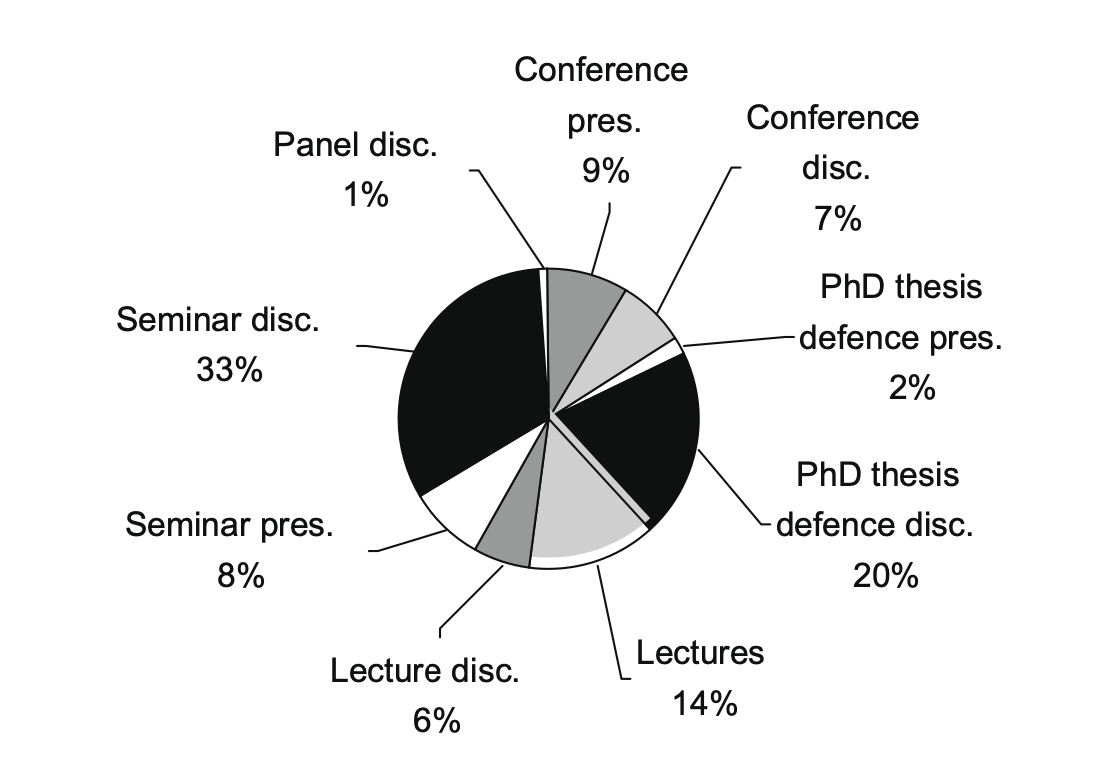
To ensure a systematic, objective, and replicable selection process, speech events from the ELFA corpus were selected based on explicit quantitative thresholds and structural eligibility criteria rather than subjective sampling. To achieve cross-genre comparability, an empirical threshold of per event-type subcorpus was established. Based on this threshold, minor event categories that individually accounted for only 1% (Panel Discussions) and 2% (Defense Presentations) of the total ELFA corpus volume were explicitly excluded, as their limited data size precluded reliable comparative analysis. Conversely, seven speech event types met the eligibility threshold: Conference Discussions, Conference Presentations, Doctoral Defense Discussions, Lecture Discussions, Lectures, Seminar Discussions, and Seminar Presentations. To prevent arbitrary textual fragmentation and preserve the natural interactional flow, extended single-event transcripts (such as Conference Discussions, totaling 78,484 tokens) were retained in their complete form rather than truncated to match the exact 60,000-token baseline. Importantly, all eligible files in the ELFA corpus meeting these explicit criteria across the seven selected event types were retained in full, resulting in an exhaustive analytical corpus of 83 complete speech event transcripts.
Table 1. Descriptions of ELFA Corpus Speech Events
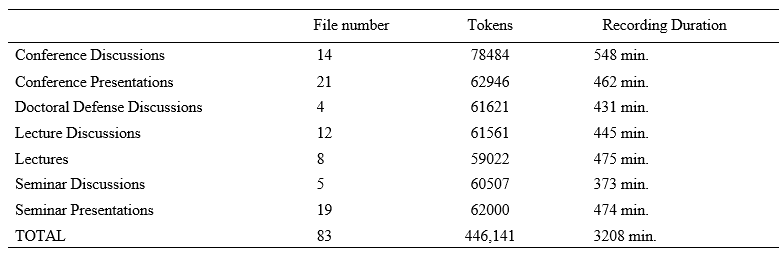
As Table 1 shows, the total corpus comprises 83 texts, totaling 446,141 tokens and approximately 3,208 minutes of recorded data. These include monologic events such as lectures, seminar presentations, and conference presentations, as well as dialogic events including seminar discussions, lecture discussions, doctoral defense discussions, and conference discussions. The study maintains the integrity of each speech event's content while ensuring a fair and methodical comparison of metadiscourse across various academic speech genres by incorporating a range of token counts.
3.2. Data Analysis Process
Data analysis was conducted manually using the UAM Corpus Tool (Version 3.3, O’Donnell, 2008). This tool enables users to annotate texts at various linguistic layers according to their preferences. In this study, 83 texts were initially uploaded to the UAM CorpusTool. Each event was carefully reviewed and annotated for linguistic elements, with a qualitative focus on coding and tagging segments based on relevant metadiscourse features. While Ädel (2022) proposes a comprehensive taxonomy with multiple dimensions, this study focuses specifically on the features related to managing discourse flow, including announcing the topic, concluding the topic, contextualizing, endophoric marking, enumerating, previewing, and reviewing. To ensure consistency, each feature was coded based on Ädel’s (2022) explicit definitions and examples. In cases where coding was not straightforward or required reconsideration, a retreating process was followed, allowing for reevaluation and refinement of earlier decisions. When uncertainty endured, interrater discussion was used to resolve ambiguities and reach a shared decision.
Figure 2. An annotation window of the UAM Corpus Tool
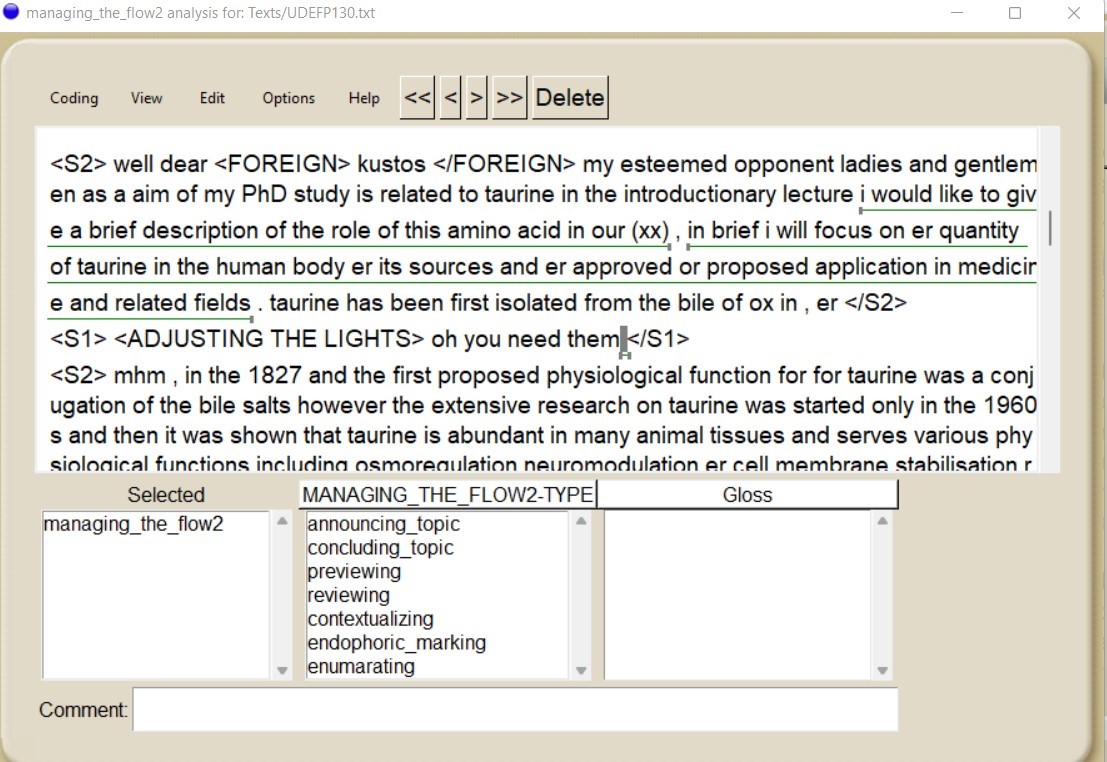
The manual analysis involved a close reading of the texts. This was to ensure that no potential markers were missed during the tagging process. Target markers were first identified using concordance lines, and each marker was then carefully examined to ensure accuracy. This kind of detailed analysis was necessary because metadiscursive expressions often have multiple functions and are highly content-dependent. In this way, it is possible to identify sentences that may appear to be metadiscursive but which do not have the characteristics of metadiscourse. As an example, structures that fall ‘out of the world of discourse’ (Ädel, 2006) are not classified as metadiscourse. For instance, without close reading, the structure in the following sentence would typically be categorized as enumerating.
(1) The third-world economies became geared more toward the needs of their first world colonial masters than the domestic needs of their own societies. (Seminar Presentations 011C)
(2) We are the third world’s third largest largest automobile producer. (Seminar Presentations 08B)
In general, the metadiscursive features were clear and concise. However, occasional overlaps were observed, particularly with the feature 'announcing the topic.' In cases where metadiscursive features demonstrated multiple functions or overlapped, the primary communicative goal of the speaker served as the basis for the coding decision. For example, in Seminar Presentation 01A ('I shall explain how above arguments is based on the following subtopics...'), although the speaker was both previewing and announcing upcoming sections, the primary function was coded as announcing the topic because the focus was on introducing the main structure of the talk. In another case, in Conference Presentations 03E (‘Today I will er, if not more, talk about a project that I’ve been coordinating the last few years, so on an e-European level.’), even though the speaker provides a brief overview of the content (previewing), the central goal is to declare the topic, leading to its annotation as announcing. These examples demonstrate how overlapping instances were handled systematically by emphasizing the dominant function. Such fluidity illustrates the need for context-sensitive annotation in metadiscourse analysis.
In addition, to operationalize Ädel’s (2006, 2022) reflexive framework, this study distinguishes between macro-level discourse segments and micro-level functional moves. Ädel’s (2022) framework defines metadiscourse based on its reflexive communicative function within the ongoing interaction. Within this framework, an operational 'instance' was defined as a discrete linguistic expression performing a distinct metadiscursive micro-act. In real-time spoken ELF interactions, speakers frequently deploy consecutive metadiscursive signals (e.g., self-corrections, reformulations, or iterative signposts) within a single turn to reinforce structural clarity for multilingual listeners. For instance, in Conference Presentation 05J, the speaker uses several distinct metadiscursive expressions in succession:
(3) ‘well I’ll this is the s- the er topic of my presentation today I’ll be discussing basically that’s the title of the paper that I’ve written here, and er there this is the summary what I generally want to to discuss so I’ll talk a little bit about the intro- introduce er the the topic there.’
Rather than treating the entire turn as a single broad macro-segment, each expression was annotated individually because it performs a distinct reflexive micro-function: (a) declaring the presentation topic ('this is the topic of my presentation today'), (b) referencing the written paper title ('that's the title of the paper'), (c) delineating the talk agenda ('this is the summary what I generally want to discuss'), and (d) signaling the initial structural move ('so I'll talk a little bit about... introduce the topic there'). This micro-move tagging strategy ensures that the full extent of online metadiscursive effort expended by spoken ELF speakers is captured. While micro-level tagging yields higher absolute occurrence counts than macro-segmentation, this operational unit was applied with strict consistency across all 83 transcripts, thereby maintaining construct validity and ensuring unconfounded cross-genre comparisons. The UAM Corpus Tool (O'Donnell, 2008) was employed to support both the qualitative coding process and the quantitative analysis of metadiscursive features. The tool provides statistical outputs, including distributions, frequencies, and percentages, which enable researchers to compare linguistic features across different sections of a corpus. In this study, the tool initially facilitated the annotation of all 83 speech events, providing an overview of feature distributions across the data. However, due to the large size and complexity of the annotated dataset, the software occasionally crashed during statistical processing. As a result, the percentages and frequencies presented in this study were recalculated manually based on the raw counts exported from the tool. The findings from both qualitative and quantitative analyses were then compared across the seven speech event types to identify shared and distinctive patterns in the use of metadiscourse. These results are discussed with a focus on the usage, function, and distribution of metadiscursive features within and across the analyzed academic genres.
To ensure the consistency, credibility and replicability of the coding schema, the dataset was evaluated through both intra-rater and inter-rater reliability testing. Reliability testing was conducted on a randomly selected, representative sample of 220 complete metadiscursive cases drawn across all seven academic speech event types. Case-processing analysis confirmed a complete dataset with
0 missing cases (100% valid processing). To evaluate intra-rater consistency, the first author re-coded the entire 220-case sample after a three-month interval to eliminate recall bias. For inter-rater reliability, the sample was independently coded by a second researcher who held a PhD in applied linguistics specializing in Ädel’s (2022) taxonomy. The second coder was not involved in the initial data annotation but was briefed on the specific operational parameters of this study. Cohen’s kappa statistics were calculated on initial, unassisted coding to determine baseline agreement before consensus discussions. Initial independent coding yielded 17 divergent decisions out of 220 cases. The baseline inter-rater agreement achieved  (Asymptotic SE = 0.20,
  < .001), while intra-rater agreement achieved
  (Asymptotic SE = 0.009, < .001). According to established statistical benchmarks (Landis and Koch, 1977; McHugh, 2012), kappa values above 0.81 represent almost perfect agreement. Following the calculation of baseline kappa, all 17 initial discrepancies were collaboratively reviewed and raters reached a consensus.
3.3. Statistical Analysis Procedure
To determine whether observed differences in metadiscourse distribution across the seven academic speech event types were statistically distinguishable (RQ2), inferential statistical testing was conducted. Because subcorpus sizes varied across genres (from 59,022 to 78,484 tokens), a weighted Chi-Square Goodness-of-Fit test was performed (df=6). The null hypothesis  specified that metadiscourse occurrences are distributed across the seven speech event subcorpora in exact proportion to their word counts. Expected frequencies were mathematically calculated as
  where
where  represents the word count of subcorpus. All expected cell counts exceeded the minimum assumption threshold
  With this, we aim to ensure that expected values reflect subcorpus size imbalances rather than assuming equal word counts across genres. In addition, an overall 7x7 contingency table Chi-Square test was performed across all categories and genres. Effect sizes for the category-level goodness-of-fit tests were quantified using Cohen's w (interpreted as small = .10, medium = .30, large = .50), whereas Cramér's V was calculated for the overall 7 × 7 contingency-table test.Furthermore, while token-level Chi-Square testing, a standard baseline heuristic in corpus linguistics (McEnery et al., 2006) provides a standard baseline in corpus linguistics, we recognize that metadiscourse tokens are nested within 83 transcripts. Because individual tokens within the same transcript are not strictly independent, the Chi-Square statistics are treated as indicative baseline measures rather than definitive proof of causal variation, and inferential claims are qualified accordingly. We also acknowledge that no formal adjustment for multiple comparisons was applied during initial category-level testing. Nevertheless, to account for potential alpha inflation across seven simultaneous Chi-Square tests, we evaluate the resulting individual
  -values against a conventional Bonferroni-adjusted significance threshold
  ). Therefore, we interpreted the results falling between .0071 and .05 cautiously as exploratory or marginal trends rather than robustly significant category-level variations.
4. Results and Discussion
To explore how metadiscourse features were employed across different academic speech events, an analysis was conducted to determine the frequency and the percentage distributions of each MD feature. Several findings are identified about how speakers organize the flow and clarify their discourse in terms of MD features. A quantitative analysis of these MD functions across the speech events in question resulted in a total of 1909 instances. The number of tokens employed in each speech event was set at approximately 60,000 To account for unequal subcorpus sizes across the seven speech event types (ranging from 59,022 tokens in Lectures to 78,484 tokens in Conference Discussions), raw occurrence counts were normalized to a standardized metric of occurrences per 10,000 tokens. Thus, while raw frequencies are retained in all tables for transparency, cross-event comparisons and genre-sensitive interpretations throughout the results are based on these normalized frequency rates per 10,000 tokens.
Table 2. Overall Distribution of Metadiscourse Features about Managing the Flow
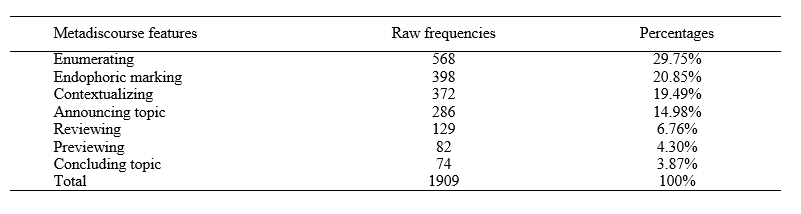
Enumerating is the most commonly employed feature, accounting for 29.75% of the total, as shown in Table 2. This might indicate that speakers needed more sequential organization to guide their listeners through complexity by emphasizing logical order and clarity. Its consistent usage may also help L2 listeners to follow the progression of ideas and points. This feature can help to reduce potential ambiguity in academic speeches by, for example, allowing arguments to be ranked in order of importance and ensuring a clear progression of argument (Ädel, 2006).
Endophoric markings occur in 20.85% of instances, which demonstrates the importance of referring to discourse elements. It can be argued that by frequently employing endophoric references, speakers can maintain a clear and organized flow of information, allowing listeners to concentrate on the topic or points being discussed. As can be observed, both endophoric marking and enumerating are frequently employed in these speech events, supporting Ädel's (2022) analysis of an online MA-level English language teaching context, which suggests that these features are vital in academic settings for achieving coherence and clarity. This is also supported by Kashiha (2022), who emphasizes the importance of endophoric marking in educational genres. His research shows that endophoric marking is the most commonly employed discourse organizer in university lectures.
We could argue that the importance of endophoric marking in specific academic contexts for organization, coherence, and clear communication is supported by this consistency across studies. However, the findings of Lee and Subtirelu (2015), who found that endophoric markers were rare and among the least employed features in both the L2CD and MICASE corpora, present a contrasting perspective. They attribute this to the nature of classroom communication and its reliance on deictic expressions and gestures, which, as we have previously noted, suggests that multimodal elements may influence the use of MD. The discrepancy between their findings and the current study may also stem from contextual and functional differences in the types of speech events analyzed. Unlike general classroom interactions, academic discourses involve the simultaneous processing of high-level intellectual content and real-time speech, and they offer more sophisticated data than more conventional interactions (Mauranen, 2006a).
The frequent use of discourse organizers similar to those in this study was also observed in Molino’s (2018) study on English-medium instruction (EMI) lectures. In her research, discourse organizers were found to be frequently employed to organize the discourse flow, particularly through the use of impersonal metatext, previewing, reviewing, endophoric marking, and, finally, contextualizing with personal metatext. As a result, it can be inferred that the frequent usage of such features of MD is a characteristic of academic discourse. In these academic settings, speakers are likely to prefer explicit references to ensure the flow of discourse and clarity. This may be especially important when they address diverse ELF audiences who may not share the same physical or situational context.
The frequency of contextualizing reflects a primary orientation toward framing and structuring ideas during discourse organization. Its frequent occurrence in the spoken genre is consistent with Ädel’s (2010) findings. She demonstrated that contextualization occurs more frequently in spoken discourse than in written texts. This is most likely because spoken communication has a more flexible structure, and speakers often refer to the production process and their ongoing actions, in contrast to written discourse, which is more rigid and pre-planned. Another possible explanation is that ELF speakers try to make the content accessible by setting the scene or providing background information to manage the flow of conversation.
With a not insignificant usage, the features announcing the topic (14.98%) and reviewing (6.76%) indicate that speakers intentionally introduce and review issues to manage the flow of discourse. The announcement of the topic helps establish the focus of the discourse or signals a shift to a new topic, thus making transitions evident. Similarly, reviewing allows speakers to reinforce or clarify ideas that have already been presented, hence contributing to coherence and understanding by the audience. In contrast to these more frequently employed features, the relatively low frequencies of previewing and concluding a topic may suggest that while references and formal closures are employed, they may not be as big a part of managing flow as other features. This suggests that ELF speakers in academic speech events rely more heavily on ongoing organization, context building as well as backward referencing than on forward-looking previewing or explicit topic closure. Nonetheless, the comparatively low overall frequency of Previewing can reveal substantial variation across academic speech event types, which could indicate that the resource can be selectively concentrated in particular academic spoken contexts.
Considering the results above, this study is in line with Bernad-Mechó's (2024) findings in several respects. Both studies show that contextualizing is the third most frequent feature, whereas concluding the topic appears less frequent when compared to the other features. Furthermore, a similar pattern appears in both studies in which reviewing is more common than previewing, which emphasizes the shared tendencies in metadiscourse usage. The concluding topic feature had the lowest frequency across courses, according to another study by Bernad-Mechó and Fortanet-Gómez (2019), with values ranging from 0.1 in the American Literature course to 0.4 in others. This suggests that lecturers may not frequently signal the conclusion of topics. The present study supports this observation and further emphasizes the minor role of formal topic conclusions in spoken academic discourse.
These results indicate a broader tendency among speakers to give more weight to elements that support flow management, such as enumerating endophoric markings, than to those that formally close topics. In this context, features like enumerating, which was found to be the most frequently employed, may serve not only structural purposes but also cognitive and communicative ones. As Ädel (2012) argues, enumerating supports listener orientation strategies by guiding the audience through complex content and aiding comprehension. Thus, further research could explore how such features function not only to organize discourse but also to reduce processing load in ELF speech and enhance listener engagement in multilingual academic interactions.
Table 3. Inferential Chi-Square (  Goodness-of-Fit Tests Across Speech Events
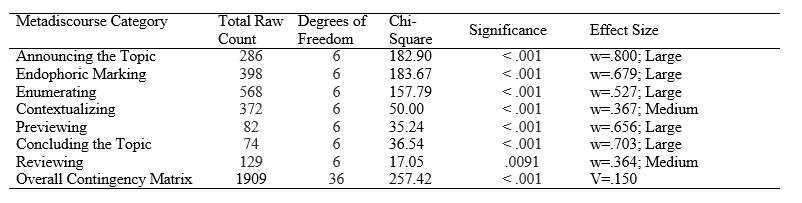
Regarding the statistical difference across speech event types, inferential statistical testing supported that the distribution of reflexive metadiscourse features varies significantly across the seven academic speech event types 
Under the Bonferroni-adjusted threshold  = .0071), six of the seven individual categories (i.e., Enumerating, Endophoric Marking, Contextualizing, Topic Announcement, Previewing, and Topic Conclusion) remain statistically significant ( to
  ). In contrast with this, Reviewing (
  ) falls between .0071 and .05 and is interpreted cautiously as an exploratory but marginal trend rather than a category-level difference. these inferential results suggest that cross-genre variations in metadiscourse density are statistically distinguishable across speech event types. While quantitative corpus data alone cannot establish direct causal mechanisms, these distributional patterns imply that metadiscourse use may adapt to the various communicative and structural demands of distinct academic contexts rather than occurring at random
4.1. Enumerating Across Speech Events
Enumerating reveals the order of certain parts of the discourse by using numbers to relate them to each other. As can be seen in the examples below, it enables speakers to break down content into manageable sections, making it easier for the audience to follow and understand the discourse's structure.
(4) the first thing I have to say that my title has changed a little bit changed (Conference Presentation 06B)
(5) okay the third criticism comes from the limits of the narrative analysis (Conference Presentations 03D)
(6) In the second step we discuss the theorotical framework (Doctoral Defense Discussion 020)
Table 4. Distribution of Enumerating across speech events (raw frequency & normalized rate per 10,000 tokens)
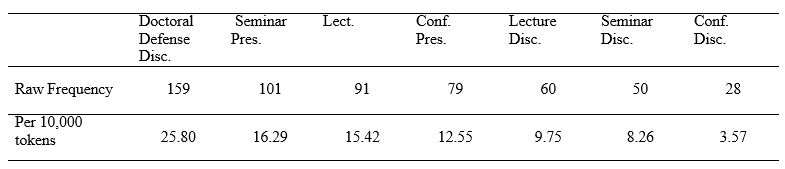
According to the data, each genre employs enumerating differently, which is unique to that genre's characteristics. If we were to analyze each one, the data would indicate that enumerating is most prevalent in doctoral defense discussions (25.80 per 10,000 words). This far exceeds the density observed in monologic genres such as Seminar Presentations (16.29 per 10,000) and Lectures (15.42 per 10,000). This high reliance on sequential signposting aligns with the specialized communicative and evaluative demands of doctoral defenses. It may also suggest that in these high-stakes academic speech events, both doctoral opponents/examiners and candidates utilize enumerating as a cognitive and pragmatic tool to navigate complex multi-layered discourse. This may also stem from the formal and argumentative nature of doctoral defenses. The high frequency of enumerating in lectures (15.42 per 10,000 tokens) and seminar presentations (16.29 per 10,000 tokens) further underscores the necessity for presenters to organize content clearly for the audience. This may be explained by the fact that academic writing and lectures share similarities in that both require content to be arranged in a clear, hierarchical manner (Thompson, 2003). At the lower end, "enumerating" appears less frequently in seminar discussions (8.26 per 10,000 tokens) and even less so in conference discussions (3.57 per 10,000 tokens), where discourse unfolds through spontaneous turn-taking rather than pre-planned or highly formalized argumentation. This could suggest a less straightforward, more adaptable discourse style that is often present in these diverse and interactive discussions. In light of the results obtained, it can be suggested that enumerating is more prevalent in formal, structured contexts, such as doctoral defenses, seminar presentations, and lectures, where it facilitates the organization of information for a coherent discourse flow. Nevertheless, it is less common in events that are more flexible and do not require strict sequencing, like conference discussions.
4.2. Endophoric Marking across Speech Events
Endophoric marking concerns instances in which reference is made to a particular point in the discourse. It does not clarify whether it is before or after the current point. Thus, unlike previewing and reviewing, endophoric marking occurs in situations where this distinction is irrelevant (Ädel, 2022). It can be employed, for example, to draw the audience's attention to specific materials, such as a table, a particular point in a handout, or a visual aid. The examples that follow illustrate this point clearly. The speaker in example (7) draws the audience's attention to specific funding sources, most likely using a slide or chart as a visual aid. In example (8), the speaker points to a particular line, directing the audience to focus on one specific detail. Similarly, in example (9), the speaker draws attention to the last page of a handout, and in example (10), the speaker combines explanation with visual observation, directing the audience to notice specific color changes within a film. The implication here is that the speakers employ endophoric marking to reinforce the explanation by linking it to a dynamic visual element.
(7) if you look you you see er the, the the the sources of financing change (Conference Presentations 05J)
(8) if you look at the second line, there
is the new bussiness opportunity
(Conference Presentations 08B)
(9) if you look at the last page of that that copy you see this er chart with united nations at various bodies under that (Lecture 01A)
(10) here is the movie which shows you this effect if you look at the green and the red color you will see that at a certain point red color goes the intensity goes up (Lecture 023A)
Table 5. Distribution of Endophoric Marking across speech events (raw frequency & normalized rate per 10,000 tokens)
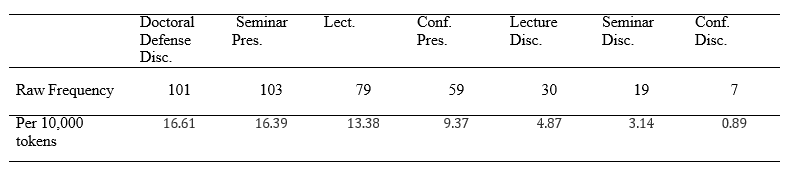
The normalized distribution per 10,000 tokens demonstrates clear variation in how endophoric markings are utilized across academic speech event types. The highest frequency of endophoric marking is observed in Seminar Presentations (16.61 per 10,000 tokens) and Doctoral Defense Discussions (16.39 per 10,000 tokens). In seminar presentations, student speakers seem to employ endophoric markers to cross-reference visual aids, slides or preceding sections of their talk to structure information and guide their peers. Similarly, in doctoral defenses, candidates and examiners frequently utilize text-internal references to point directly to specific chapters, data tables or arguments within the dissertation to substantiate claims during rigorous academic evaluation. We also find that monologic lectures exhibit a high density of endophoric markers (13.38 per 10,000 tokens), which can serve a pedagogical function to organize complex course material and orient students across multi-part topics. Moderate use of endophoric markers occurs in Conference Presentations (9.37 per 10,000 tokens), in which presenters employ endophorics to connect slides and revisit key points efficiently under strict time limits. Unlike structured presentations or high-stakes defenses, Lecture, Seminar and Conference Discussions (4.87; 3.14 and 0.89 per 10,000 tokens, respectively) as dialogic speech events unfold through spontaneous, turn-by-turn interaction in which speakers directly respond to immediate conversational turns rather than referencing pre-planned textual structures, resulting in significantly lower densities of endophoric marking across these interactive speech events.
It is also important to note that in ELF academic communication, particularly in lectures and presentations, endophoric marking is often not limited to verbal cues alone. As pointed out by Broggini and Murphy (2017), speakers often reinforce these features with multimodal resources, such as pointing to slides, referring to handouts, or employing spatial deixis. This suggests that these multimodal strategies enhance audience orientation and reinforce the rhetorical function of endophoric markers by linking spoken content to visual or physical elements in the communicative environment. This pattern is consistent with the findings of Zare and Tavakoli's (2015) study. They found that endophoric markings were frequently employed in academic lectures because handouts and slides were readily available and that limited references to particular parts of the discourse explained their absence in dialogic forms. In conclusion, endophoric markers are deployed predominantly in structured, formal settings such as presentations and lectures. In contrast, they occur less frequently in interactive discussions where text-internal cross-referencing is less necessary.
4.3. Contextualizing Across Speech Events
Contextualizing is the comment of the speaker or writer on the planning, production, and organization of discourse. According to Ädel (2022), it often involves justifying the choices made in structuring texts, which helps to understand how the discourse was produced. This is an important part of managing the flow of discourse, as the speakers ensure that the audience understands the reasons for the course of the discourse. Thus, this allows for a more coherent flow, prepares the audience for what is to come, and explains why certain decisions have been taken. The significance of contextualizing in spoken discourse aligns with the findings of Luukka (1994) and Ädel (2010). Both of these scholars emphasize the high occurrence of contextual metadiscourse in spoken academic texts. Luukka (1994) attributes this to the ‘live’ nature of oral presentations, where speakers have to structure their arguments in real time without the possibility of revision. Similarly, Ädel (2010) notes that contextualizing occurs primarily in spoken data due to the limited time available for planning and editing in real-time discourse.
The following examples illustrate the urgent need for speaker organization and justification to manage the flow effectively. The speaker's statement in (11), for instance, that a decision will be made during the presentation helps in flow management by providing expectations for the audience. It indicates that the speaker is explaining the preparation time, which may influence how the audience interprets the timing and pace of the talk. Similarly, in (12), the speaker's explanation of the available time for discussion helps manage the flow. The speaker explains how the schedule was planned, which keeps the session structured and helps the audience know what to expect. In (13), the speaker justifies not including a long bibliography, which helps to avoid confusion and keeps the focus on the main points. Finally, in the example from lecture 020A, the speaker explains why they are starting with a particular concept. This enables the audience to understand the flow of ideas and why this starting point can be essential. As is clear from these examples, these explanations facilitate real-time flow management by providing the audience with a more transparent and predictable understanding of the discourse's structure.
(11) it is not so easy to unders- okay but er before it one more er excuse me i have prepared not for (one two) hours and that’s why i er, er i have to decide during my presentation er (xx) okay one example er, later I will speak about library architecture. (Lecture 030)
(12) but we thought that two days might be enough if we have a two full days we <S16>(yes)<S16> could squeeze we know now enough of each other’s topics so that we go rather directly and we we shall thoroughfully discuss each case half an hour at least maybe three quarters but we could do them in two days if we al- take two days and even eve-evening between for some drinking. (Seminar Discussion 04B)
(13) i did actually want to mention as well that i didn’t write a long bibliography i have actually quite many sources but i didn’t put them down. (Seminar Discussion 04B)
(14) i start with that it is not the one we start with in in the paper but i think it’s better to start there to set the scene or what is going on and for the discussion of the three concepts we are going to to compare in my presentation. (Lecture 020A)
Table 6. Distribution of Contextualizing across speech events (raw frequency & normalized rate per 10,000 tokens)
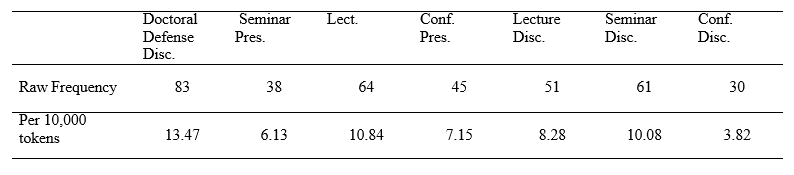
As illustrated in Table 6, the highest frequency of contextualizing is observed in Doctoral Defense Discussions (13.47 per 10,000 tokens). This elevated rate underscores how candidates and examiners frequently contextualize discourse to clarify research parameters, justify methodological decisions, and outline the scope of their arguments under high-stakes academic evaluation. Monologic Lectures follow with a high density of 10.84 per 10,000 tokens. This aligns with Ädel’s (2010) findings in MICASE lectures, demonstrating that university lecturers regularly employ contextualizing moves to make spontaneous meta-comments such as managing time constraints or framing ongoing explanations to maintain discourse coherence and audience orientation. We also find that high to moderate usage is evident in dialogic settings such as Seminar Discussions (10.08 per 10,000 tokens) and Lecture Discussions (8.28 per 10,000 tokens). In such interactive contexts, we suggest that participants use contextualizing as a pragmatic resource to signal shifts in focus, contextualize spontaneous contributions and tie incoming comments to preceding discussion points. Conversely, lower densities of contextualizing occur in formal presentations, including Conference Presentations (7.15 per 10,000 tokens) and Seminar Presentations (6.13 per 10,000 tokens). This may be because they tend to be more formal and pre-structured. Speakers in such settings might mainly rely on prepared scripts or visual aids, which would reduce the opportunity for contextual comments. In contrast, Conference Discussions also exhibit the lowest rate of contextualization (3.82 per 10,000 tokens), most likely because these relatively fast-paced, turn-taking exchanges leave limited space for extended contextual meta-comments, which may reduce the opportunity for extended contextual explanations.
Taken as a whole, these findings underline the role of contextualizing in adapting to the specific characteristics and organizational needs of each speech event. We can argue that the management of academic flow is supported by the strategic usage of contextualizing, which varies across genres. This variability emphasizes the importance of adapting metadiscourse strategies to the communicative demands of different academic genres, making it relevant to explore how contextualizing is linguistically realized in real-time academic discourse. For instance, speakers may contextualize through declarative structures (e.g., ‘I presented it that way here, but of course there might be different possibilities…’(Doctoral defense disc. 010)), justifications (e.g., ‘I just added it there after I printed the handouts…’ (Lecture disc. 050)), or metalinguistic comments (e.g., ‘Let me explain why I structured it this way…’ (Doctoral defense disc. 020)). By explicitly revealing the speaker's planning and reasoning, such expressions facilitate real-time discourse flow and support audience orientation. They illustrate how contextualizing functions as both a metadiscursive strategy and an interactional resource in these academic events.
4.4. Announcing the Topic Across Speech Events
Announcing the topic is a feature that is employed to introduce or open a new topic, as the term suggests. Speakers or writers utilize this feature to inform listeners or readers about the topic they will discuss, making it easier to follow the discourse's flow. This feature can be marked by various expressions, as shown in the examples below, such as ‘I want to talk about...’, ‘well I’ll this is the s- the er topic of my presentation today i’ll be discussing…,’ ‘i’m going to give you a short lecture on..,’ well erm, erm the subject I erm choosing for my for my essay is…,’ so first I would like to say about…’
(15) I want to talk about the free trade area of the americas negotiations and its main challenges (Conference Presentations 05I)
(16) well i’ll this is the s- the er topic of my presentation today i’ll be discussing basically that’s the title of the paper that I’ve written here (Conf. Presentations 05J)
(17) my name is >NAME S1> and i’m going to give you a short lecture on finnish economic and social history (Lecture020)
(18) well erm, erm the subject I erm choosing for my for my essay is the human rights in Estonia (Seminar presentations 01D)
(19) so first I would like to say about a relation of political system at a whole as a whole the political system in Zambie (Seminar presentations 08B)
Table 7.Distribution of Announcing the Topic across speech events (raw frequency & normalized rate per 10,000 tokens)
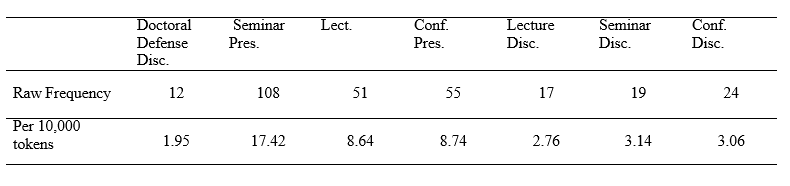
The normalized distribution of announcing the topic reveals a sharp functional divide between monologic presentation genres and interactive discussion settings. As shown in Table 7, Seminar Presentations display the corpus-wide peak frequency of topic announcements, reaching 17.42 instances per 10,000 tokens. This is followed by Conference Presentations (8.74 per 10,000 tokens) and Monologic Lectures (8.64 per 10,000 tokens). In these structured settings, speakers tend to rely heavily on explicit topic announcements (e.g., "Today I’d like to focus on...", "My main focus is...") to set the communicative agenda, signal transitions between sub-topics or visual slides, and provide clear macro-structural orientation for their audience. In contrast, we find that interactive discussion genres exhibit substantially lower reliance on explicit topic announcements. Normalized rates drop to 3.14 per 10,000 tokens in Seminar Discussions, 3.06 per 10,000 tokens in Conference Discussions, 2.76 per 10,000 tokens in Lecture Discussions, and reach a corpus-wide low in Doctoral Defense Discussions (1.95 per 10,000 tokens). Since discourse in dialogic settings could unforld through dynamic turn-taking, open floor management or examiner-driven questioning, participants may rarely need to formally announce topics. Instead, the findings show that conversational focus shifts fluidly in response to immediate interactive contributions rather than pre-planned thematic agendas.These results are consistent with those of Kashiha (2022), which show that announcing the topic appears in various modes with differing usage. Kashiha (2022) found that topic introduction was more frequent in university lectures due to their naturally topic-based structure, in which lecturers commonly employed it at the beginning of their speech to guide students. In a similar vein, Ädel (2010) discovered that, especially in academic discourse, the frequent announcement of the topic in lectures is an effectivetool for maintaining audience focus and engagement. However, as previously mentioned, the announcing of the topic occurs less frequently in interactive and discussion-based events such as conferences (24 times), seminars (19 times), lectures (17 times), and doctoral defenses (12 times). This lower frequency can be explained by the dynamic and less structured nature of discussions. Topic changes in these formats tend to occur naturally through conversation rather than being introduced explicitly.
4.5. Reviewing Across Speech Events
Reviewing describes a discourse strategy that draws attention to previous points and allows the audience to recall information that has already been discussed. This function enables maintaining the flow of the discourse by reminding the listeners of earlier discussions. This strengthens the links between ideas, allowing the audience to follow the logical progression of ideas as it minimizes repetition as shown below:
(20) that I explained earlier that’s the reason why I didn’t get back to that (Doctoral Defense Discussions 020)
(21) as as i pointed out earlier already er we we do not know exactly if if the unemployment goes down (Doctoral Defense Discussions 020)
(22) of course this has been taken as as being proved zone we talked about that earlier (Seminar Presentations 04E)
(23) participatory democracy where the UNIP was ruling party as I have mentioned before in December 90 1990 er president kaunda signed this legislation (Seminar Presentations 011A)
Table 8. Distribution of Reviewing across speech events (raw frequency & normalized rate per 10,000 tokens)
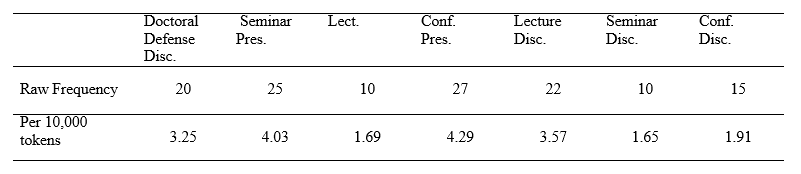
For Reviewing, as indicated earlier, the Chi-Square test yielded  . When evaluated against the Bonferroni-adjusted threshold (
  ), no formal statistical significance was reached. Consequently, cross-genre variations in Reviewing could be interpreted as a marginal and exploratory trend rather than a statistical difference. However, Table 8 with normalized distribution shows that the highest frequency of reviewing is found in Conference Presentations (4.29 per 10,000 tokens), implying that presenters refer back to earlier points to help ELF listeners from diverse linguacultural backgrounds follow the ongoing discourse. Relatively high rates of reviewing are also observed in Seminar Presentations (4.03 per 10,000 tokens) and Lecture Discussions (3.57 per 10,000 tokens), in which speakers use reviewing moves to link presentation points together and revisit notable concepts during interactive dialogue. Conversely, Monologic Lectures display a relatively low incidence of reviewing (1.69 per 10,000 tokens), suggesting that lecturers in this corpus may prefer introducing new subject matter over systematically reviewing prior knowledge. These findings suggest a pattern in which reviewing strategies appear to be used more frequently in specific settings to support coherence, reinforce arguments and improve mutual understanding tailored to the specific communicative demands of each academic event. In keeping with Molino’s (2018) findings, reviewing serves a valuable discourse-structuring function in academic speech, where personal pronouns (such as we) frequently function as retrospective signposts to hold audience attention. While Molino (2018) observed frequent reviewing in EMI lectures, the lower reliance on reviewing in the present ELFA lecture sample highlights potential genre variability, potentially indicating that conference and seminar presentation settings may demand more explicit retrospective scaffolding than standard monologic lectures.
4.6. Previewing Across Speech Events
Previewing draws the audience’s attention to upcoming content. It is a way for the speaker to indicate what the next topic of discussion will be. This will make the speech more structured and will be easier for the audience to follow. To put it another way, by clearly stating what will be discussed later, speakers establish a sense of continuity and coherence. For instance, in (24), ‘demographic transition, which I’ll explain later more closely’ (Lecture 020), the speaker tells the listeners that a detailed explanation will be provided. This allows the listeners to anticipate the critical points. Similarly, the speaker reduces possible confusion by assuring the audience that the subject will be covered in (25) by saying, ‘I will come into the content of that a little bit later on’ (Lecture 020A). The speaker employs previewing in (26), ‘so they did not give up although I will explain later in my presentation’ (Seminar Presentations 01A), to keep the audience interested and to ensure their focus remains on the details that will be discussed later. Likewise, in (27), the speaker reminds the audience of a particular point by saying, ‘they will have different start position for the next er I will come back here’ (Seminar Presentations 04E), which reinforces the structural flow of the discussion. Last but not least, in (28), ‘I want to say a little bit later something about the exports and the imports and the trade’ (Seminar Presentations 08B), the speaker helps the audience follow the flow of ideas by informing them of an upcoming focus on trade-related issues. As these examples demonstrate, by managing audience expectations and maintaining coherence throughout the speech, previewing contributes to regulating the flow of discourse.
(24) demographic transition which i’ll explain later more closely (Lecture 020)
(25) I’ll come into the content of that a little bit later on (Lecture 020A)
(26) so they didn’t gave up although I will explain later er in my presentation (Seminar presentations01A)
(27) they will have different start position for the next er I will come back here (Seminar presentations 04E)
(28) I want to say a little bit later something about the exports and the imports and the trade (Seminar presentations 08B)
Table 9. Distribution of Previewing across speech events (raw frequency & normalized rate per 10,000 tokens)
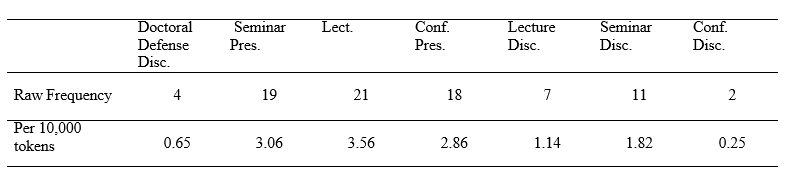
While previewing accounts for a relatively small proportion of metadiscourse overall (4.30%), inferential testing confirms that its distribution varies significantly across speech event types (χ² (6) = 35.24, p < .001). This statistically significant contrast implies a sharp functional divide; that is, monologic lectures (3.56 per 10,000) rely on forward-looking previewing to guide student expectations, whereas interactive discussions (0.25 per 10,000) dispense with pre-planned previews in favor of real-time adaptive talk. Table 9 above illustrates how the structural organization and communicative purpose of different academic speech events directly influence the reliance on previewing moves. Monologic Lectures seem to exhibit the highest normalized density across the corpus (3.56 per 10,000 tokens), as university lecturers may routinely employ forward-looking signposts (e.g., "In a moment, we will look at...", "I will return to this topic later...") to guide students through upcoming lecture content. It is obvious that noteworthy use is also sustained across formal presentation genres, including Seminar Presentations (3.06 per 10,000 tokens) and Conference Presentations (2.86 per 10,000 tokens), where presenters are expected to structure their ideas in advance to manage the overall logical flow. In contrast to this, previewing occurs considerably less frequently in interactive speech events. Normalized rates appear to decline to 1.82 per 10,000 tokens in Seminar Discussions and 1.14 per 10,000 tokens in Lecture Discussions (only 7 raw occurrences) followed by Doctoral Defense Discussions. We argue that such low frequency of previewing in interactive and defense contexts in time pressure could be attributed to some key contextual and communicative factors. Since spontaneous discussions, defense examinations and conference discussion sessions are driven by real-time turn-taking, reactive questioning and co-constructed dialogue, speakers may well operate under high online processing demands with little structural necessity or opportunity to outline upcoming discourse segments in advance.It is important to note that in ELF communication or in more interactive and spontaneous settings such as seminars or conference discussions, speakers often employ alternative strategies instead of directly previewing content in a structured way. Instead of directly stating what they will discuss (e.g., ‘I’m going to talk about...’), speakers may employ more flexible strategies to guide the conversation's flow. As needed, these may include reiterating key points, reformulating, or framing points like ‘what I mean is...’ and ‘let me clarify that point...’ to introduce or explain ideas. These substitutes still guide the audience through the discourse, but in a more direct way. Thus, the findings suggest that Previewing is not simply a low-frequency metadiscursive resource; instead, its low-frequency use appears to be particularly sensitive to the structural and interactional affordances of different academic speech events.
Taken together with the findings for Reviewing in 4.5 above, we suggest an interesting asymmetry between retrospective and prospective flow management in academic ELF communication. Reviewing, although more frequent overall, is relatively dispersed across speech events. Previewing, by contrast, is less frequent overall but shows substantially stronger cross-event variation, with its highest normalized rates occurring in Lectures, Seminar Presentations and Conference Presentations. We argue that such a pattern suggests that prospective discourse management may be particularly sensitive to the degree of pre-structuring afforded by a speech event; speakers in lectures and presentations can anticipate and signal upcoming discourse, whereas the trajectory of interactive discussions is more contingent on emerging turns and contributions. Retrospective reference, by comparison, may represent a more broadly available discourse-management resource since academic ELF speakers could refer back to prior discourse regardless of whether the interaction has been extensively pre-planned.
4.7. Concluding the Topic Across Speech Events
The speaker employs the feature of concluding the topic to bring a topic to a close. Thus, its usage lets the audience know that the main topic is changing or coming to an end. Speakers make it clear when a section is coming to an end to create a clear transition to the next or last phase of the discussion. For example, the speakers in the following examples employ MD markers, which signify closure or summary, to identify the end of the topic, such as ‘I’ll end there because of the time,’ ‘okay, so here are my concluding remarks,’ ‘I want to stress this point, erm, maybe as a conclusion to my presentation,’ ‘would like to make the final statements from the opponents’ side,’ ‘yes, and erm, now the last word, er, I would say that’ and ‘we finished paper; we are done.’
By making it more evident to the audience when a topic is coming to an end and getting them ready for a change in subject or closing remarks, these features aid in structuring the conversation. In particular, the use of phrases like ‘concluding remarks’ or ‘final statements’ indicates that the speaker is coming to an end, which strengthens the speech's organizational flow.
(29) I’ll end there because of the time. (Conf. Presentations 05J)
(30) okay so here are my concluding remarks erm (Conf. Presentations 06C)
(31) i want to stress this point, erm maybe as a conclusion to my presentation (Conf. Presentations 05J)
(32) would like to make the final statements from the opponents’ side. er <READING ALOUD> the dissertation of <NAME S1> lactic acid based on hot melt adhesive (Doctoral defense disc 010I)
(33) yes and er now the last word er i would say that (Lecture discussions 010)
(34) we finished <NAME S4>‘s paper we are done (Seminar discussions 04B)
Table 10. Distribution of Concluding Topic across speech events (raw frequency & normalized rate per 10,000 tokens)
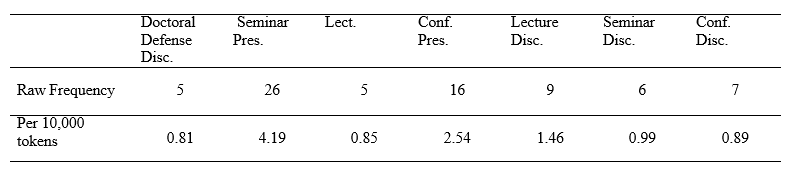
As shown in Table 10, the use of concluding the topic varies markedly according to speech event type. Even if concluding the topic is the least frequently employed metadiscursive feature overall across the corpus (averaging 1.66 instances per 10,000 tokens), it reaches its highest density in Seminar Presentations (4.19 per 10,000 tokens). A primary reason for this peak usage could be that student presenters in seminar settings may often need to mark explicit boundaries and provide clear transitions between distinct thematic sections. Conference Presentations also frequently employ topic closures (2.54 per 10,000 tokens), as structured, time-restricted presentations can require explicit topic wrap-ups before transitioning to the next slide or final conclusions. In interactive genres such as Lecture Discussions and Seminar Discussions, it often evolves organically from one comment to another without formal, pre-planned topic closures, reflecting the open-ended and turn-by-turn nature of spoken dialogue. Regarding lectures, tight time constraints and a primary pedagogical focus on introducing new material could often lead lecturers to move straight into incoming topics rather than formally closing preceding ones. Similar to this, in doctoral defenses, the discourse may be steered continuously by external examiner questions and ongoing critiques, reducing the opportunity or necessity for candidates to deliver formal topic-closing statements. As can be seen, one of the least used forms is found in doctoral defense discussions. The communicative norms of ELF interactions may explain the generally low frequency of explicit topic-concluding markers across genres. In ELF contexts, speakers often favor mutual intelligibility and adaptability over strict adherence to native-like discourse conventions (Seidlhofer, 2011). Thus, rather than employing explicit linguistic cues to indicate the end of a topic, they may use implicit strategies or non-verbal signals, such as pausing, changing their body posture, or ending the screen share. These multimodal resources may serve as functional equivalents to explicit metadiscourse, especially in spontaneous or interactive settings where flexibility and shared understanding take priority over formality. This finding is consistent with Cogo and Dewey's (2012) argument that ELF communication is often characterized by pragmatic strategies adapted to the communicative situation rather than predetermined linguistic forms.
5. Conclusion
This study set out to investigate how speakers of English as a Lingua Franca manage the flow of spoken academic discourse across various speech events through the use of MD features. The results, based on a detailed analysis of 83 texts, including monological and dialogical event types from the ELFA corpus, support the role of metadiscursive strategies in organizing real-time academic communication. By normalizing frequency counts to occurrences per 10,000 tokens and conducting weighted inferential Chi-Square, the findings demonstrate that metadiscourse deployment in ELF academic speech is genre-sensitive. To this end, the findings highlight the role of MD features, including enumeration, endophoric marking, contextualization, topic announcement, review, preview, and conclusion in managing the flow of academic discourse. Rather than operating as uniform discourse markers, metadiscourse features vary significantly according to the interactional structure and evaluative stakes of each speech event. Structured monologic presentation genres, particularly Seminar Presentations and Monologic Lectures, rely heavily on macro-structural topic announcements (up to 14.98 per 10,000 tokens) and forward-looking previewing (up to 4.30 per 10,000 tokens) to establish explicit communicative agendas for multilingual audiences. In contrast, we show that high-stakes evaluative settings such as Doctoral Defense Discussions display a distinct hybrid profile, exhibiting the corpus-wide peak rate for Enumerating (29.75 per 10,000 tokens) alongside substantial densities of Endophoric Marking (20.85 per 10,000 tokens) and Contextualizing (19.49 per 10,000 tokens). These findings point to noticeable variations in reflexive signposting across event types, where structural signposting and interactive flexibility vary by genre, consistent with broader accounts of metadiscourse as sensitive to disciplinary, rhetorical, and communicative context (Jiang and Akbaş, 2024). While this distribution could align with the idea that speakers adapt their language to contextual demands, it is important to emphasize that multiple contextual factors, including genre expectations, participant roles, evaluative relationships, audience composition and disciplinary conventions, may also contribute to these observed patterns.
Table 11. Visual Summary: Metadiscourse Functions Across ELF Speech Events
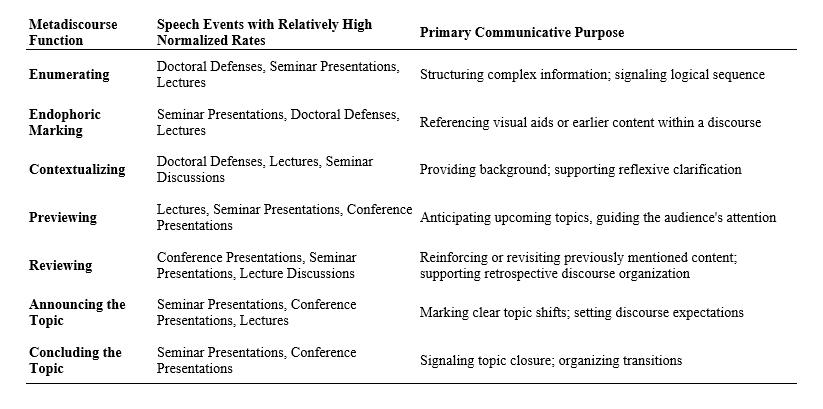
As shown in Table 11, the use of MD varies depending on the speech event, and the observed distributions appear to correspond to differences in the communicative and interactional organization of these events. Lectures, seminars, and conference presentations are examples of structured, monologic events that show relatively high rates of several sequencing and prospective resources, such as enumerating, previewing, and concluding the topic, to manage flow. It is particularly noteworthy that Doctoral Defense Discussions present a distinct hybrid profile within the ELF academic speech event continuum. Even though highly dialogic and interactive in nature, doctoral defenses share and, in some respects, exceed the structural signposting typical of monologic presentations. In interactive events, contextualizing appears particularly salient in some settings, while the distribution of reviewing is more variable across event types. Here, we can refer to the contrast between Previewing and Reviewing, as an example. Although Reviewing is more frequent overall (129 occurrences; 6.76%) than Previewing (82 occurrences; 4.30%), Reviewing shows comparatively weaker cross-event variation. Previewing, by contrast, is less frequent overall but shows a cross-event differentiation, χ²(6) = 35.24, p < .001, w = .656, with its highest normalized rates occurring in Lectures and presentation genres. We can argue that such a pattern suggests that prospective discourse management may be particularly sensitive to the degree of pre-structuring afforded by a speech event; speakers in lectures and presentations can anticipate and signal upcoming discourse, whereas the trajectory of interactive discussions is more contingent on emerging turns and contributions. The contrasting distributions of previewing and contextualizing across speech events suggest that ELF speakers draw on different discourse-organizing resources depending on the structural and interactional characteristics of the event, a pattern broadly consistent with previous observations on reflexive discourse organization in academic ELF communication (Akbaş and Hatipoğlu, 2018; Ädel, 2022; Jiang and Akbaş, 2024; Mauranen, 2007).
It is interesting to note that doctoral defenses present a hybrid profile showing a noteworthy distinction in how metadiscourse is employed. Although they are interactive in nature, they share some features with structured events, such as frequent use of endophoric marking and enumeration; however, they stand out in that they rarely employ topic announcements or closures. Instead, speakers frequently contextualize their responses, a pattern that may reflect the explanatory and evaluative demands of this genre. The interactionally contingent nature of doctoral-defense discourse in ELF settings has also been demonstrated by Çiftçi and Akbaş (2021), whose analysis of ELFA doctoral-defense discussions showed how speakers deploy linguistic resources dynamically to manage interpersonal and face-related demands during unfolding interaction. This genre-specific distribution supports the view that metadiscourse use can be sensitive to the communicative organization of particular academic speech events. Thus, this result supports the genre-sensitive claims made by Bernad-Mechó and Fortanet-Gómez (2019), demonstrating that certain academic occasions, such as defenses, may simultaneously combine formal, argumentative and interactive discourse demands. This type of hybridity can be consistent with the view that academic speech events may draw on overlapping discourse configurations rather than following straightforwardly to a binary distinction between monologic and dialogic genres.
Furthermore, the findings illustrate the functions of MD features in managing real-time spoken academic interaction. Metadiscourse features, which serve the functions of enumerating, endophoric marking, contextualizing, and announcing the topic, occurred more frequently in the current data, aligning with earlier work (Ädel, 2022; Molino, 2018), which points to the importance of these discourse organizers as central to the management of sequentiality and referential clarity. Among these, enumerating, in particular, may help break down complex content and present information in a logical sequence of steps. Similarly, contextualizing and announcing the topic can guide audience understanding by signaling structure, intent, or transitions, while endophoric marking connects different parts of discourse to enhance flow. In genres of academic speech where linear argumentation and content density are valued, these features may be especially prominent. We argue that their role is both organizational and potentially facilitative for audience orientation, particularly in ELF communication, as they provide listeners with cues that may assist the processing of discourse in linguistically diverse academic contexts.
These findings also allow the metadiscourse use in ELF academic discourse to be considered in relation to broader accounts of ELF communication. Previous research has characterized ELF interaction in terms of adaptability, mutual intelligibility as well as accommodation (Seidlhofer, 2011), and some of the present distributional patterns are compatible with such an account. However, our findings point more directly to variation associated with speech-event structure/types. In structured monologic events, such as lectures and presentations, sequencing and prospective functions (i.e., enumerating and previewing) appear to support linear organization and audience orientation. In contrast, more interactive events appear to show greater reliance on locally responsive resources such as contextualizing, although Reviewing is more broadly distributed and does not show robust cross-event differentiation under the Bonferroni-adjusted criterion. Hence, our findings suggest that the balance between prospective and retrospective discourse management varies with the structural and interactional affordances of the speech event. Moreover, it is likely that factors such as the speakers’ L1 background, disciplinary culture, power dynamics (as seen in doctoral defenses), and audience composition (e.g., mixed proficiency levels or diverse academic backgrounds) further influence how MD features are deployed. These variables offer fruitful directions for future research to build on the present findings.
The results of this study have significant implications for academic communication and teaching strategies, particularly in the context of English for Academic Purposes (EAP) classes. Our findings suggest that instruction in spoken academic metadiscourse could move beyond teaching individual markers to raising learners’ awareness of how discourse-management resources could vary according to communicative settings and purposes. For example, learners preparing for lectures or formal presentations may benefit from explicit attention to prospective resources such as previewing and topic announcement, whereas preparation for more interactive academic events could foreground locally responsive strategies such as contextualizing and retrospective reference. Educators can create role-playing exercises in EAP classes, for example, where students act as academic presenters or engage in discussions, focusing on the strategic use of these MD features. We believe that such activities could help learners develop a repertoire of discourse-management strategies that can be adapted to different academic speaking contexts rather than treating metadiscourse as a uniform set of expressions. The study's findings are significant not only for EAP courses but also for researchers attending international conferences, conducting research, and teaching. By becoming familiar with MD features, they can enhance their ability to manage discourse flow effectively.
6. Limitations and Directions for Future Research
While this study provides new empirical insights into reflexive metadiscourse across spoken ELF academic speech events, several methodological and contextual limitations should be acknowledged. The ELFA corpus was compiled primarily within Finnish university settings, with Finnish L1 speakers constituting 28.5% of the total participant pool. While ELFA represents authentic, highly international academic interactions, local institutional norms or dominant L1 transfer effects may influence spoken metadiscourse patterns. Replicating this study across ELF speech corpora from different geographic regions (e.g., Asian or Southern European higher education contexts) would help determine the cross-cultural generalizability of these findings. In addition, because the ELFA corpus consists of orthographic transcripts derived from audio recordings, this study focused exclusively on verbal metadiscourse features. While verbal references to visual aids (e.g., slides, handouts) were captured within categories such as endophoric marking, non-verbal visual resources (such as bodily gestures, gaze, and slide transitions) could not be systematically annotated. Future research utilizing video-recorded spoken corpora could adopt a multimodal framework to examine how non-verbal cues co-occur with verbal metadiscourse in spoken ELF contexts. Even though frequency counts were normalized to a standardized metric of occurrences per 10,000 tokens to correct for word-count variations, the number of individual speech events varies across genres in the ELFA corpus (ranging from 4 doctoral defense discussions to 21 conference presentations). Future research utilizing larger, more evenly balanced corpus samples could further examine genre-specific density. An additional statistical limitation concerns data nesting, as the 1909 metadiscourse instances are clustered within 83 speech-event transcripts with unequal distributions across genres (i.e., 4 doctoral defenses vs. 21 conference presentations). While token-level Chi-Square tests could offer a standard corpus-linguistic baseline (McEnery et al., 2006), treating individual tokens as strictly independent observations does not account for transcript-level clustering. We thus suggest future studies utilizing hierarchical linear modeling or mixed-effects regression on larger, balanced transcript samples would be valuable to isolate speaker-level as well as transcript-level variance.
Furthermore, a key methodological limitation of observational corpus-based frequency analysis is that variations across speech events establish structural patterns rather than proving underlying functional or cognitive motivations. While we could interpret these variations as potential functional responses to interactional settings, other contextual variables, such as disciplinary traditions, participant power dynamics, audience familiarity and individual speaker styles, may also influence metadiscourse density/frequency. Therefore, future research incorporating qualitative participant interviews, retrospective recall protocols, or multi-variate modeling would help further untangle such contributing factors.
Finally, a theoretical limitation concerns the granularity of the coding unit. This study adopted a fine-grained, micro-move unit of analysis (annotating individual metadiscursive expressions) rather than a broad macro-segment approach (coding extended discourse stretches as single moves). While micro-unit tagging reflects the real-time, iterative nature of spoken ELF discourse, where reformulations and successive signposts are frequent, it inherently results in higher raw frequency counts than macro-segmentation would yield. Because the micro-unit coding protocol was applied consistently across all subcorpora, cross-genre relative comparisons remain valid. However, research comparing micro-level expression counts against macro-level segment boundaries could offer additional new insights into metadiscoursal granularity in academic speech.
Statement on the Use of Generative AI: During the preparation of this manuscript, the authors used an AI-based language editing tool to assist with proofreading and improving the clarity and linguistic quality of the manuscript. The tool was used solely for language refinement and did not contribute to the conceptualisation, analysis, or interpretation of the data. All content, arguments, and conclusions remain the responsibility of the authors (Gemini, 2.0 & 2.5, https://gemini.google.com). We also acknowledge that during the preparation of revisions, the author(s) used Grammarly, ChatGPT 5.6 and Gemini 3.7 only to improve the readability and grammatical accuracy of the manuscript. The author reviewed and verified the final content and takes full responsibility for the accuracy, interpretation and conclusions presented in the manuscript.
Thanks
This article is derived from the first author’s unpublished thesis under the supervision of the second author, submitted in 2025. The content has been revised and extended for the purposes of this article. We would also like to thank the Proofreading & Editing Office of the Dean for Research at Erciyes University for additional copyediting and the proofreading services that assisted with this manuscript.















Reference lists
Ädel, A. (2006). Metadiscourse in L1 and L2 English, John Benjamins Publishing Company. https://doi.org/10.1075/scl.24(In English)
Ädel, A. (2010). Just to give you kind of a map of where we are going: A taxonomy of metadiscourse in spoken and written academic English. Nordic Journal of English Studies, 9 (2), 69–97. https://doi.org/10.35360/njes.218(In English)
Ädel, A. (2012). “What I want you to remember is…”: Audience orientation in monologic academic discourse, English Text Construction, 5 (1), 69–97. https://doi.org/10.1075/etc.5.1.06ade(In English)
Ädel, A. (2022). Adopting a ‘move’ rather than a ‘marker’ approach to metadiscourse: A taxonomy for spoken student presentations, English for Specific Purposes, 69, 4–18. https://doi.org/10.1016/j.esp.2022.09.001(In English)
Ädel, A. and Mauranen, A. (2010). Metadiscourse: Diverse and divided perspectives, Nordic Journal of English Studies, 9 (2), 1–11. https://doi.org/10.35360/njes.215(In English)
Aertselaer, J. A. and Dafouz-Milne, E. (2008). Argumentation patterns in different languages: An analysis of metadiscourse markers in English and Spanish texts, In Contrastive rhetoric: Approaches to contrastive linguistics, De Gruyter, 87–102. https://doi.org/10.1515/9783110207217.1.87(In English)
Akbaş, E. (2012). Exploring metadiscourse in master’s dissertation abstracts: Cultural and linguistic variations across postgraduate writers, International Journal of Applied Linguistics and English Literature, 1 (1), 12–21. https://doi.org/10.7575/ijalel.v.1n.1p.12(In English)
Akbaş, E. and Hatipoğlu, Ç. (2018). Metadiscourse variations across academic genres: Rhetorical preferences in textual and interpersonal markers, Educational Sciences: Theory & Practice, 18 (4), 767–775. (In English)
Akbaş, E., Hatipoğlu, Ç. and Bayyurt, Y. (2017). Metadiscourse in written genres: Uncovering textual and interactional aspects of texts, Peter Lang. (In English)
Bell, A. (1984). Language style as audience design, Language in Society, 13 (2), 145–204. https://doi.org/10.1017/S004740450001037X(In English)
Bernad-Mechó, E. (2024). Building successful communication in EMI contexts: A multimodal approach to organizational metadiscourse in intercultural lectures, Chinese Journal of Applied Linguistics, 47 (2), 259–280. https://doi.org/10.1515/CJAL-2024-0206(In English)
Bernad-Mechó, E. and Fortanet-Gómez, I. (2019). Organizational metadiscourse across lecturing styles: Engagement beyond language. In Engaging in the language learning process, John Benjamins, 301–317. https://doi.org/10.1075/pbns.301.17ber(In English)
Björkman, B. (2009). From code to discourse in spoken ELF, in A. Mauranen (Ed.), English as a lingua franca: Studies and findings, Cambridge Scholars Publishing, 225–254. (In English)
Björkman, B. (2011). English as a lingua franca in higher education: Implications for EAP, Iberica, 22, 79–100. (In English)
Bondi, M. (2010). Metadiscursive practices in introductions: Phraseology and semantic sequences across genres, Nordic Journal of English Studies, 9 (2), 99–123. https://doi.org/10.35360/njes.219(In English)
Bouziri, B. (2020). Topic signaling metadiscourse devices in the Tunisian lecture corpus. ESP Today, 8 (2), 227–249. https://doi.org/10.18485/esptoday.2020.8.2.3(In English)
Broggini, S. and Murphy, A. C. (2017). Metadiscourse in EMI lectures: Reflections on a small corpus of spoken academic discourse. L’analisi linguistica e letteraria, 25 (2 Supplement). (In English)
Cogo, A. and Dewey, M. (2012). Analysing English as a lingua franca: A corpus-driven investigation, Continuum. (In English)
Crismore, A., Markkanen, R. and Steffensen, M. (1993). Metadiscourse in persuasive writing: A study of texts written by American and Finnish university students, Written Communication, 10 (1), 39–71. https://doi.org/10.1177/0741088393010001002(In English)
Çiftçi, H. and Akbaş, E. (2021). Stancetaking in spoken ELF discourse in academic settings: interpersonal functions of I don’t know as a face-maintaining strategy, Eurasian Journal of Applied Linguistics, 7 (1), 484–502. https://doi.org/10.32601/ejal.911499(In English)
Dafouz, E. and Perucha, B. (2010). Metadiscursive devices in university lectures, in Academic and professional discourse genres in Spanish, John Benjamins, 193–210. https://doi.org/10.1075/aals.7.11daf(In English)
Dahl, T. (2004). Textual metadiscourse in research articles: A marker of national culture or of academic discipline?, Journal of Pragmatics, 36 (10), 1807–1825. https://doi.org/10.1016/j.pragma.2004.05.004(In English)
Dewey, M. (2009). English as a lingua franca: Heightened variability and theoretical implications, in A. Mauranen (Ed.), English as a lingua franca: Studies and findings, Cambridge Scholars Publishing, 60–83. (In English)
Doiz, A. and Lasagabaster, D. (2022). Metadiscourse in English-medium instruction: Teachers’ reflections and implementation, System, 105, 102738. https://doi.org/10.1016/j.system.2022.102738(In English)
Gnutzmann, C. and Intemann, F. (2008). Introduction: The globalisation of English. Language, politics and the English language classroom, in C. Gnutzmann and F. Intemann (Eds.), The globalisation of English and the English language classroom, Narr, 9–24. (In English)
Graddol, D. (2006). English next: Why global English might mean the end of ‘English as a foreign language’, The English Company (UK) Ltd. British Council, available at: http://www.britishcouncil.org/learning-research-english-next.pdf (Accessed 15.09.2026) (In English)
House, J. (1996). Developing pragmatic fluency in English as a foreign language: Routines and metapragmatic awareness. Studies in Second Language Acquisition, 18 (2), 225–252. https://doi.org/10.1017/S0272263100014893(In English)
House, J. (2010). The pragmatics of English as a lingua franca. In A. Trosborg (Ed.), Handbook of pragmatics, De Gruyter, 363–387. (In English)
Hyland, K. (2005). Metadiscourse: Exploring interaction in writing, Continuum. (In English)
Hyland, K. and Jiang, F. (2018). "In this paper we suggest": Changing patterns of disciplinary metadiscourse. English for Specific Purposes, 51, 18–30. https://doi.org/10.1016/j.esp.2018.02.001(In English)
Hyland, K. and Tse, P. (2004). Metadiscourse in academic writing: A reappraisal. Applied Linguistics, 25 (2), 156–177. https://doi.org/10.1093/applin/25.2.156(In English)
Jenkins, J. (2009). (Un)pleasant? (In)correct? (Un)intelligible? ELF speakers’ perceptions of their accents, in A. Mauranen (Ed.), English as a lingua franca: Studies and findings, Cambridge Scholars Publishing, 254–278. (In English)
Jenkins, J. (2013). English as a lingua franca in the international university: The politics of academic English language policy, Routledge. https://doi.org/10.4324/9780203798157(In English)
Jiang, F. and Akbaş, E. (2024). Metadiscourse in a disciplinary context: An overview, Chinese Journal of Applied Linguistics, 47 (2), 163–177. (In English)
Jokić, N. (2017). Metadiscourse in ELF spoken discourse of Erasmus students in Austria. AAA: Arbeiten aus Anglistik und Amerikanistik, 42 (2), 211–223. http://www.jstor.org/stable/26379472(In English)
Kashiha, H. (2022). Academic lectures versus political speeches: Metadiscourse functions affected by the role of the audience, Journal of Pragmatics, 190, 60–72. https://doi.org/10.1016/j.pragma.2022.01.003(In English)
Kaur, J. (2009). Pre-empting problems of understanding in English as a lingua franca, in A. Mauranen (Ed.), English as a lingua franca: Studies and findings, Cambridge Scholars Publishing, 107–123. (In English)
Kawase, T. (2015). Metadiscourse in the introductions of PhD theses and research articles. Journal of English for Academic Purposes, 20, 114–124. https://doi.org/10.1016/j.jeap.2015.08.004(In English)
Landis, J. R. and Koch, G. G. (1977). An application of hierarchical kappa-type statistics in the assessment of majority agreement among multiple observers, Biometrics, 363–374. (In English)
Lee, J. J. and Subtirelu, N. (2015). Metadiscourse in the classroom: A comparative analysis of EAP lessons and university lectures, English for Specific Purposes, 37, 52–62. https://doi.org/10.1016/j.esp.2014.08.005(In English)
Luukka, R. (1994). Metadiscourse in academic texts, in B. L. Gunnarsson, P. Linell and B. Nordberg (Eds.), Text and talk in professional contexts, ASLA, 77–88. (In English)
Magnucz, Á. (2012). Are you with me? A metadiscursive analysis of interactive strategies in college students’ course presentations, International Journal of English Studies, 12 (1), 55-78. https://doi.org/10.6018/ijes.12.1.118281(In English)
Mauranen, A. (1993). Contrastive ESP rhetoric: Metatext in Finnish-English economic text, English for Specific Purposes, 12 (1), 3–22. https://doi.org/10.1016/0889-4906(93)90024-I(In English)
Mauranen, A. (2001). Reflexive academic talk: Observations from MICASE. In Corpus linguistics in North America: Selections from the 1999 symposium, University of Michigan Press, 165–178. (In English)
Mauranen, A. (2005). English as lingua franca: An unknown language?, Nordic Journal of English Studies, 4 (2), 269–293. (In English)
Mauranen, A. (2006a). A rich domain of ELF: The ELFA corpus of academic discourse, Nordic Journal of English Studies, 5 (2), 145–159. https://doi.org/10.35360/njes.15(In English)
Mauranen, A. (2006b). Signaling and preventing misunderstanding in English as lingua franca communication, International Journal of the Sociology of Language, 2006 (177), 123–150. https://doi.org/10.1515/IJSL.2006.008(In English)
Mauranen, A. (2007). Hybrid voices: English as the lingua franca of academics, in K. Fløttum (Ed.), Language and discipline perspectives on academic discourse, Cambridge Scholars Publishing, 243–257. (In English)
Mauranen, A. (2009). Spoken rhetoric, in Rhetoric in detail, John Benjamins, 275–298. https://doi.org/10.1075/pbns.193.13mau(In English)
Mauranen, A. (2010). Discourse reflexivity: A discourse universal? The case of ELF, Nordic Journal of English Studies, 9 (2), 13–40. https://doi.org/10.35360/njes.216(In English)
Mauranen, A., Hynninen, N. and Ranta, E. (2020). English as an academic lingua franca, in J. Jenkins, W. Baker and M. Dewey (Eds.), The Routledge handbook of English as a lingua franca, Routledge, 200–213. (In English)
Mauranen, A. and Pérez-Llantada, C. and Swales, J. (2010). Academic Englishes: A standardised knowledge?, in English as an academic lingua franca, De Gruyter, 19–34. (In English)
Mauranen, A. and Ranta, E. (2008). English as an academic lingua franca, Nordic Journal of English Studies, 7 (3), 1–10. (In English)
McArthur, T. (2002). The Oxford guide to world English, Oxford University Press. (In English)
McEnery, T., Xiao, R. and Tono, Y. (2006). Corpus-based language studies: An advanced resource book, Routledge. (In English)
McHugh, M. L. (2012). Interrater reliability: the kappa statistic, Biochemia medica, 22 (3), 276–282. (In English)
Molino, A. (2018). “What I’m speaking is almost English…”: A corpus-based study of metadiscourse in English-medium lectures at an Italian university, Educational Sciences: Theory and Practice, 18 (4), 1–15. https://doi.org/10.12738/estp.2018.4.0330(In English)
Mur-Dueñas, P. (2011). An intercultural analysis of metadiscourse features in research articles written in English and in Spanish, Journal of Pragmatics, 43 (12), 3068–3079. https://doi.org/10.1016/j.pragma.2011.05.002(In English)
O’Donnell, M. (2008). The UAM CorpusTool: Software for corpus annotation and exploration. In C. M. Bretones Callejas et al. (Eds.), Applied linguistics now: Understanding language and mind, Universidad de Almería, 1433–1447. (In English)
Penz, H. (2017). Metadiscourse in multi-party conflict talk, AAA: Arbeiten aus Anglistik und Amerikanistik, 42 (2), 301–323. http://www.jstor.org/stable/26379476(In English)
Pérez-Llantada, C. (2010). The discourse functions of metadiscourse in published academic writing: Issues of culture and language, Nordic Journal of English Studies, 9 (2), 41–68. (In English)
Pickering, L. (2006). Current research on intelligibility in English as a lingua franca, Annual Review of Applied Linguistics, 26, 219–233. https://doi.org/10.1017/S0267190506000110(In English)
Rowley-Jolivet, E. and Carter-Thomas, S. (2005). Genre awareness and rhetorical appropriacy: Manipulation of information structure by NS and NNS scientists in the international conference setting, English for Specific Purposes, 24 (1), 41–64. https://doi.org/10.1016/j.esp.2003.09.003(In English)
Rubio, M. M. (2011). A pragmatic approach to the macro-structure and metadiscoursal features of research article introductions in the field of agricultural sciences, English for Specific Purposes, 30 (4), 258–271. https://doi.org/10.1016/j.esp.2011.04.002(In English)
Seidlhofer, B. (2004). Research perspectives on teaching English as a lingua franca, Annual Review of Applied Linguistics, 24, 209–239. https://doi.org/10.1017/S0267190504000145(In English)
Seidlhofer, B. (2011). Understanding English as a lingua franca, Oxford University Press.
Sifakis, N. (2014). ELF awareness as an opportunity for change: A transformative perspective for ESOL teacher education, Journal of English as a Lingua Franca, 3 (2), 317–335. https://doi.org/10.1515/jelf-2014-0019(In English)
Swales, J. M. (1990). Genre analysis: English in academic and research settings, Cambridge University Press. (In English)
Thompson, S. (2003). Text-structuring metadiscourse, intonation and the signalling of organisation in academic lectures, Journal of English for Academic Purposes, 2 (1), 5–20. https://doi.org/10.1016/S1475-1585(02)00036-X(In English)
Vande Kopple, W. J. (1985). Some explanatory discourse on metadiscourse, College Composition and Communication, 36 (1), 82–93.
Vettorel, P. (2018). ELF and communication strategies: Are they taken into account in ELT materials? RELC Journal, 49 (1), 58–73. https://doi.org/10.1177/0033688217746204(In English)
Warren, M. (2006). Features of naturalness in conversation, John Benjamins. https://doi.org/10.1075/pbns.152(In English)
Zare, J. and Tavakoli, M. (2015). Frequency and diversity of personal metadiscourse across monologic and dialogic modes of academic speech. Journal of English for Academic Purposes, 20, 1–12. https://doi.org/10.1016/j.jeap.2015.05.003(In English)
Zhu, Y. (2018). An intercultural analysis of personal metadiscourse in English and Chinese commencement speeches. Advances in Language and Literary Studies, 9 (5), 100–110. https://doi.org/10.7575/aiac.alls.v.9n.5p.100(In English)