

Post-Relativism as a New Paradigm in Linguistics: A Bibliometric Review
The relevance of the study is determined by the emergence of post-relativism as a new scientific paradigm in modern linguistics. This approach, originating at the turn of the 21st century, offers a fundamentally different perspective on the relationship between language, thought and culture. As a response to the limitations of classical universalism and neo-relativism, post-relativism highlights the need for an integrated study of cognitive processes within an authentic socio-cultural context. That makes a comprehensive analysis of its current state and development prospects particularly pertinent.
The problem is that despite the growing number of theoretical and empirical studies devoted to the linguistic relativity principle, there is no substantiated understanding of postrelativism’s structure in terms of its constituent disciplines, its core and periphery, nor the correspondence between current research and the theoretical claims about its interdisciplinarity.
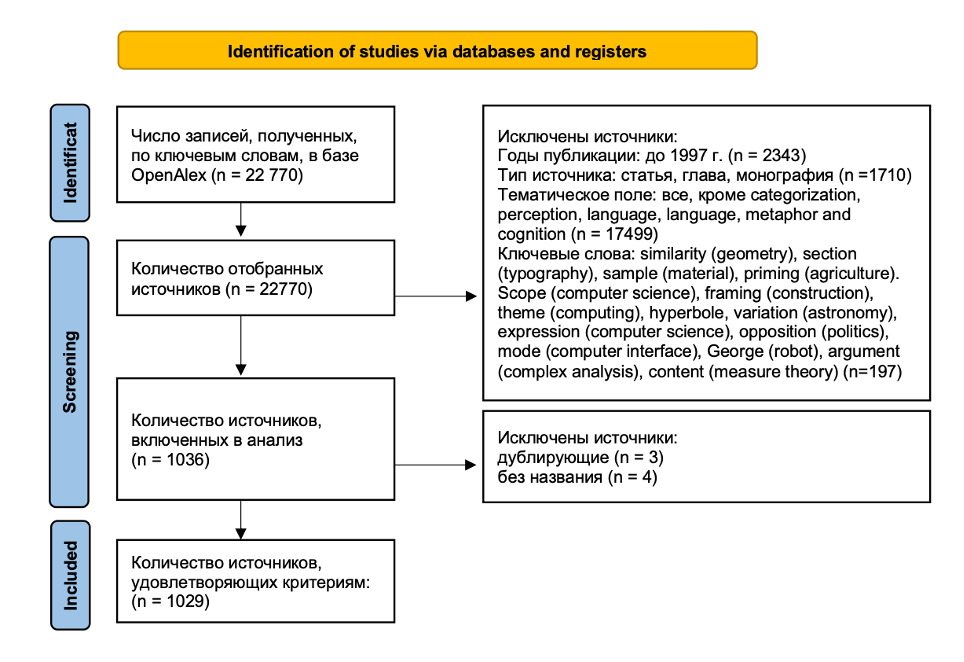
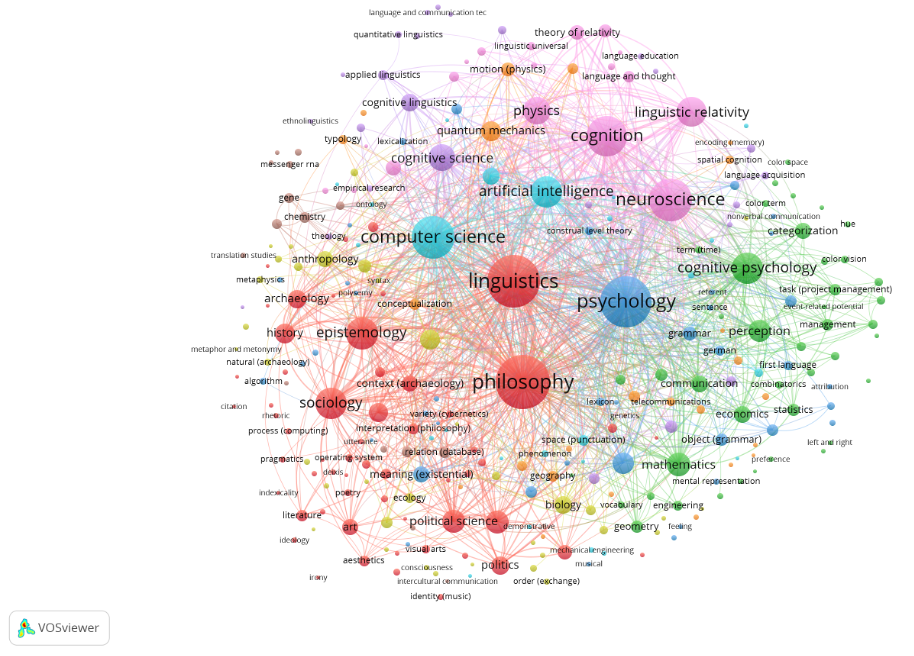
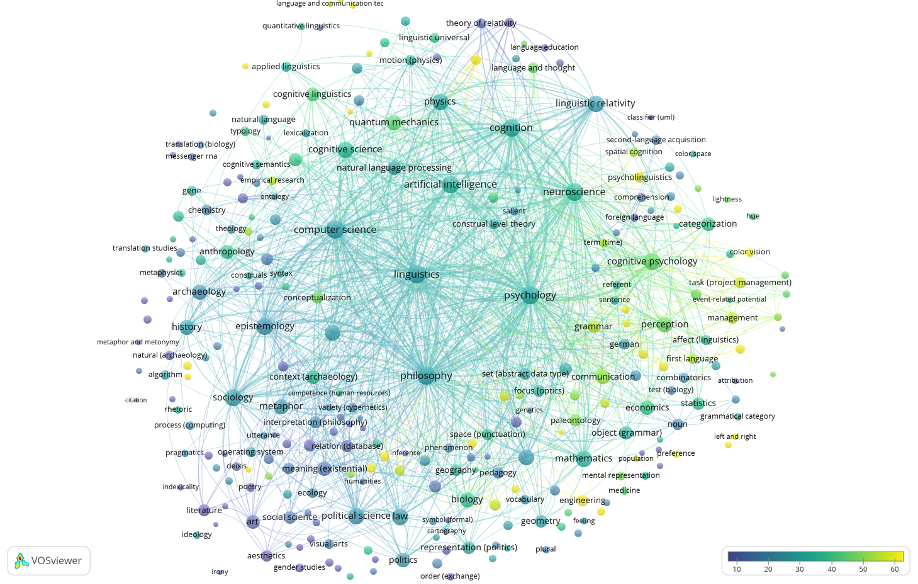
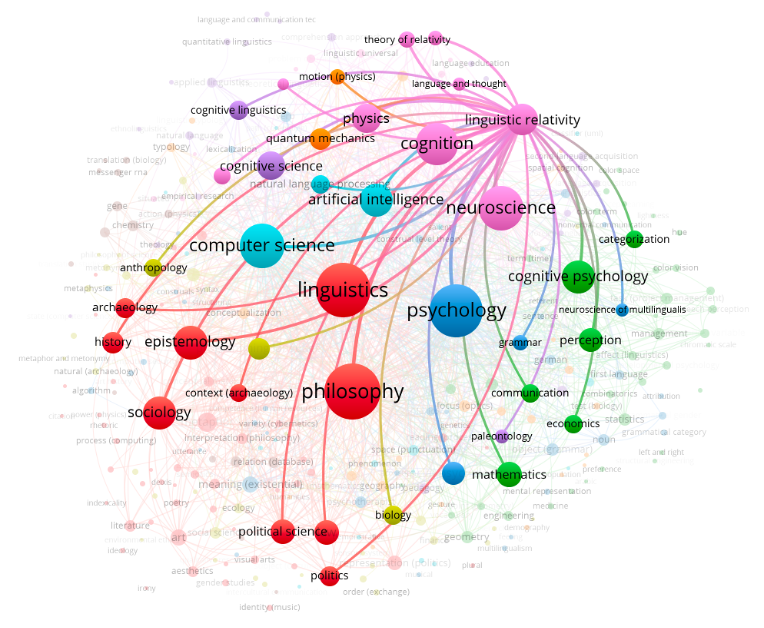
The aim of this paper is to verify the process of postrelativism’s formation as a scientific paradigm through bibliometric analysis. In accordance with the PRISMA protocol, a dataset of 1029 relevant publications from 1998 to 2024 were compiled based on the OpenAlex database. Data visualization and analysis, including co-citation analysis and keyword co-occurrence mapping (using concepts algorithmically generated by OpenAlex) to identify the conceptual structure of the field, were performed using VOSviewer software.
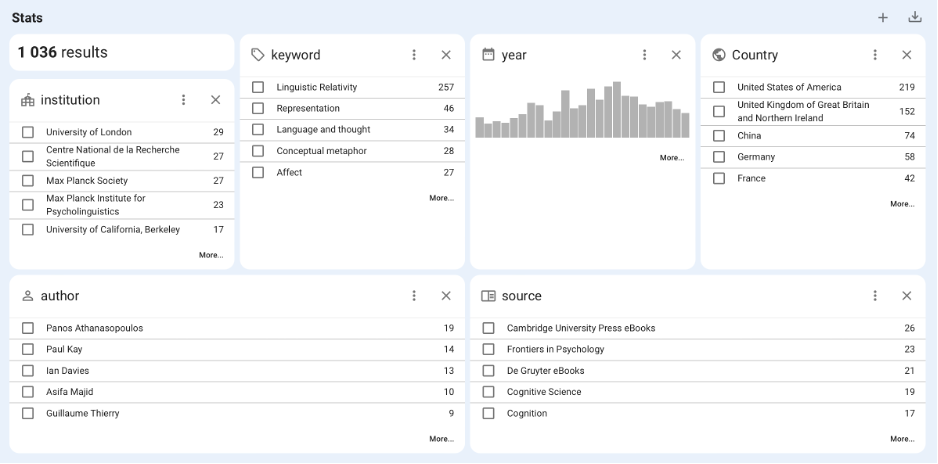
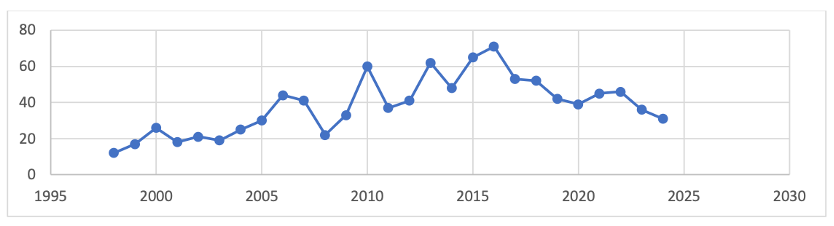
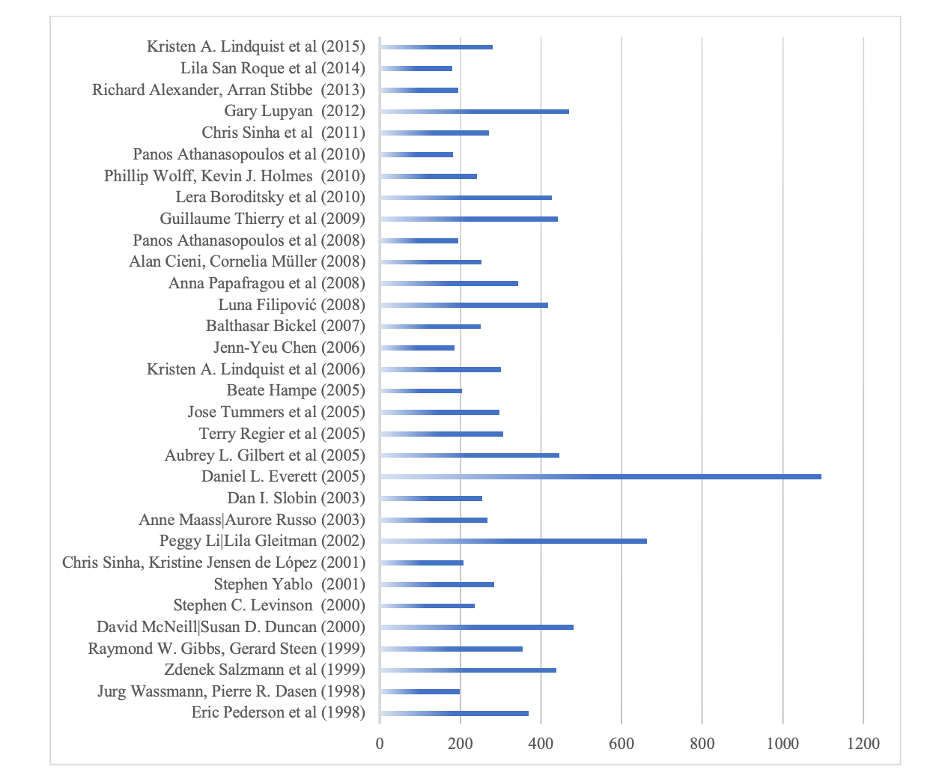
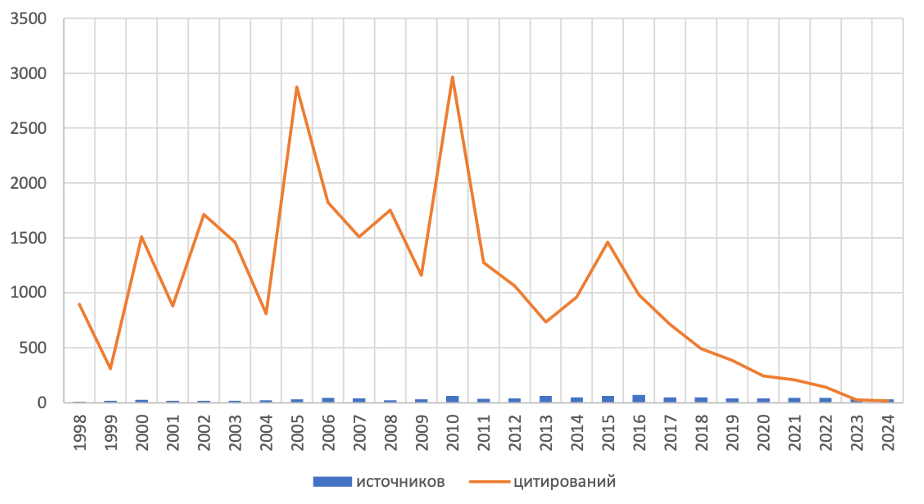
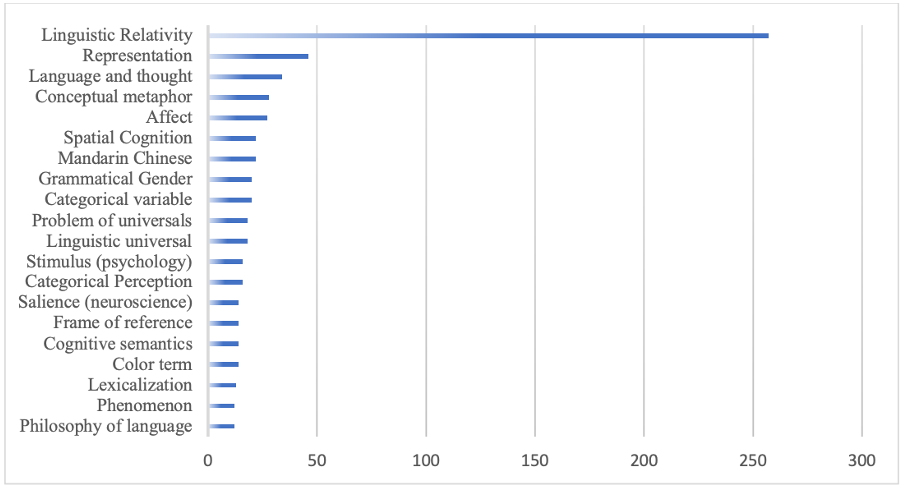
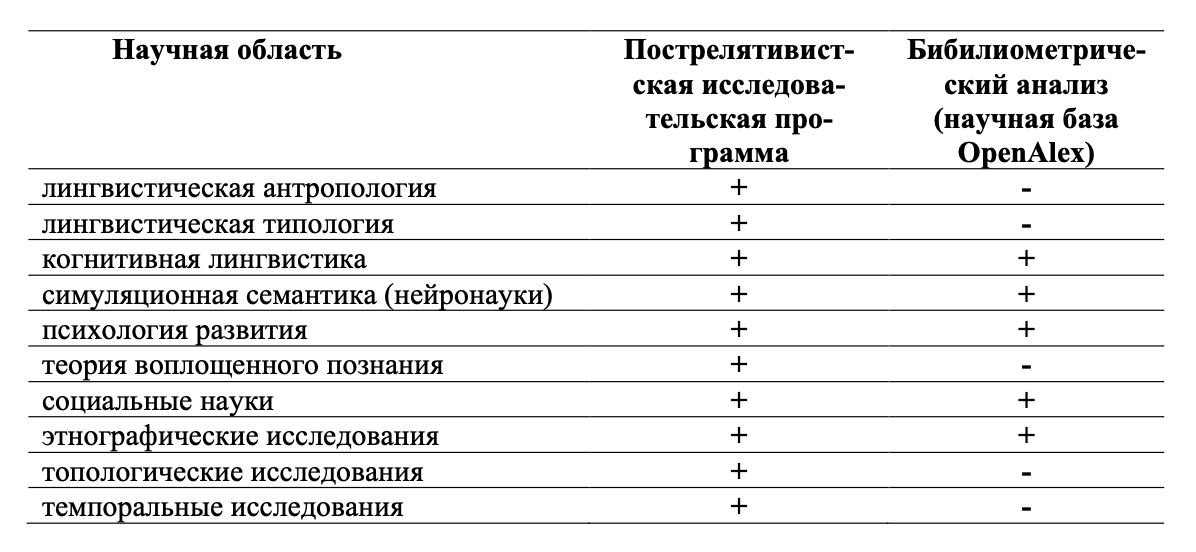
The study resulted in identifying the most productive authors (P. Athanasopoulos, P. Kay), influential journals (Frontiers in Psychology, Cognitive Science, Cognition), and key research centers. Conceptual network analysis and mapping revealed that the core of the field consists of cognitive linguistics, psycholinguistics, and neuroscience, while linguistic typology, anthropology, and embodied cognition theory remain on the periphery. The interdisciplinary thesis is partially confirmed, as linguistic relativity is most prominently represented in this dataset in papers related to philosophy of language, psychology and computer science. A peak in the field activity was established (2016), followed by a decline, which is interpreted as a possible transformation of the research landscape requiring (considering the algorithmic nature of OpenAlex data) further qualitative analysis.
The analysis confirms the emergence of post-relativism, but points to the unevenness of its development, both in terms of interdisciplinarity and its alignment with the theoretical program. The obtained results not only describe the current state of the field but also clearly outline its promising directions, the exploration of which will contribute to the establishment of post-relativism as one of the leading research programs in modern linguistics.
Figures
Glukhova, O. V. (2026). Post-Relativism as a New Paradigm in Linguistics: A Bibliometric Review, Research Result. Theoretical and Applied Linguistics, 12 (1), 67–89.
















While nobody left any comments to this publication.
You can be first.
Borodai, S. Yu. (2019). Language and cognition: a post-relativist research program, Voprosy Yazykoznaniya, (4), 106–136. (In Russian)
Borodai, S. Yu. (2020). Yazyk i poznaniye: Vvedeniye v postrelyativizm [Language and Cognition: An Introduction to Post-Relativism], Sadra; LRC Publishing House, Moscow, Russia. (In Russian)
Borodai, S. Yu. (2023). Language and cognition: a post-relativist research program, in Smirnov, A.V. (ed.), Osoznat smysl, osmyslit soznaniye: manifest Drugoy filosofii [To Realize the Meaning, to Comprehend Consciousness: A Manifesto of Another Philosophy], Sadra, Moscow, Russia, 213–263. (In Russian)
Barsalou, L., Santos, A., Simmons, W. and Wilson, C. D. (2008). Language and simulation in conceptual processing, Symbols, Embodiment, and Meaning, eds M. De Vega, A. M. Glenberg, and A. C. Graesser (Oxford. UK: Oxford University Press), 245–284. (In English)
Blasi, D. E., Henrich, J., Adamou, E., Kemmerer, D. and Majid, A. (2022). Over-reliance on English hinders cognitive science. Trends in Cognitive Sciences, 26(12), 1153–1170. https://doi.org/10.1016/j.tics.2022.09.015(In English)
Dixon, R. M. W. (1972). The Dyirbal language of North Queensland (1. publ). Cambridge Univ. Press. (In English)
Everett, D. L. (2005). Cultural Constraints on Grammar and Cognition in Pirahã: Another Look at the Design Features of Human Language. Current Anthropology, 46(4), 621–646. https://doi.org/10.1086/431525(In English)
Glukhova, O.V. (2025). Cognitive typology in linguistic diversity issues: A bibliometric review using PRISMA protocol and VOSviewer. In Book of abstracts. 17th international cognitive linguistics conference "discourse, culture, and cognition". Audisio, C.P. & the 17th ICLC Organizing Committee (eds.). Buenos Aires, Argentina, 300–302 [Online], available at: https://iclc17.com/book-of-abstracts/ (Accessed 20.12.2025) (In English)
Glukhova, O. and Dekhnich, O. (2025). Cognitive typology matters: A bibliometric review using Prisma protocol and VOSviewer. Lege Artis. Language Yesterday, Today, Tomorrow., Vol. X, Issue 2, 73–91. https://doi.org/10.34135/lartis.25.10.2.05(In English)
Gumperz, J. J. and Levinson, S. C. (1996). Rethinking Linguistic Relativity. Cambridge University Press [Online], available at: https://books.google.ru/books?id=dPXvxgL2t1oC (Accessed 20.12.2025) (In English)
Gutchess, A. and Rajaram, S. (2023). Consideration of culture in cognition: How we can enrich methodology and theory, Psychonomic Bulletin & Review, 30 (3), 914–931. https://doi.org/10.3758/s13423-022-02227-5(In English)
Ishii, K. (2013). Culture and the mode of thought: A review. Asian Journal of Social Psychology, 16 (2), 123–132. https://doi.org/10.1111/ajsp.12011(In English)
Lakoff, G. (1987). Women, fire and dangerous things: what categories reveal about the mind. University of Chicago press.
Langacker, R. W. (1976). Semantic Representations and the Linguistic Relativity Hypothesis. Foundations of Language, 14(3), 307–357 [Online], available at: http://www.jstor.org/stable/25170064 (Accessed 30.10.2025). (In English)
Lee, P. (1996). The Whorf Theory Complex: A critical reconstruction (Vol. 81). John Benjamins Publishing Company. https://doi.org/10.1075/sihols.81(In English)
Levinson, S. C. (2003). Space in Language and Cognition: Explorations in Cognitive Diversity (1st edn). Cambridge University Press. https://doi.org/10.1017/CBO9780511613609 (In English)
Li, P. and Gleitman, L. (2002). Turning the tables: language and spatial reasoning, Cognition, 83 (3), 265–294. https://doi.org/10.1016/S0010-0277(02)00009-4(In English)
Lucy, J. A. (1992). Grammatical Categories and Cognition: A Case Study of the Linguistic Relativity Hypothesis (1st edn). Cambridge University Press. https://doi.org/10.1017/CBO9780511620713(In English)
Lucy, J. A. (1996). Language diversity and thought: a reformulation of the linguistic relativity hypothesis (Reprint). Cambridge Univ. Press. 1992a. (In English)
Lucy J. (1996a) The scope of linguistic relativity: an analysis and review of empirical research, in J. Gumperz, S. Levinson (Eds), Rethinking linguistic relativity, 37–69. (In English)
Lucy, J. A. (1997). Linguistic Relativity. Annual Review of Anthropology, 26, 291–312. JSTOR [Online], available at: http://www.jstor.org/stable/2952524 (Accessed 30.10.2025). (In English)
Lupyan, G. (2012). Linguistically Modulated Perception and Cognition: The Label-Feedback Hypothesis. Frontiers in Psychology, 3. https://doi.org/10.3389/fpsyg.2012.00054(In English)
McNeill, D. and Duncan, S. D. (2000). Growth points in thinking-for-speaking. In D. McNeill (Ed.), Language and Gesture (1st edn, pp. 141–161). Cambridge University Press. https://doi.org/10.1017/CBO9780511620850.010(In English)
Peirce C.S. (1966). Collected Papers of Charles Sanders Peirce. Burks AW, editor. Cambridge, Massachusets. Vols. 7–8. (In English)
Rosch, E. and Lloyd, B. B. (Eds). (1978). Cognition and categorization: Conference. Lawrence Erlbaum Associates. (In English)
Samuel, S., Cole, G. and Eacott, M. J. (2019). Grammatical gender and linguistic relativity: A systematic review. Psychonomic Bulletin & Review, 26 (6), 1767–1786. https://doi.org/10.3758/s13423-019-01652-3(In English)
Sapir, E. (1921). Language, an introduction to the study of speech. New York : Harcourt, Brace and Company [Online], available at: http://archive.org/details/languageanintrod00sapi (Accessed 30.10.2025) (In English)
Slobin, D. I. (1996). From "thought and language" to "thinking for speaking." J. J. Gumperz and S. C. Levinson (Eds.), Rethinking linguistic relativity, Cambridge University Press. (Reprinted in modified form from "Pragmatics," 1, 1991, pp. 7–26) 70–96. (In English)
Talmy, L. (1983). How Language Structures Space. In H. L. Pick and L. P. Acredolo (Eds), Spatial Orientation: Theory, Research, and Application (pp. 225–282). Springer US. https://doi.org/10.1007/978-1-4615-9325-6_11 (In English)
Thierry, G. (2016). Neurolinguistic Relativity: How Language Flexes Human Perception and Cognition. Language Learning, 66(3), 690–713. https://doi.org/10.1111/lang.12186(In English)
Page, M. J., Moher, D., Bossuyt, P. M., Boutron, I., Hoffmann, T. C., Mulrow, C. D., Shamseer, L., Tetzlaff, J. M., Akl, E. A., Brennan, S. E., Chou, R., Glanville, J., Grimshaw, J. M., Hróbjartsson, A., Lalu, M. M., Li, T., Loder, E. W., Mayo-Wilson, E., McDonald, S., … McKenzie, J. E. (2021). PRISMA 2020 explanation and elaboration: updated guidance and exemplars for reporting systematic reviews. BMJ, n160. https://doi.org/10.1136/bmj.n160(In English)
Priem, J., Piwowar, H. and Orr, R. (2022). OpenAlex: A fully-open index of scholarly works, authors, venues, institutions, and concepts. arXiv. https://doi.org/10.48550/ARXIV.2205.01833(In English)
Van Eck, N. J. and Waltman, L. (2014). Visualizing Bibliometric Networks. In Y. Ding,
R. Rousseau and D. Wolfram (Eds), Measuring Scholarly Impact (pp. 285–320). Springer International Publishing. https://doi.org/10.1007/978-3-319-10377-8_13(In English)
Van Eck, N. J. (2024). Classification of research publications based on data from OpenAlex (Version 2023nov) [dataset]. Zenodo. https://doi.org/10.5281/zenodo.10560276(In English)
Whorf, B. L. (1941). The Relation of Habitual Thought and Behaviour to Language. Language, culture, and personality. Menasha. Wis.: Sapir Memorial Publication Fund, 75–93. (In English)
Whorf, B. L. and Carroll, J. B. (1956). Language, Thought, and Reality: Selected Writings of Benjamin Lee Whorf. M.I.T. Press, available at: https://books.google.kz/books?id=W2d1Q4el00QC (Accessed 30.10.2025). (In English)