

Move-Step Structures in English vs. Persian Research-Article Abstracts Across Three Disciplines (2022-2024)
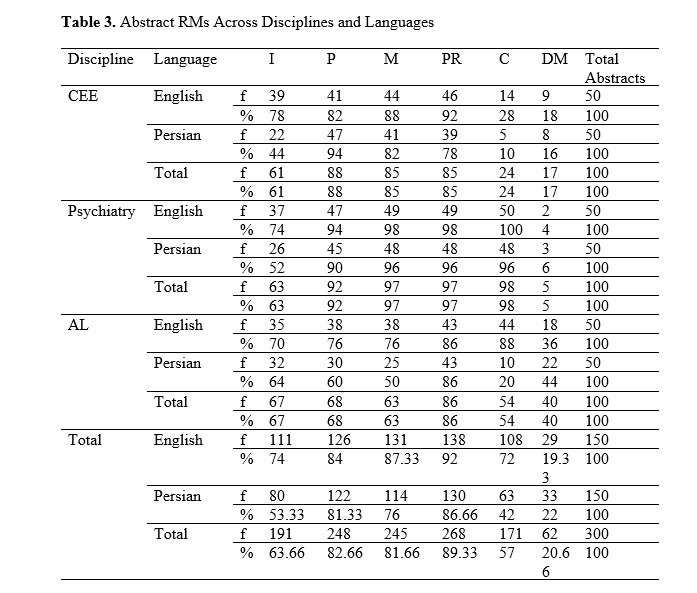
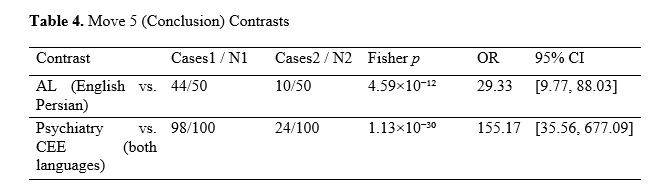
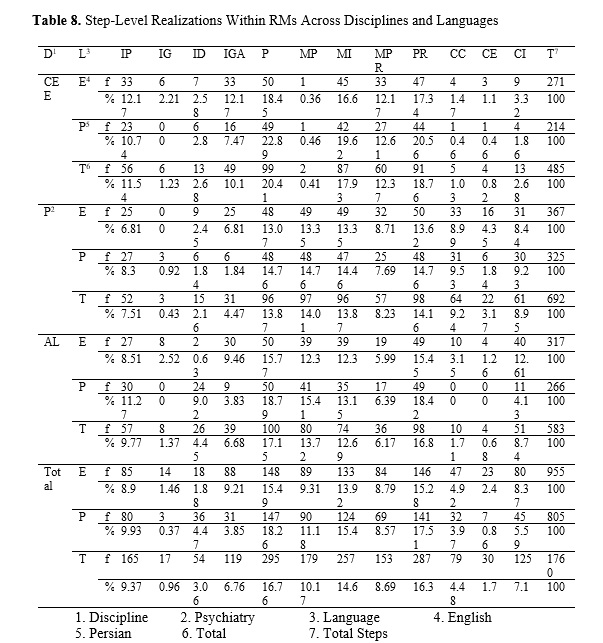
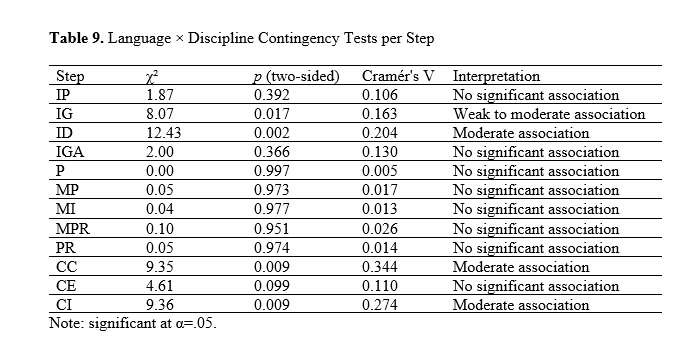
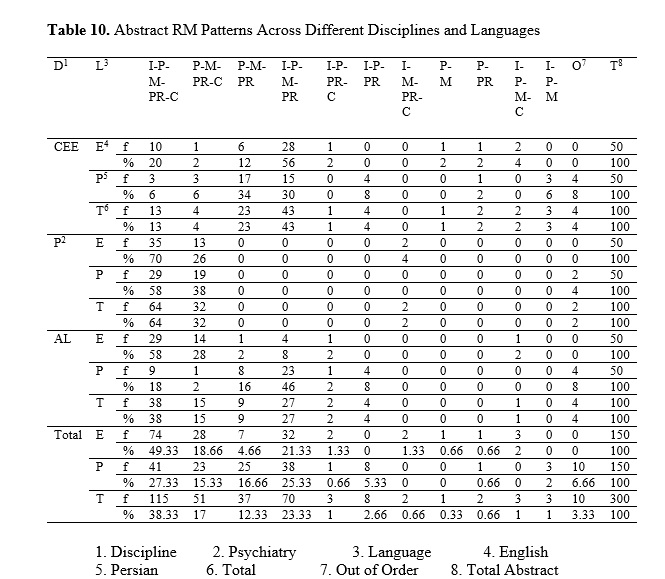
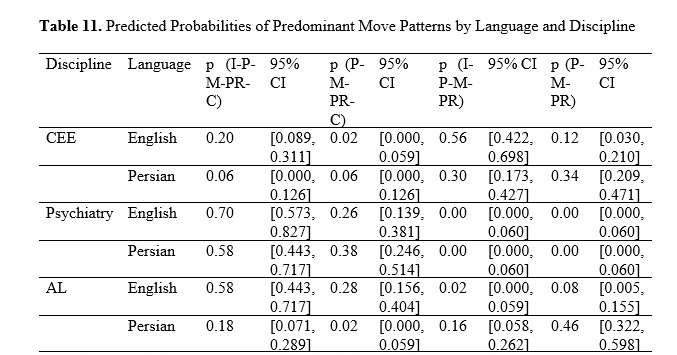
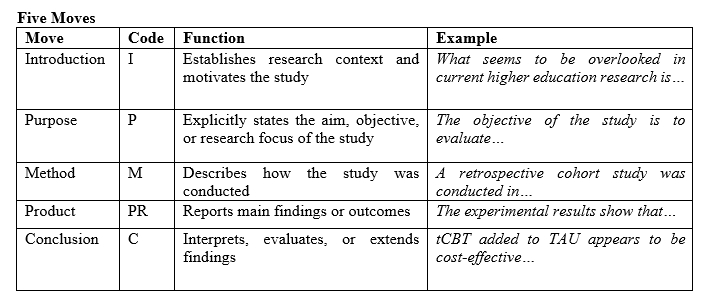
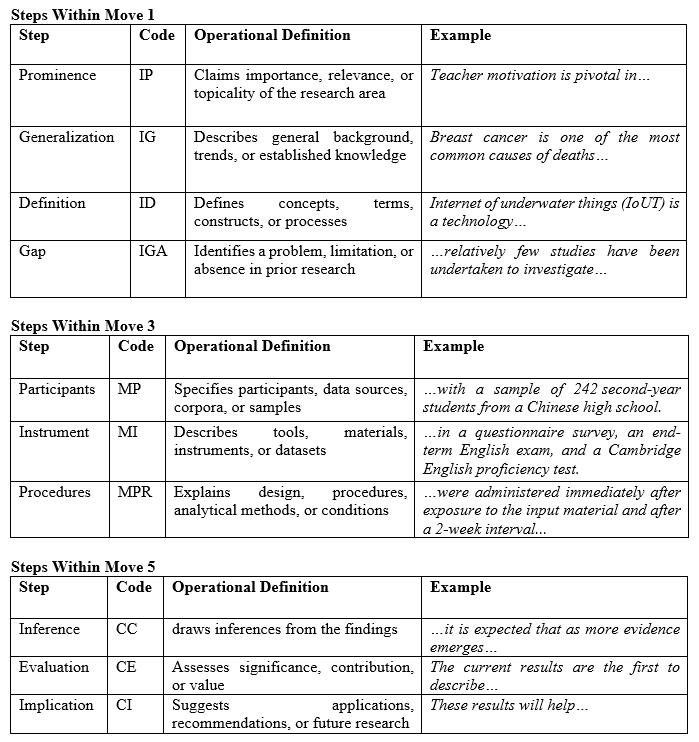
Researchers often have to develop abstracts in both English and their native language when intending to get their research articles (RAs) published in scholarly journals. Some, however, encounter challenges in this process, one of which is related to the rhetorical moves (RMs). This study endeavored to examine the RMs and steps of English and Persian RA abstracts recently published in top-tier journals across hard, medical, and soft disciplines. To this end, 150 English and 150 Persian abstracts from the disciplinary domains of Computers and Electrical Engineering (CEE), Psychiatry, and Applied Linguistics (AL), published in Scopus or Web of Science-indexed journals from 2022 to 2024, were selected, according to journal indexing, abstract policy, and availability. The corpus comprised primarily unstructured abstracts, with the exception of Psychiatry journals, which followed disciplinary conventions for structured formats. The abstracts were analyzed adopting Hyland's (2000) five-move framework. The findings suggested that the Product, Purpose, and Method moves were the most frequent in the abstracts (89.33%, 82.66%, and 81.66%, respectively). The most common RM pattern was the five-move organization of Introduction-Purpose-Method-Product-Conclusion (38.33%) in the RA abstracts. Inferential analyses revealed that the probability of observing the full pattern was over 0.70 in Psychiatry but only 0.20 in CEE, with Persian abstracts showing greater structural diversity. They also demonstrated that the Conclusion move was significantly more prevalent in Psychiatry abstracts than in CEE, and in English AL abstracts than in their Persian counterparts. Furthermore, the outcomes indicated that the abstracts typically contained an average of 5.86 steps, with the Purpose step being the most recurrent (16.76%), followed by the Product and Instrument steps (16.3% and 14.6%, respectively). Statistical modeling of steps identified significant language-discipline interactions, with the Definition and Conclusion steps showing the most pronounced variation. Additionally, it was found that the step pattern of the Prominence-Gap-Purpose-Participant-Instrument-Product-Implication was the most frequently used in abstract development. This study’s findings may give valuable insights into the patterns of English and Persian abstracts in various fields of study, which can be beneficial for English for Academic Purposes and academic writing courses.
Figures

Shahidipour, V. (2026). Move-Step Structures in English vs. Persian Research-Article Abstracts Across Three Disciplines (2022-2024), Research Result. Theoretical and Applied Linguistics, 12 (1), 236–261.















While nobody left any comments to this publication.
You can be first.
Al-Khasawneh, F. M. (2017). A genre analysis of research article abstracts written by native and non-native speakers of English, Journal of Applied Linguistics and Language Research, 4(1), 1–13.
Amnuai, W. (2019). Analyses of rhetorical moves and linguistic realizations in accounting research article abstracts published in international and Thai-based journals, SAGE Open, 9 (1), 1–9. https://doi.org/10.1177/2158244018822384
Arsyad, S., Pratiwi, V. A., An-Nashir, A. A., Erviona, L. and Marjelina, O. (2023). The rhetorical structure and research gap strategies in journal article abstracts in language-related fields published in high-impact international journals, LEARN Journal: Language Education and Acquisition Research Network, 16(1), 703–725.
Bhatia, V. K. (1993). Analyzing genre: Language use in professional settings. Longman.
Doró, K. (2013). The rhetoric structure of research article abstracts in English studies journals, Prague Journal of English Studies, 2 (1), 119–139. https://doi.org/10.2478/pjes-2014-0013
Ghasempour, B. and Farnia, M. (2017). Contrastive move analysis: Persian and English research article abstracts in law, Journal of Teaching English for Specific and Academic Purposes, 5 (4), 739–753. https://doi.org/10.22190/JTESAP1704739G
Hyland, K. (2000). Disciplinary discourses: Social interactions in academic writing. Longman.
Johns, T. (1992). It is presented initially: Linear dislocation and inter-language strategies in Brazilian academic abstracts in English and Portuguese, Ilha do Desterro, 27 (1), 9–32.
Karimah, N. A., Munir, A. and Anam, S. (2023). Comparative study: Rhetorical moves of research article abstracts written by American and Indonesian authors, PRASASTI: Journal of Linguistics, 8 (2), 245–257. https://doi.org/10.26714/lensa.13.1.2023.82-94
Khany, R. and Malmir, B. (2020). A move-marker list: A study of rhetorical move-lexis linguistic realizations of research article abstracts in social and behavioural sciences, RELC Journal, 51 (3), 381–396. https://doi.org/10.1177/0033688219833131
Li, X. (2020). Mediating cross-cultural differences in research article rhetorical moves in academic translation: A pilot corpus-based study of abstracts, Lingua, 238, 1–11. https://doi.org/10.1016/j.lingua.2020.102795
Lorés, R. (2004). On RA abstracts: From rhetorical structure to thematic organization. English for Specific Purposes, 23(3), 280–302. https://doi.org/10.1016/j.esp.2003.06.001
Marefat, F., Farahanynia, M., Bolouri, M., Chamani, F. and Soleimani, T. (2021). Generic structure of literature reviews in research articles: Iranian and international journals (Research paper), Iranian Journal of English for Academic Purposes, 10 (3), 33–50. https://dorl.net/dor/20.1001.1.24763187.2021.10.3.3.1
Marefat, H. and Mohammadzadeh, S. (2013). Genre analysis of literature research article abstracts: A cross-linguistic, cross-cultural study, Applied Research on English Language, 2(2), 37–50.
Nagano, L. R. (2015). Research article titles and disciplinary conventions: A corpus study of eight disciplines, Journal of Academic Writing, 5(1), 133–144. https://doi.org/10.18552/joaw.v5i1.168
Pho, P. D. (2008). Research article abstracts in applied linguistics and educational technology: A study of linguistic realizations of rhetorical structure and authorial stance, Discourse Studies, 10(2), 231–250. https://doi.org/10.1177/1461445607087010
Porush, D. A. (1995). A short guide to writing about science. Harper Collins College Publisher.
Ramadhini, T. M., Wahyuni, I. T., Ramadhani, N. T., Kurniawan, E., Gunawan, W. and Muniroh, R. D. D. A. (2021, April). The rhetorical moves of abstracts written by the authors in the field of hard sciences, in Thirteenth Conference on Applied Linguistics (CONAPLIN 2020), 587–592. Atlantis Press. https://doi.org/10.2991/assehr.k.210427.089
Relawati, M. and Basthomi, Y. (2021). The common move and step in research article abstracts [Unpublished doctoral dissertation]. State University of Malang.
Samraj, B. (2005). An exploration of a genre set: Research article abstracts and introductions in two disciplines, English for Specific Purposes, 24 (2), 141–156. https://doi.org/10.1016/j.esp.2002.10.001
Santos, M. (1996). The text organization of research papers abstracts in applied linguistics, Text, 16 (4), 481–499. https://doi.org/10.1515/text.1.1996.16.4.481
Suntara, W. and Usaha, S. (2013). Research article abstracts in two related disciplines: Rhetorical variation between linguistics and applied linguistics, English Language Teaching, 6 (2), 84–99. https://doi.org/10.5539/elt.v6n2p84
Swales, J. M. (1981). Aspects of article introductions, The University of Aston, Language Studies Unit.
Swales, J. M. (1990). Genre analysis, Cambridge University Press.
Swales, J. M. (2004). Research genres: Explorations and applications, Cambridge University Press. https://doi.org/10.1017/CBO9781139524827
Swales, J. M. (2019). The futures of EAP genre studies: A personal viewpoint, Journal of English for Academic Purposes, 38, 75–82. https://doi.org/10.1016/j.jeap.2019.01.003
Tankó, G. (2017). Literary research article abstracts: An analysis of rhetorical moves and their linguistic realizations, Journal of English for Academic Purposes, 27, 42–55. https://doi.org/10.1016/j.jeap.2017.04.003
Tseng, F. (2011). Analyses of move structure and verb tense of research article abstracts in applied linguistics journals. International Journal of English Linguistics, 1 (2), 27–39. https://doi.org/10.5539/ijel.v1n2p27
Ventola, E. (1994). Abstracts as an object of linguistic study. In S. Cmejrkova, F. Danes and E. Havlova (Eds.), Proceedings of the conference on writing vs. speaking: Language, text, discourse, communication (pp. 333–52). Gunter Narr Verlag.
Zand-Moghadam, A. and Meihami, H. (2016). A rhetorical move analysis of TEFL thesis abstracts: The case of Allameh Tabataba’i University, Issues in Language Teaching, 5 (1), 1–23. https://doi.org/10.22054/ilt.2016.7714
Zand-Moghadam, A. and Zhaleh, K. (2022). Comparative rhetorical move analysis of qualitative, quantitative, and mixed methods research article abstracts in Iranian vs. international applied linguistics journals. Journal of Modern Research in EnglishLanguage Studies, 9 (3), 25–47. https://doi.org/10.30479/jmrels.2022.16708.2009
Zand-Vakili, E. and Fard Kashani, A. (2012). The contrastive move analysis: An investigation of Persian and English research articles’ abstract and introduction parts. Mediterranean Journal of Social Sciences, 3 (2), 129–137. https://doi.org/10.5901/mjss.2012.v3n2.129
Corpus Material
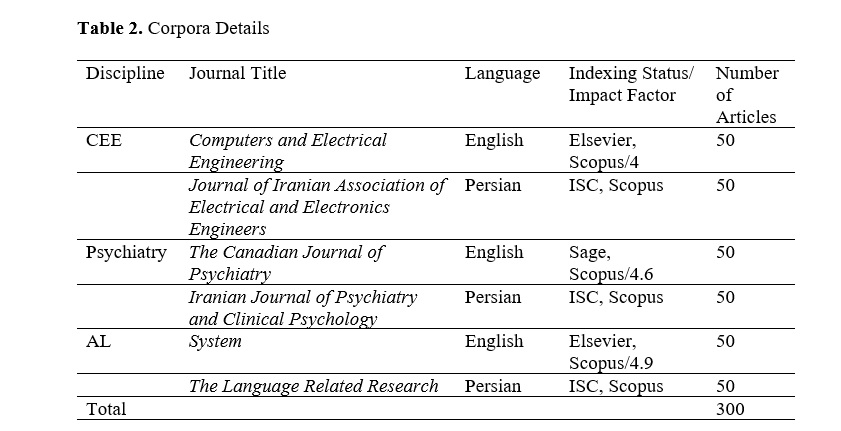
Computers and Electrical Engineering. (2022–2024). Elsevier.
Journal of Iranian Association of Electrical and Electronics Engineers. (2022–2024). ISC, Scopus.
The Canadian Journal of Psychiatry. (2022–2024). Sage.
Iranian Journal of Psychiatry and Clinical Psychology. (2022–2024). ISC, Scopus.
System. (2022–2024). Elsevier.
The Language Related Research. (2022–2024). ISC, Scopus.
The author would like to acknowledge the significant contributions of colleagues and experts in the fields of Computers and Electrical Engineering, Psychiatry, and Applied Linguistics to this study.