

The Chinese mythological archetypes of images in Rebecca Kuang’s novel The Poppy War
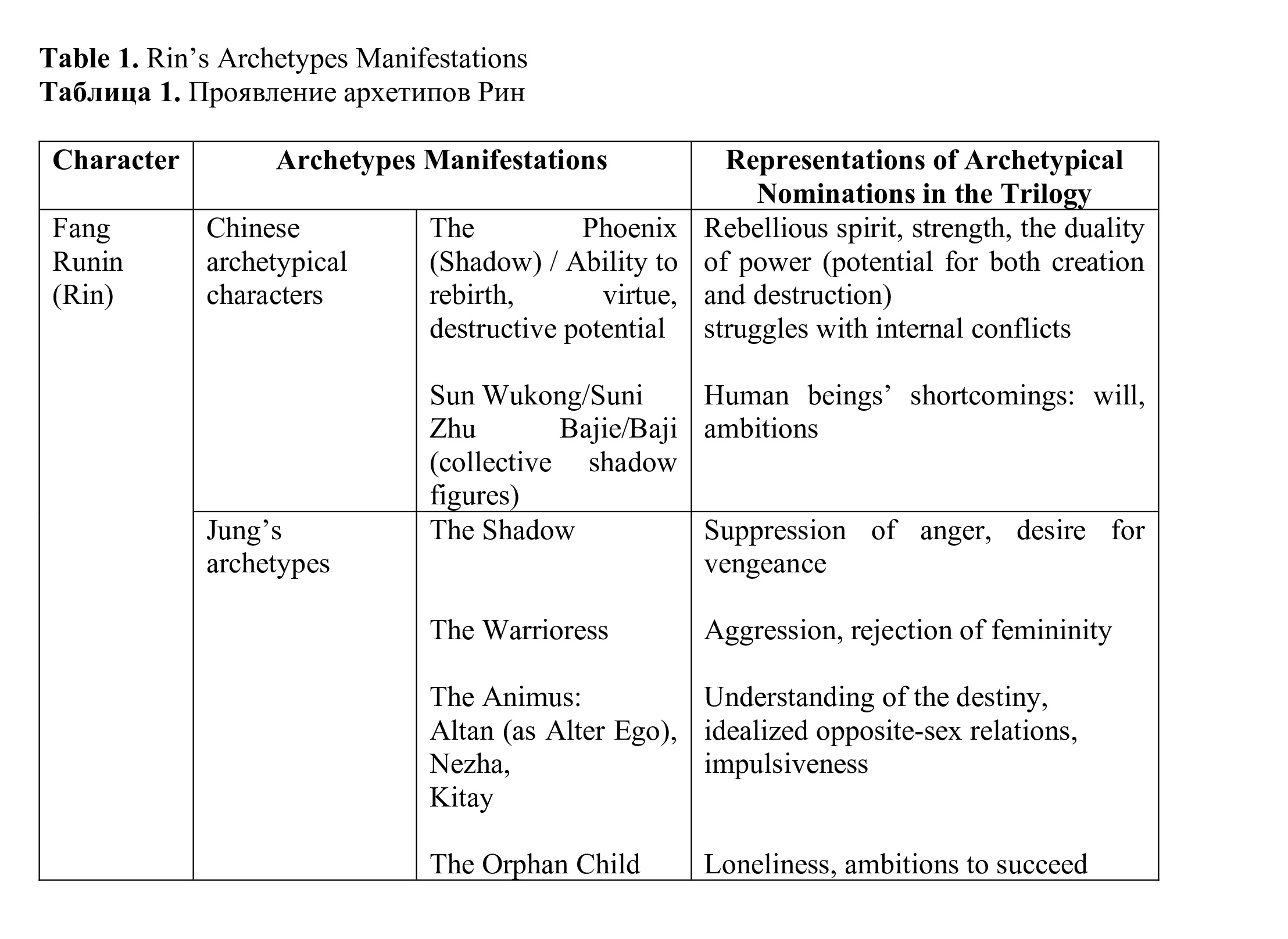
The article focuses on the study of Chinese mythological archetypes in R. F. Kuang’s trilogy The Poppy War, that contribute to a deeper understanding of the cultural and psychological aspects of the novels. The Poppy War, as a good example of the contemporary fantasy genre, is understudied in the context of Jungian analysis. The problem arises from the need to reveal the integration of mythological archetypes in the narrative’s structure and the archetype’s nominations impact on the characters’ storyline interpretation. The research is carried out using Jungian hermeneutics, analytical psychology, and the interpretative strategies of E. M. Meletinsky and E. Neumann. The authors come to the conclusion that key Chinese mythological archetypes such as the Dragon, the Phoenix, Sun Wukong, Zhu Bajie and Nüwa play a significant role in shaping the characters and the plot of the trilogy. Particular attention is given to the main character, Fang Runin, whose evolution personifies the Phoenix archetype. The heroine, rejecting femininity, follows the path of the Warrior, her journey is characterized by the search and interaction with such archetypes as the Shadow and the Animus leading to her personal transformation. Thus, the traditional Chinese mythological archetypes behave simultaneously as the Shadow and the Animus in the character’s psyche, creating a specific combination and shaping the narrative. The integration of mythological elements in The Poppy War gives the trilogy a deep symbolic richness and multi-layeredness that proves that the archetypal components of traditional Chinese culture and the Chinese heroic archetype influence modernity.
Figures
Alekseeva, O. P., Ivanova, O. I. (2026). The Chinese mythological archetypes of images in Rebecca Kuang’s novel The Poppy War, Research Result. Theoretical and Applied Linguistics, 12 (1), 262–276.
















While nobody left any comments to this publication.
You can be first.
Corpus materials
Rubanov, А. V. (2020). Finist – jasnyj sokol [Finist – the Bright Falcon], Editorial AST, Moscow, Russia. (In Russian)
Tunyan, Ch., Fanfan, H and Sinie, Ya. (2022). Mify i legendy Kitaja [Myths and legends of China], International Publishing Company “Shans”, Moscow, Russia. (In Russian)
Cheng’en, W. (2013). Journey to the West. Asiapac Books Pte Ltd. (In English)
Kuang, R. F. (2018). The Poppy War. HarperCollins, London, UK. (In English)
Kuang, R. F. (2019). The Dragon Republic. HarperCollins, USA. (In English)
Kuang, R. F. (2020). The Burning God. HarperCollins, UK. (In English)
Shvarts, E. (2019). The Dragon. Broadway Play Publishing INC. (In English)
References
Akhmetshin, А. R. and Gorbatov, A. V. (2015). Atributivnye priznaki arhetipa trikstera [Attributive features of the trickster archetype], Vestnik Kemerovskogo gosudarstvennogo universiteta kultury i iskusstv, Kemerovo, Russia, 81–85. (In Russian)
Alekseeva, O. P. (2006). Virtualnaya bytiнnost skazki v kulture [The virtual entity of a fairy tale in culture], Ph.D. Thesis, Rostov-on-Don, Russia. (In Russian)
Alekseeva, O. P. (2008). Strukturalny podkhod v issledovanii realnogo i virtualnogo mira skazki [The structural approach in the study of the real and virtual fairy tale world], Humanities Issues, 2 (35), 86–91. (In Russian)
Campbell, J. (2004). The Hero with a Thousand Faces, Princeton University Press, USA. (In English)
Casement, A. (2026). Integrating Shadow: Authentic Being in the World. Karnac Books. https://doi.org/10.2307/jj.33326005(In English)
Dyakonov, I. M. (1990). Arkhaicheskie mify Vostoka i Zapada [The archaic myths of the East and West], Nauka, Glavnaya redakciya vostochnoy literatury, Moscow, Russia. (In Russian)
Estes, C. P. (1996). Women Who Run with the Wolves: Myths and Stories of the Wild Woman Archetype, Ballantine Books, New York, USA. (In English)
Geng, Y. (2020). Osobennosti mifologizirovannogo obraza Feniksa v kulture raznyh stran [Literature of different cultures: reflection of ‘Phoenix’ mythological image], Libri Magistri, 4 (14), 128–137. (In Russian)
Gribina, L. V. (2021). Transformatsiya arkhetipa drakona v proizvedeniyah E. L. Shvartsa i sovremennyh pisateley [Transformation of the Dragon archetype in the works of E. L. Schwartz and modern writers], in Proc. of the Russian scientific conference “Evgeny Schwartz and the problems of development of Russian literature of the 20th century”, Adyghe State University, Maykop, Russia, 21–25. (In Russian)
Ivanova, O. I. (2025). Obrazy shamanok stikhii ognya v tsiklah romanov A. V. Borisovoy «Zemlya udaganok» i R. F. Kuang «Opiumnaya voyna» [Images of female shamans of the element of fire in the cycles of novels “The Land of the Udagans” by A. V. Borisova and “The Poppy War” by R. F. Kuang], Issues of National Literature, (2), 15–28. https://doi.org/10.25587/2782-6635-2025-2-15-28(In Russian)
Jung, C. G. (1980). The archetypes and the collective unconscious, Princeton University Press, USA. (In English)
Kulikov, E. A. (2022).Vostok realny i vymyshlenny v romane R. Kuang «Opiumnaya voyna» [The East, real and fictional, in R. Kuang’s Novel "The Poppy War"], The world of science, culture and education, Russia, 6 (97), 413–417. (In Russian)
Liu, Y. and Li W. (2013). A Comparison of the Themes of The Journey to the West and The Pilgrim’s Progress, Theory and Practice in Language Studies, 3 (7), 1243–1249. (In English)
Lju, T. T. (2022). The Chinese Myths: A Guide to the Gods and Legends, Thames & Hudson Ltd, London, UK. (In English)
Meletinsky, Е. M. (2001). Literaturnye arkhetipy i universalii [Literary archetypes and universals], Russian State University for the Humanities, Moscow, Russia. (In Russian)
Miao W. and Shi H. (2023). From National Memory to Self-Referential Symbol: The Rebirth of the Phoenix Metaphors among Chinese Immigrant Women, SAGE Open, 13 (1), 1–17. https://doi.org/10.1177/21582440221099 (In English)
Murdock, M. (2020). The Heroines Journey: Woman's Quest for Wholeness, Shambhala, USA. (In English)
Neumann, E. (2014). The Origins and History of Consciousness, Princeton University Press, USA. (In English)
Pendikova, I. G. (2008) .Akrhetip i simvol v reklame [Archetype and symbol in advertising], JuNITI-DANA, Moscow, Russia. (In Russian)
Propp, V. (2009). Morphology of the Folktale, University of Texas Press, Austin. (In English)
Rogachev, A. P. (1984). U Chjen’jen’ i ego roman "Puteshestvie na Zapad"[Wu Cheng’en and his novel "Journey to the West"], Nauka, Moscow, Russia. (In Russian)
Sannikov, S. V. (2018). Obraz, ideologiya, arkhetip: metodologicheskie aspekty izucheniya reprezentatsii vlasti [Image, ideology, archetype: methodological aspects of studying the representation of power], METOD: Moscow Annual Publications of Works of Social Sciences, 8, 61–81. (In Russian)
Shvets, A. O. (2018). Ambivalentnost kulturnogo geroya v piese E. L. Shvartsa «Drakon» i v ekranizatsii M. A. Zakharova «Ubit drakona» [The ambivalence of the cultural hero in the play by E. L. Schwartz "The Dragon" and in the film adaptation by M. A. Zakharov "To Kill the Dragon"], in Proc. of the III International scientific conference “Donetsk Readings 2018: Education, Science, Innovation, Culture and Challenges of Modernity”, Donetsk National University, Donetsk, 282–284. (In Russian)
Szyjewski, A. (2020). In the Shadow of Trickster. Research fields and controversies in the discourse on the trickster complex in the studies of myth, Studia Religiologica, 53 (3), 163–179. (In English)
Tatar, M. (2021). The Heroin with 1,001 Faces, Liveright Publishing Corporation, New York, USA. (In English)
Tun, B. (2022). Funktsiya arkhetipa teni v literature (Istinny i falshivy tsar obezyan v ‘Puteshestvii na zapad’ U Chjen-jenya, ‘Ten H. G. Andersena i ‘Nos’ N. V. Gogolya) [The function of the Shadow archetype in literature (The true and false monkey king in Wu Cheng-en's ‘Journey to the West’, H. G. Andersen’s ‘Shadow’ and N. V. Gogol’s ‘The Nose’)], Vestnik VGU, Series: Philology. Journalism, 3, 52–57. (In Russian)
Turysheva, O. N. (2012). Teoriya i metodologiya zarubezhnogo literaturovedeniya [The theory and methodology of foreign literary studies]. Moscow: Flinta: Nauka (In Russian)
Vavilova, Е. U. (2008). Transformatsiya teni (kollektivnoe bessoznatelnoe kak sfera dialektiki dobra i zla) [The transformation of the shadow (collective unconscious as an area of dialectic of good and evil)], Vestnik KGU, Russia, 241–244. (In Russian)
Voytilla, S. (1999). Myth and the Movies: Discovering the Mythic Structure of 50 Unforgettable Films, Michael Wiese Productions, Studio City, USA. (In English)
Wang, М. (2020). Evolyutsiya predstavleniy o fenikse v Kitaiskoy yazykovoy kartine mira [The evolution of Phoenix concept in Chinese language picture of the world], Voprosy sovremennoy lingvistiki, 4, 6–11. (In Russian)
Werner, E. (2007). Mify i legendy Kitaya [Myths and legends of China], ZAO Tsentrpoligraf, Moscow. (In Russian)
Williams, C. A. S. (2012). Chinese Symbolism and Art Motifs: A Comprehensive Handbook on Symbolism in Chinese Art Through the Ages, Tuttle Publishing, USA. (In English)
Xinyu Y. and Muhsin A. (2020). Comparative Study on Myth between Chinese and Arabic: Phoenix as an Example, International Journal of Humanities, Philosophy and Language, 3 (10), 12–17. https://doi.org/10.35631/IJHPL.310002(In English)
Xuezheng S., Li J., Zhang Y., Liu S., Hong J. and Lee J. (2020) Devil or God: Image Transformation of Chinese Mythology Character “Nezha”(1927–2019), Cartoon and Animation Studies, 58, 159–200. (In English)
Zagrebelnaya, M. S. (2022). Elementy kitaiskoy mifologii v proizvedenii Rebekki Kuang «Opiumnaya voyna» [The elements of Chinese mythology in the work of Rebekka Kuang ‘The Poppy war’], Modern Science, 1 (2), 303–307. (In Russian)
Zhanysbekova E. Т. and Safronova L. V. (2024). Archetypal images of a literary fairy tale, Eurasian Journal of Philology Science and Education, 196 (4), 168–177. https://doi.org/10.26577/EJPh.2024.v196.i4.ph15(InEnglish)