
When Human Writing Looks Artificial: Perceived AI-Likeness as a Property of Text
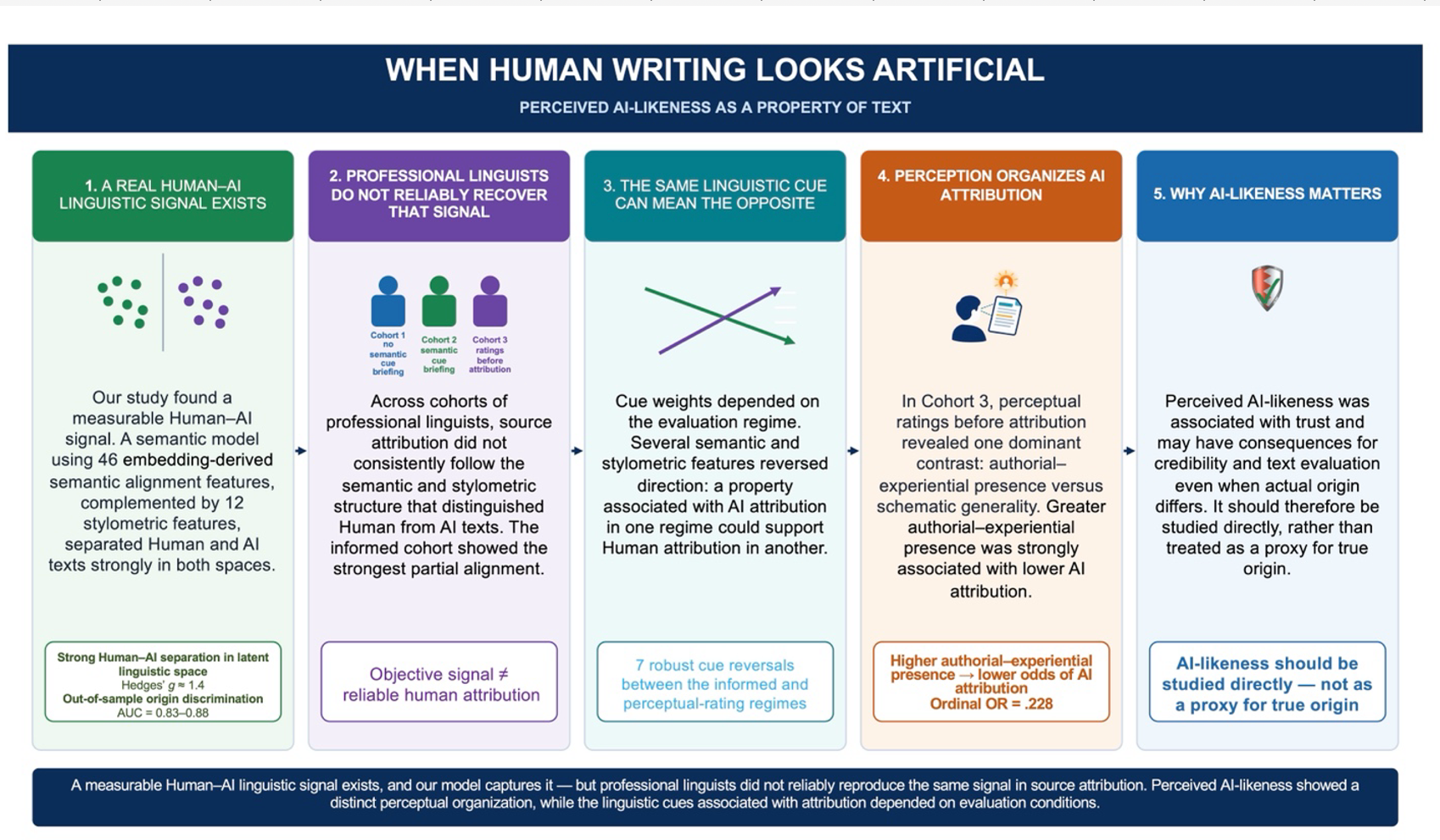
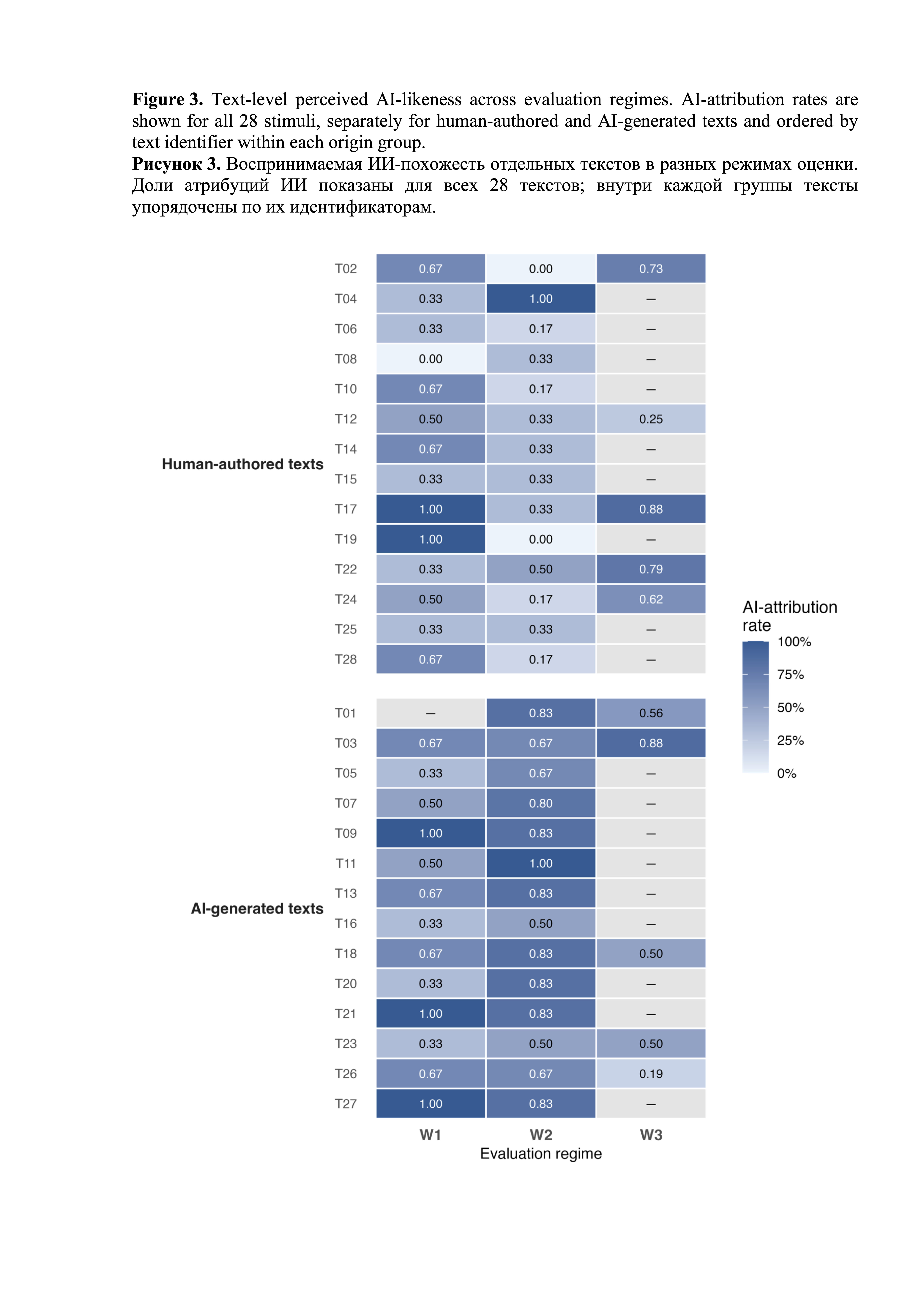
A piece of writing can look as if it were produced by AI even when it wasn’t, and conversely, text generated by AI can still be mistaken for human work. We investigated this mismatch between the true source of 28 Russian texts (14 written by humans and 14 generated by AI) and their perceived AI-likeness. The texts were assessed by professional linguists under three different evaluation setups. For each text, we extracted 46 embedding-based semantic alignment features and 12 stylometric measures. In the third evaluation regime (W3), we also used a balanced subset of 10 texts and collected ratings along 13 perceptual dimensions before participants made their source judgments.
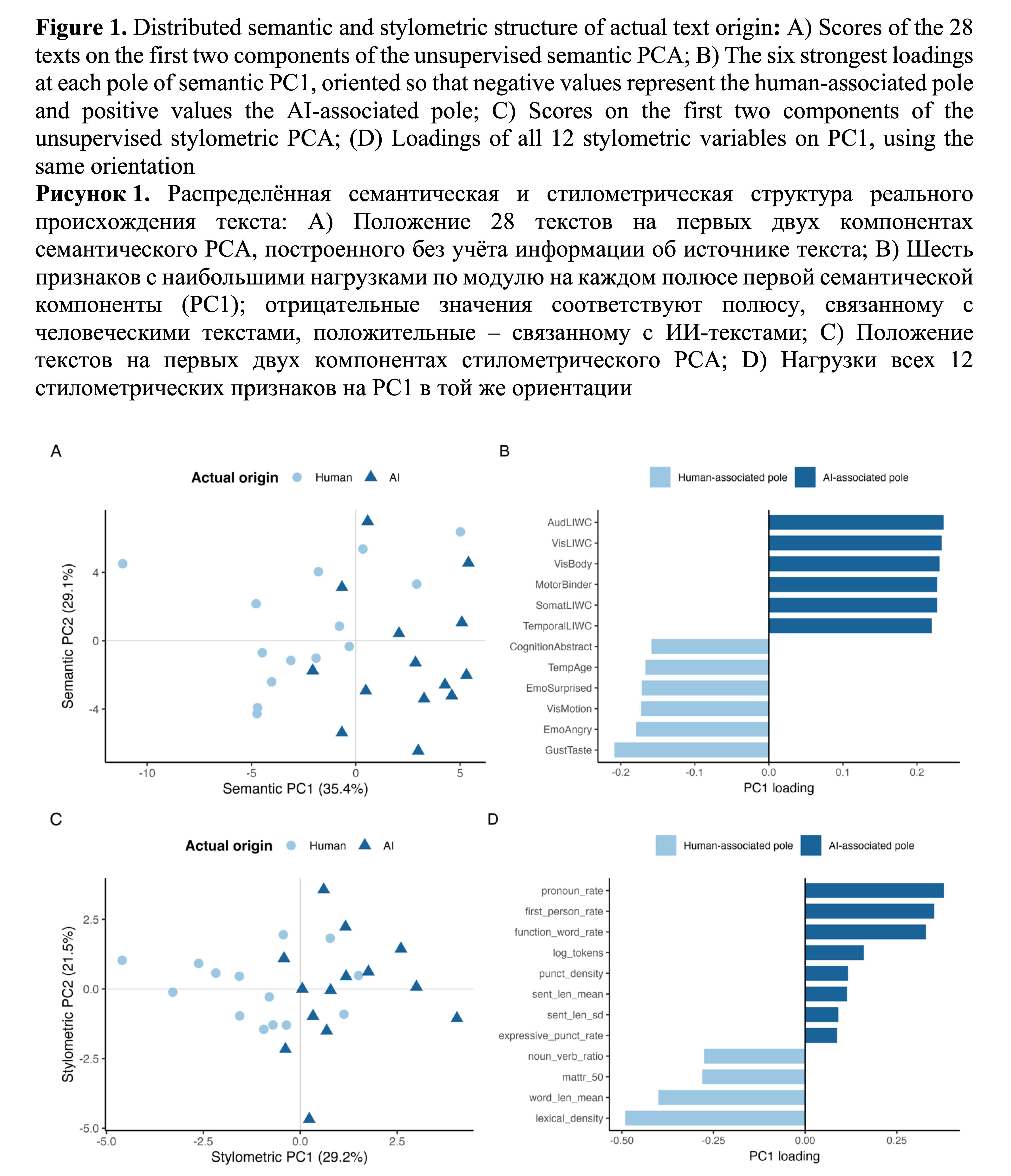
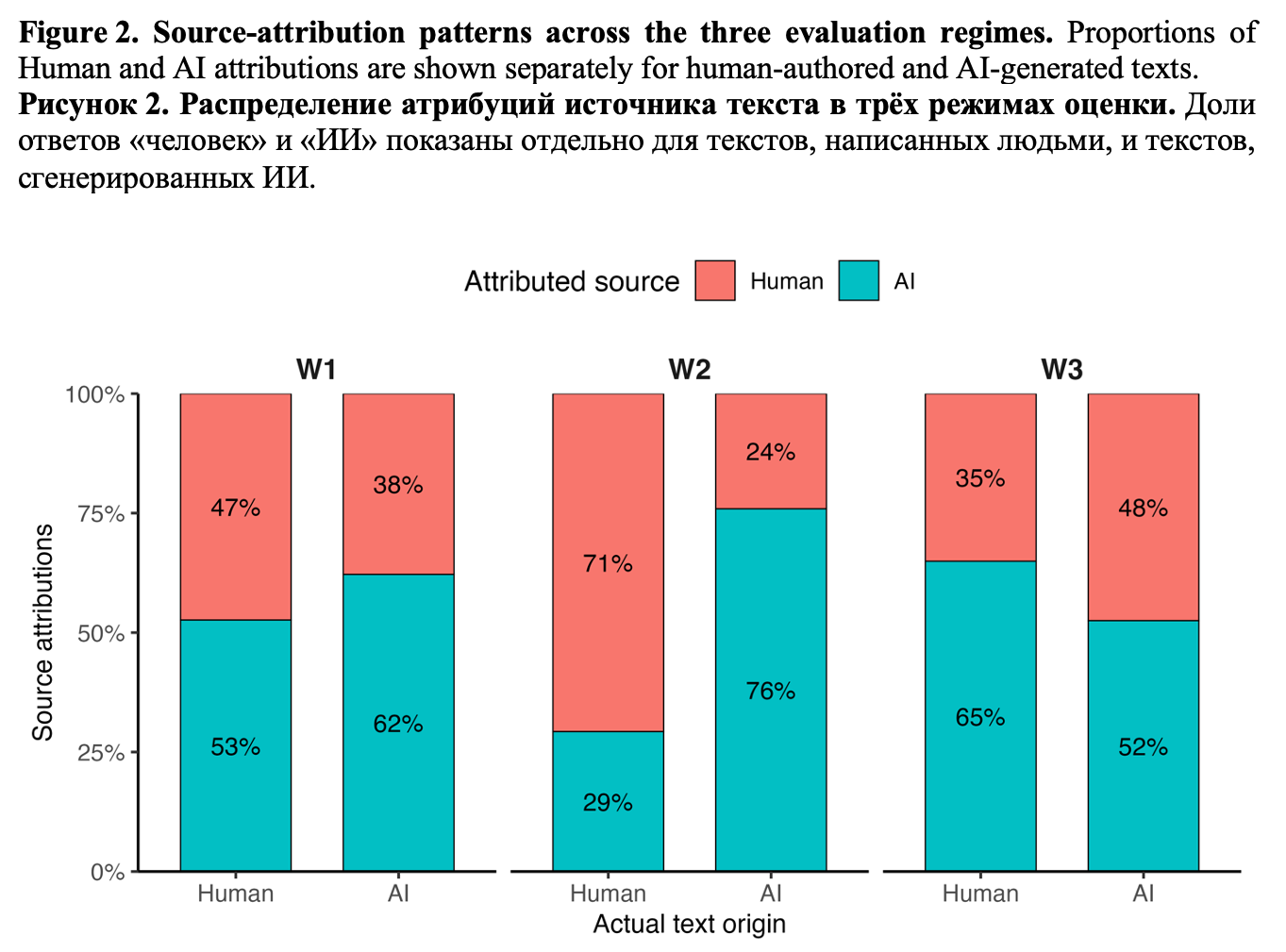
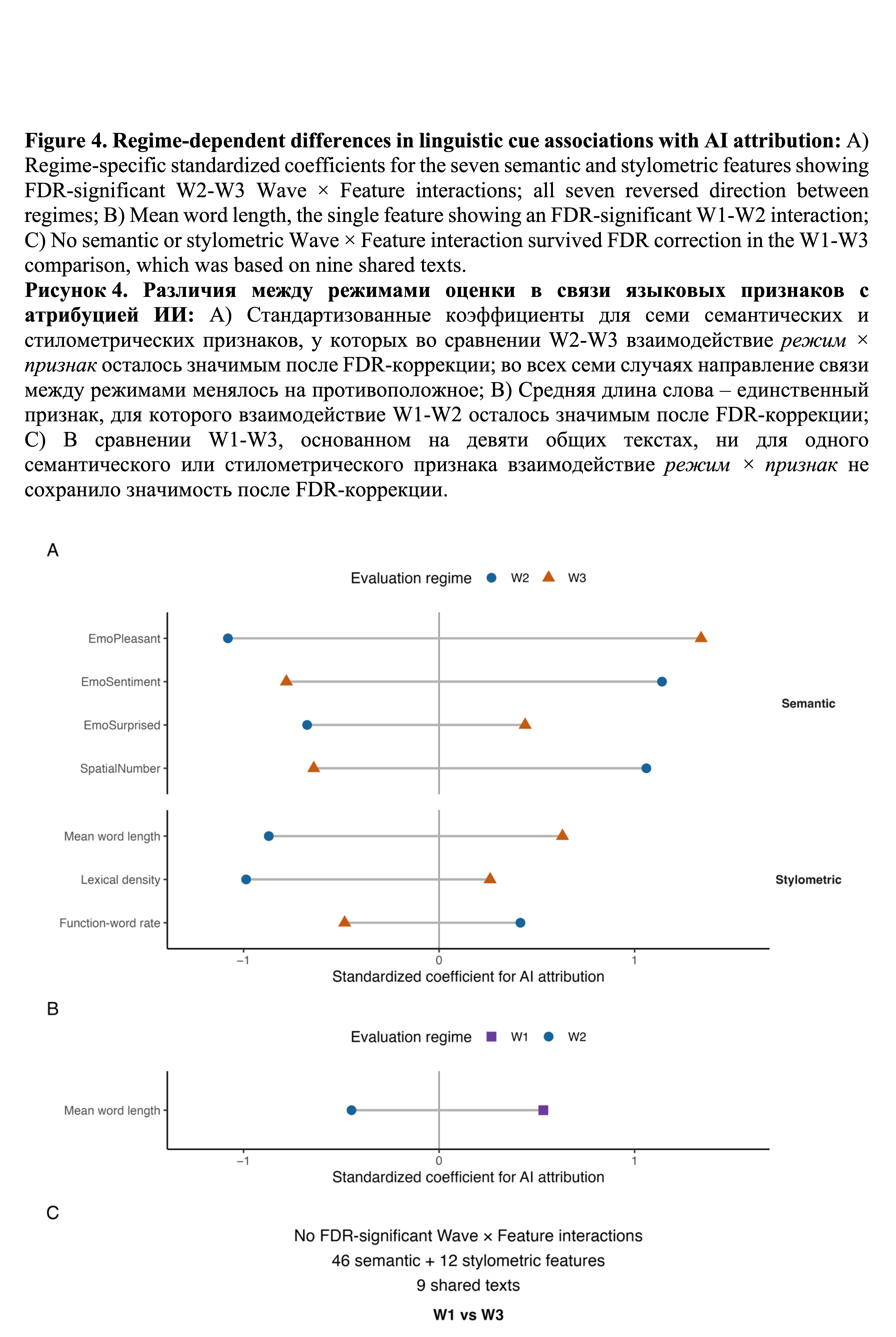
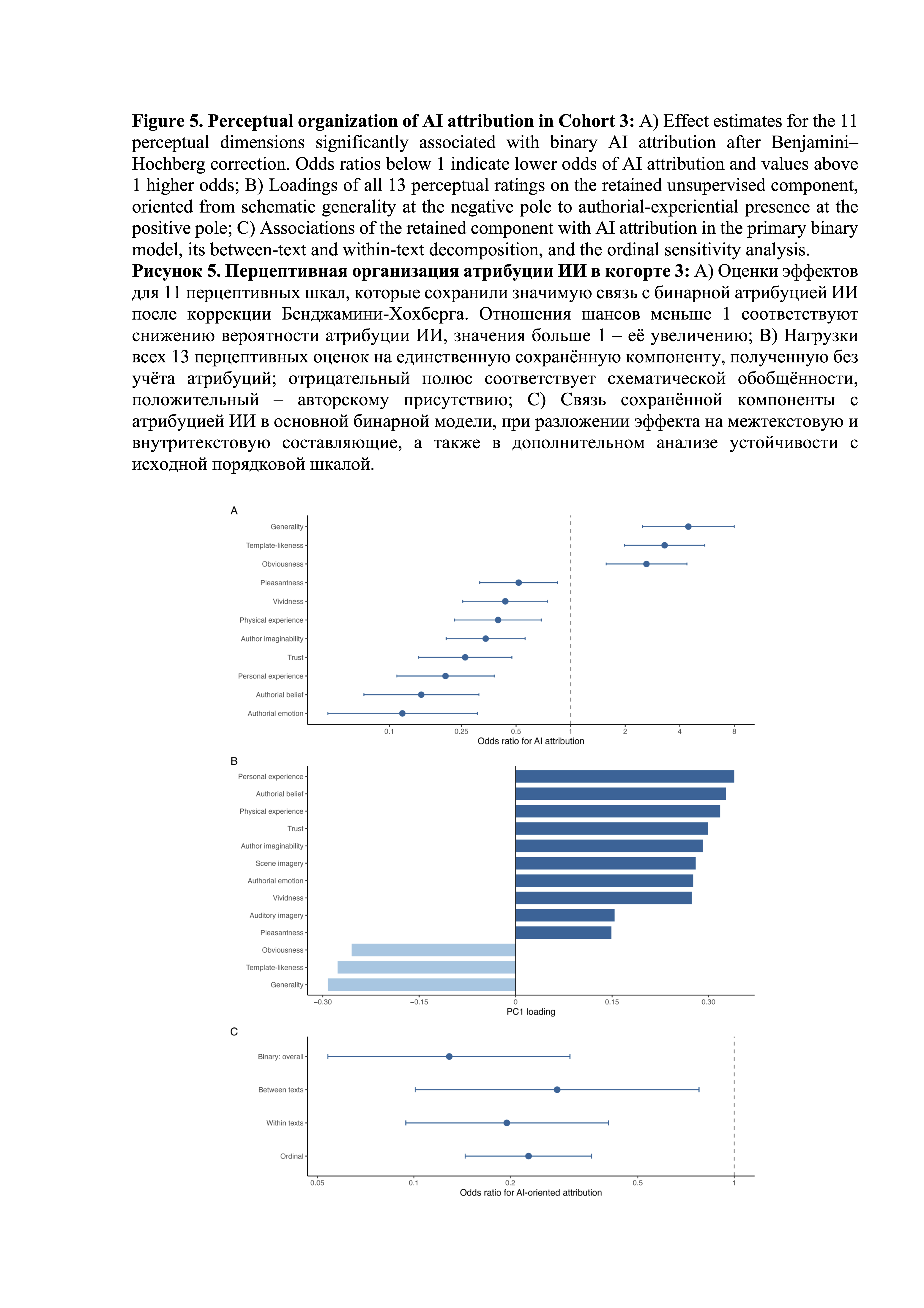
Across both semantic and stylometric space, human and AI texts showed a clear separation. Unsupervised components related to origin produced large Human-AI differences (Hedges’ |g| ≈ 1.4), and nested leave-one-text-out ridge models achieved AUCs between .832 and .878. However, the objective dimensions that distinguished the actual origin were not sufficient on their own to explain AI attribution once the origin was controlled for. The importance of cues also varied across evaluation regimes. In particular, seven features showed FDR-significant regime × feature interactions between W2 and W3, all with reversed slopes; mean word length also shifted direction between W1 and W2. In W3, the perceptual ratings were largely driven by a dimension that contrasted authorial-experiential presence with schematic generality. Shifting toward the authorial-experiential end substantially lowered AI-oriented attribution on the original five-category scale (OR = .228, 95% CI [.145, .359], p < .001).
So, perceived AI-likeness cannot be viewed as a straightforward reflection of either actual authorship or the linguistic markers tied to origin. In these results, it functioned more like a perceptual property of the text: it depended on whether readers felt there was a situated author behind what they read. Meanwhile, the linguistic cues that supported AI attribution varied depending on the evaluation regime. This distinction is important because perceived AI authorship can affect trust, credibility, and later assessments even when the source judgment turns out to be incorrect.
Figures
Litvinova, Т. А., Dekhnich, O. V. (2026). When human writing looks artificial: perceived AI-likeness as a property of text, Research Result. Theoretical and Applied Linguistics, 12 (3), 3–31.
















While nobody left any comments to this publication.
You can be first.
Altay, S. and Gilardi, F. (2024). People are skeptical of headlines labeled as AI-generated, even if true or human-made, because they assume full AI automation, PNAS Nexus, 3 (10), pgae403. https://doi.org/10.1093/pnasnexus/pgae403(In English)
Chen, R., Xiong, S., He, J. and Ross, G. J. (2026). Stylometric detection of AI-generated texts: evidence from human and machine-written essays, Digital Scholarship in the Humanities, fqag064. https://doi.org/10.1093/llc/fqag064(In English)
Demir, N. Y. (2026). Human perceptions of register alignment and functional appropriateness: ChatGPT-generated vs human-authored texts, Digital Scholarship in the Humanities, fqag084. https://doi.org/10.1093/llc/fqag084(In English)
Fiedler, A. and Döpke, J. (2025). Do humans identify AI-generated text better than machines? Evidence based on excerpts from German theses. International Review of Economics Education, 49, 100321. https://doi.org/10.1016/j.iree.2025.100321(In English)
Hau, M. F., Vulpius, J. and Tønnesen, S. (2026). AI literacy as metacommunicative agility: exploring users’ interpretive strategies in detecting and evaluating AI and human authorship, AI & Society. https://doi.org/10.1007/s00146-026-03125-3(In English)
Jakesch, M., Hancock, J. T. and Naaman, M. (2023). Human heuristics for AI-generated language are flawed, in Proceedings of the National Academy of Sciences, 120 (11), e2208839120. https://doi.org/10.1073/pnas.2208839120(In English)
Jia, H., Appelman, A., Wu, M. and Bien-Aimé, S. (2024). News bylines and perceived AI authorship: Effects on source and message credibility. Computers in Human Behavior: Artificial Humans, 2 (2), 100093. (In English)https://doi.org/10.1016/j.chbah.2024.100093
Latini, N., Bråten, I. and Strømsø, H. I. (2026). Mind Over Model? Students’ Evaluation and Use of ChatGPT-Generated Versus Human-Generated Texts. Reading Research Quarterly, 61 (1), e70087. https://doi.org/10.1002/rrq.70087(In English)
Lermann Henestrosa, A. and Kimmerle, J. (2024). The Effects of Assumed AI vs. Human Authorship on the Perception of a GPT-Generated Text, Journalism and Media, 5 (3), 1085–1097. https://doi.org/10.3390/journalmedia5030069(In English)
Litvinova, T., Molchanova, V., Dekhnich, O., Seredin, P. (2025). Describing Images: Linguistic Signatures of AI and Humans, in Proceedings of the 38th Conference of Open Innovations Association FRUCT, Helsinki, Finland. (In English)
Litvinova, T., Zavarzina, V., Panicheva, P. (2024). Individual Differences in the Most Frequent Content Word Usage as a New Type of Features in the Authorship Profiling Task, in Proceedings of The International Society for Technology Education and Science, ICRES 2024, 1901–1924. (In English)
Liu, S., Chu, H., Yuan, S., Sun, Y. and Men, L. R. (2026). The more you think you know: AI experience, literacy, heuristics, and perceived AI authorship. AI & Society, 41 (3), 2199–2211. https://doi.org/10.1007/s00146-025-02643-w(In English)
Marklová, A., Vinš, O., Vokáčová, M. and Milička, J. (2026). The author is dead, but what if they never lived? A reception experiment on Czech AI- and human-authored poetry. Digital Scholarship in the Humanities, fqag067. https://doi.org/10.1093/llc/fqag067(In English)
Markowitz, D. M., Hancock, J. T. and Bailenson, J. N. (2024). Linguistic Markers of Inherently False AI Communication and Intentionally False Human Communication: Evidence From Hotel Reviews. Journal of Language and Social Psychology, 43 (1), 63–82. https://doi.org/10.1177/0261927X231200201(In English)
Mizumoto, A., Yasuda, S. and Tamura, Y. (2024). Identifying ChatGPT-generated texts in EFL students’ writing: Through comparative analysis of linguistic fingerprints, Applied Corpus Linguistics, 4 (3), 100106. https://doi.org/10.1016/j.acorp.2024.100106(In English)
O’Sullivan, J. (2025). Stylometric comparisons of human versus AI-generated creative writing, Humanities and Social Sciences Communications, 12, 1708. https://doi.org/10.1057/s41599-025-05986-3(In English)
Proksch, S., Schühle, J., Streeb, E., Weymann, F., Luther, T. and Kimmerle, J. (2024). The impact of text topic and assumed human vs. AI authorship on competence and quality assessment, Frontiers in Artificial Intelligence, 7, 1412710. https://doi.org/10.3389/frai.2024.1412710(In English)
Szabó, G., Krizsai, F., and Deme, A. (2026). The invisible author: Citizen sociolinguistic perspectives on identifying human and AI-generated narrative texts, Social Sciences & Humanities Open, 13, 102646. https://doi.org/10.1016/j.ssaho.2026.102646(In English)
Stoltz, D. S., Taylor, M. A. (2022). text2map: R Tools for Text Matrices, Journal of Open Source Software, 7 (72), 3741.(In English)
Taylor, M. A., Stoltz, D. S. (2021). Integrating Semantic Directions with Concept Mover’s Distance to Measure Binary Concept Engagement, Journal of Computational Social Science, 4, 231–242.(In English)
Tudino, G. and Qin, Y. (2024). A corpus-driven comparative analysis of AI in academic discourse: Investigating ChatGPT-generated academic texts in social sciences, Lingua, 312, 103838. https://doi.org/10.1016/j.lingua.2024.103838(In English)
Wang, Y., Xing, R., Mansurov, J. et al. (2026). Is Human-Like Text Liked by Humans? Multilingual Human Detection and Preference Against AI, Proceedings of the 64th Annual Meeting of the Association for Computational Linguistics (Volume 1: Long Papers), 14043–14076. https://doi.org/10.18653/v1/2026.acl-long.639(In English)
This editorial is dedicated to the 150th anniversary of Belgorod State National Research University and its enduring tradition of scholarly inquiry into language, human communication, and emerging forms of human – AI interaction. Tatiana A. Litvinova acknowledges the support of Russian Science Foundation, grant N 25-28-03166, https://rscf.ru/project/25-28-03166/. Olga V. Dekhnich received no financial support for the research, authorship, and publication of this article.