

Linguistic indicators of persuasion in social advertising
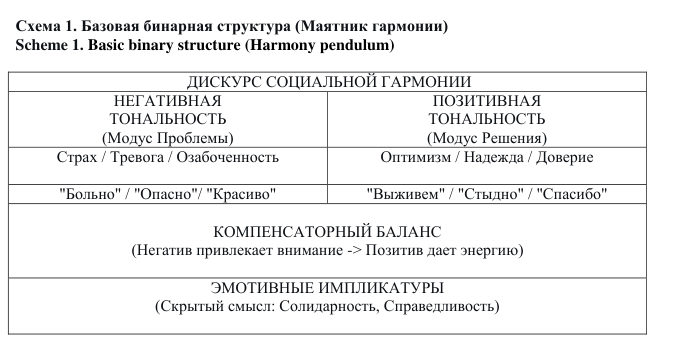
Relevance. The article is devoted to the study of persuasive linguistic indicators in social advertising, one of the speech practices (genres) of the discourse of social harmony, which is considered to be in contrast to aggressive discourse as a set of speech practices aimed at stabilizing social relations and reducing social tension. The relevance of the work is explained by the growing role of discursive means, in particular in social advertising, which are aimed at persuading the target audience of the need to change their attitudes, opinions, and behavior in the context of digitalization and information overload.
Problems. The article presents linguistic persuasive indicators used in modern social advertising and also shows the mechanism of their impact on the target audience. The research material is social advertising, which is interpreted as a special type of persuasive metadiscourse integrating a persuasive intention with socially significant content.
The aim of the study is to identify, systematize, and characterize linguistic indicators of persuasion in social advertising as a speech practice within the discourse of social harmony, as well as to determine their role in influencing the target audience and the cultural factors that determine their choice.
Methods. Several methods were used to address the tasks, which were determined by the multi-level nature of the research object. The choice of methodology tools was determined by the need to combine macroanalysis of discursive practices with microanalysis of specific language means. The following methods were used: the method of language description, which served as the foundation for this study and was applied at all stages of the work; the method of conceptual modeling; the method of classification and typologization; the comparative (contrastive) method; the method of language‑stylistic analysis, aimed at identifying and describing specific language means of implementing persuasiveness; and the method of interpretive analysis. At the final stage of the work, the method of theoretical synthesis was applied, which made it possible to combine the results obtained at different levels of analysis into a comprehensive description of the functioning of persuasive linguistic indicators in the discourse of social harmony. Synthesis is carried out both in the horizontal dimension (generalization of data obtained using different methods) and in the vertical dimension (integration of theoretical concepts and empirical observations into general conclusions).
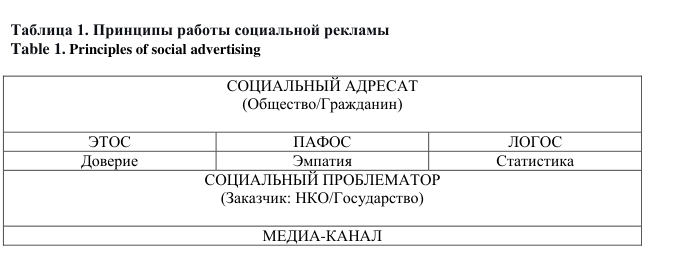
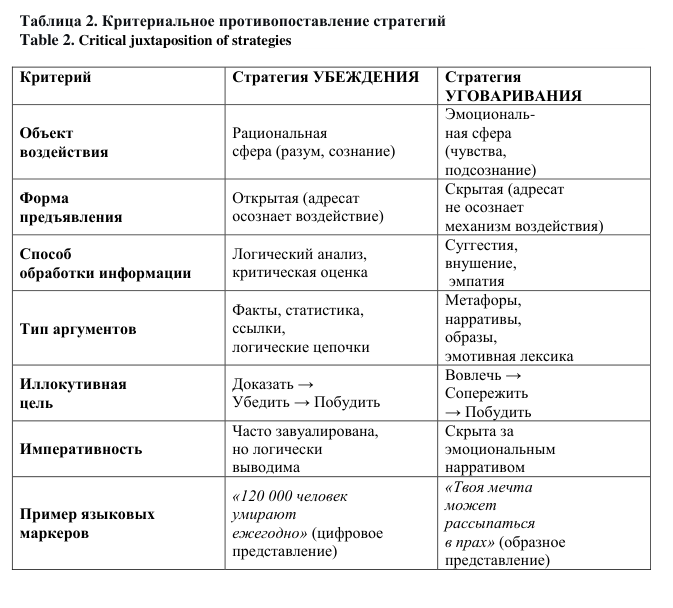
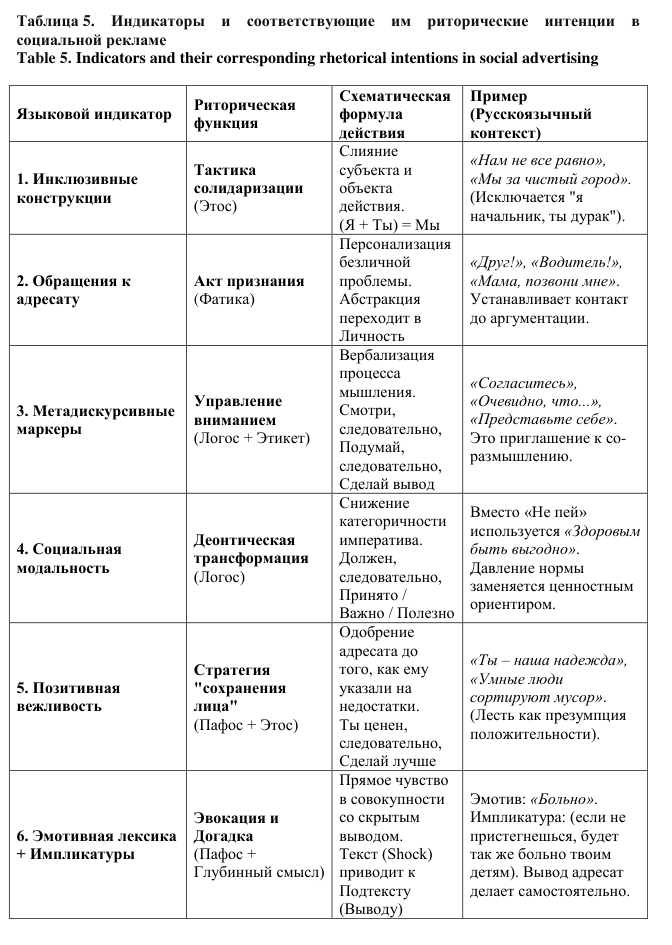
Results. Two types of persuasive strategies are distinguished: persuasion, which appeals to the rational sphere of the addressee, and coaxing (a suggestive strategy), which is focused on emotional perception. Within each strategy, speech tactics are identified and characterized. Special attention is paid to the language means of realizing persuasiveness, that is persuasive indicators: inclusive constructions, appealing to the addressee, metadiscursive markers, indicators of social modality, means of positive politeness, as well as emotive vocabulary and implicatures.
Conclusions. The conclusions emphasize that the system of persuasive indicators is multi‑level in nature. A typology of persuasive language indicators of social advertising is presented. A comparative analysis of social advertising in Russian, German and Italian reveals that the choice of persuasive means is culturally conditioned: Russian social advertising tends to use psycholinguistic techniques, German social advertising is characterised by rational argumentation, and Italian social advertising uses more playful strategies. In general, the effectiveness of social advertising in the discourse of social harmony directly depends on taking into account the cultural characteristics of the target audience.
Figures
Rarenko, M. B. (2026). Linguistic indicators of invasiveness in social advertising, Research Result. Theoretical and Applied Linguistics, 12 (3), 32–51.














While nobody left any comments to this publication.
You can be first.
Bibikova, A. M., Kurilov, A. M. (2025). Lingvopragmaticheskie aspekty meditsinskoy sotsialnoy reklamy v italyanskom mediadiskurse [Linguopragmatic aspects of medical social advertising in the Italian media discourse], Bulletin of the Moscow State Linguistic University. Humanities, Issue 11 (905), 9–15. (In Russian)
Gerasimenko, V. N., Nikolaeva, Ya. D. and Temireva, K. A. (2016). Sotsialnaya reklama v internete kak sposob konstruirovaniya sotsialnoy realnosti [Social advertising on the Internet as a way of constructing social reality], Socio-humanitarian problems of education and professional self-realization (Social Engineer-2016), Collection of materials of the All-Russian Scientific Forum of Young Researchers, 33–35. (In Russian)
Golodnov, A. V. (2010). Persuazivnaya kommunikatsiya: strategii i taktiki vozdeystviya (na materiale sovremennoy nemetskoyazychnoy reklamy [Persuasive communication: strategies and tactics of influence (based on the material of modern German-language advertising], Asterion, St. Petersburg, 244 p. (In Russian)
Golodnov, A. V. (2001). Leksicheskie markery persuazivnosti v reklamnyh sloganah [Lexical markers of persistence in advertising slogans], Multilevel characteristics of lexical units. Part 1.: Vocabulary and phraseology. Terminology, Smolensk: SSPU Publishing House, 80–86. (In Russian)
Golodnov, A. V. (2002). Lingvostilisticheskaya interpretatsiya kommunikativnyh strategiy persuazivnosti v tekstah kommercheskoy reklamy [Linguostylistic interpretation of communicative strategies of persistence in commercial advertising texts], Studia Linguistica - P. Problems of cognitive semantics, Publishing House of the Russian Academy of Medical Sciences, St. Petersburg, 114–119. (In Russian)
Zubkova, Ya. V., Ryabova, M. E. and Shatokhina, O. A. (2025). Yazykovye sredstva vyrazheniya persuazivnosti v russkoyazychnoy i nemeckoyazychnoy sotsialnoy reklame [Linguistic means of expressing persistence in Russian and German-language social advertising], Russian Social and Humanitarian Journal, No. 2 [Online], available at: www.evestnik-mgou.ru (Accessed 15.09.2026) (In Russian)
Igoshina, T. S. (2008). Sotsialnaya reklama kak forma sotsialnoy kommunikatsii i obiekt proektirovaniya [Social advertising as a form of social communication and an object of design], Almanac of Modern Science and Education, No. 4–2, 94–97. (In Russian)
Malyuga, E. N., Popova, K. V. (2018). Lingvopragmatika rechevyh strategiy v sotsialnoy reklame [Linguopragmatics of speech strategies in social advertising], Bulletin of Moscow State Regional University (electronic journal). № 4 [Online], available at: www.evestnik-mgou.ru (Accessed 15.09.2026) (In Russian)
Miroshnichenko, G. A. (2019). Vnushenie v reklame: osobennosti kommunikativnogo mekhanizma [Suggestion in advertising: features of the communicative mechanism], Bulletin of the Peoples Friendship University of Russia. Series: Literary Studies. Journalism, Vol. 24. No. 2, 264–272. (In Russian)
Rarenko, M. B. (2026). Konеыeptualnoe pole diskursa sotsialnoy garmonii [The conceptual field of the discourse of social harmony], Bulletin of Moscow State Linguistic University. The Humanities, Issue 5 (911), 76–83. (In Russian)
Rarenko, M. B. (2020). Lingvokulturnye parametry verbalizatsii sotsialnoy garmonii [Linguocultural parameters of verbalization of social harmony], Bulletin of Moscow State Linguistic University. Humanities, Issue 12 (841), 147–157. (In Russian)
Tyan, K. (2021). Sotsialnaya reklama kak sposob sotsialnoy kommunikatsii v novyh media [Social advertising as a way of social communication in new media], Successes of the Humanities, No. 7, 227–230. (In Russian)
Hu, C. (2023). Realizatsiya strategii ubezhdeniya i strategii ugovarivaniya v rossiyskoy televizionnoy reklame (na materiale videorolikov o produktah pitaniya) [Implementation of urging and persuasion strategies in Russian television advertising (based on videos about food)], Mir Nauki. Sociology, philology, cultural studies, Vol. 14. No. 4 [Online], available at: https://sfk-mn.ru/PDF/28FLSK423.pdf (Accessed 15.09.2026) (In Russian)
Chernyavskaya, V. E., Gorshkova, N. E. (2025). Gibridizatsiya zhanra v persuazivnoy kommunikatsii [Hybridization of genre in the aggressive communication], Word.ru: Baltic Accent, Vol. 16, No. 1, 74–89. (In Russian)
Annisa Zahrani, Muhammad Hamzah, Marpaung, F. S. and Simarmata, A. A. (2025). A Speech Act Analysis of Persuasion and Evaluation in Marques Brownlees “M4 MacBook Air Review: Too Easy!”, Journal of Applied Linguistics, 5 (2), 48–59. https://doi.org/10.52622/joal.v5i2.571(In English)
Ertimur, B. and Chen, S. (2026). Toward Destigmatization of Mental Health: The Institutional Role of Advertising, Journal of Advertising, 55 (1), 81–97. https://doi.org/10.1080/00913367.2025.2593665(In English)
Han, J., Ni, Y., Amon, M. J., Necaise, A., Han, M. and Lee, M. (2025). Multimodal Physiological Responses Predict Advertisement Effectiveness, Journal of Advertising, 54 (5), 693–712. https://doi.org/10.1080/00913367.2025.2524185(In English)
Isakova, I. A. (2007). Social Advertising As Cultural Phenomenon, MAN. SOCIETY. CULTURE. SOCIALIZATION,Materials of the All-Russian student conference dedicated to the 450th anniversary of Bashkirias voluntary incorporation into Russia, 2007, 48–50. (In Russian)
Lathiva Istavida and Joko Wibowo. (2026). Persuasive Illocutionary Speech Acts in Canva Advertisements on the Ptalform: A Linguistic Approach, Journal of Applied Linguistics, 5 (2), 106–114. https://doi.org/10.52622/joal.v5i2.607(In English)
Wasif Hussain and Panggabean, H. (2024). Language and Power Dynamics in Automobile Advertising: A Multimodal Discourse Analysis of Word Choice and Semiotics, Journal of Applied Linguistics, 4 (1), 71–81. https://doi.org/10.52622/joal.v4i1.242(In English)