

Cooperative responses of a voice assistant and a psychologist: adherence to the principles of Herbert Paul Grice and Geoffrey Leech
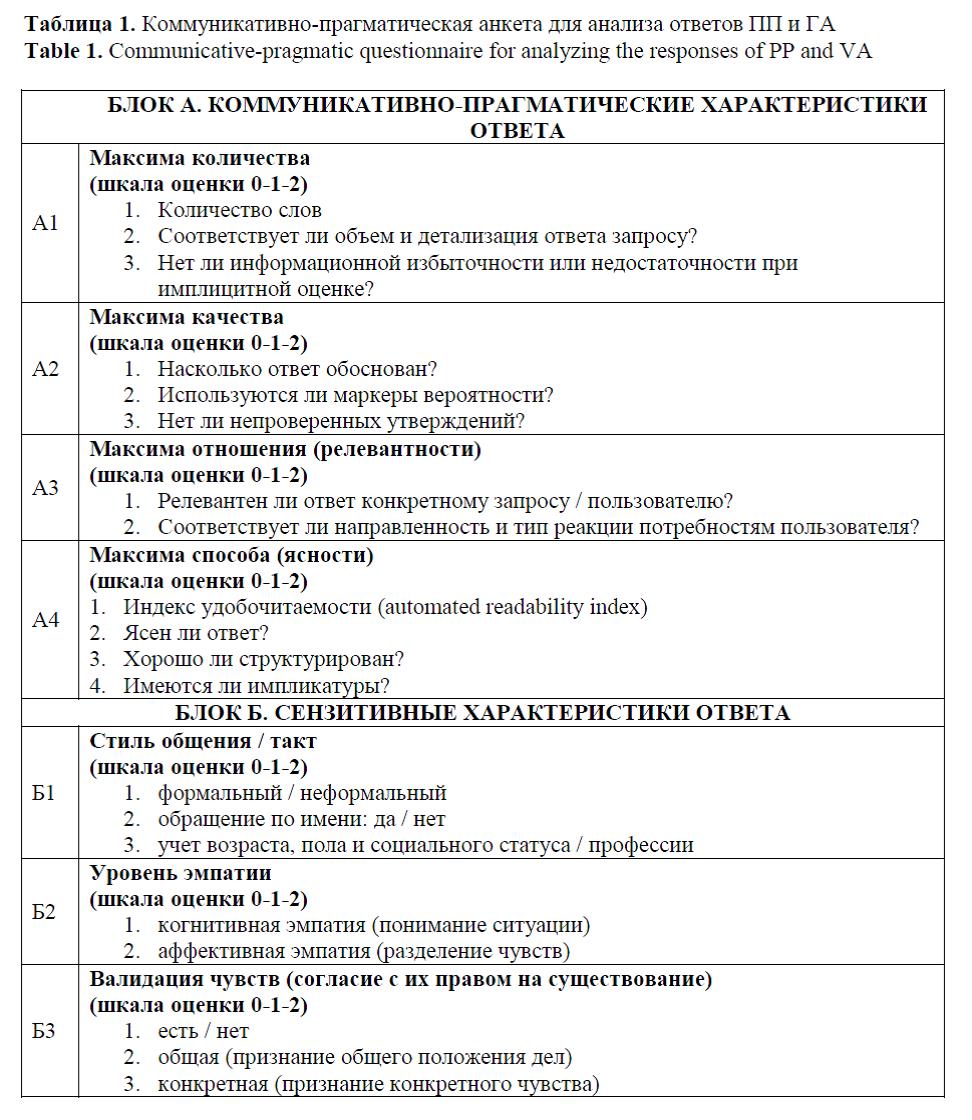
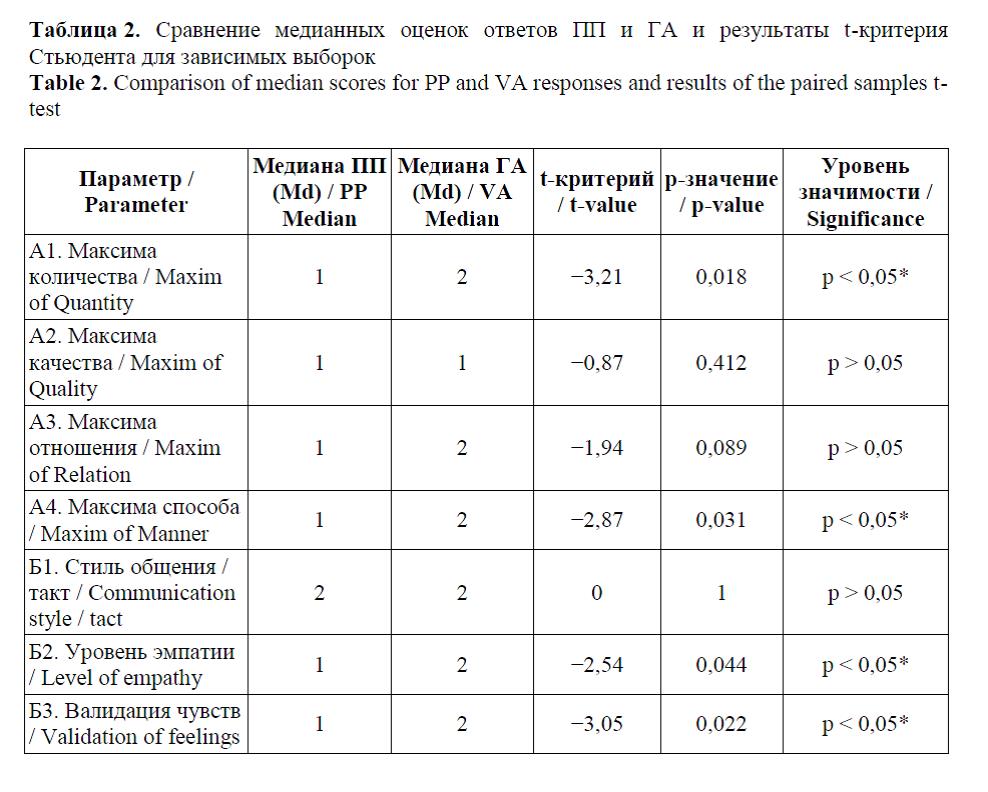
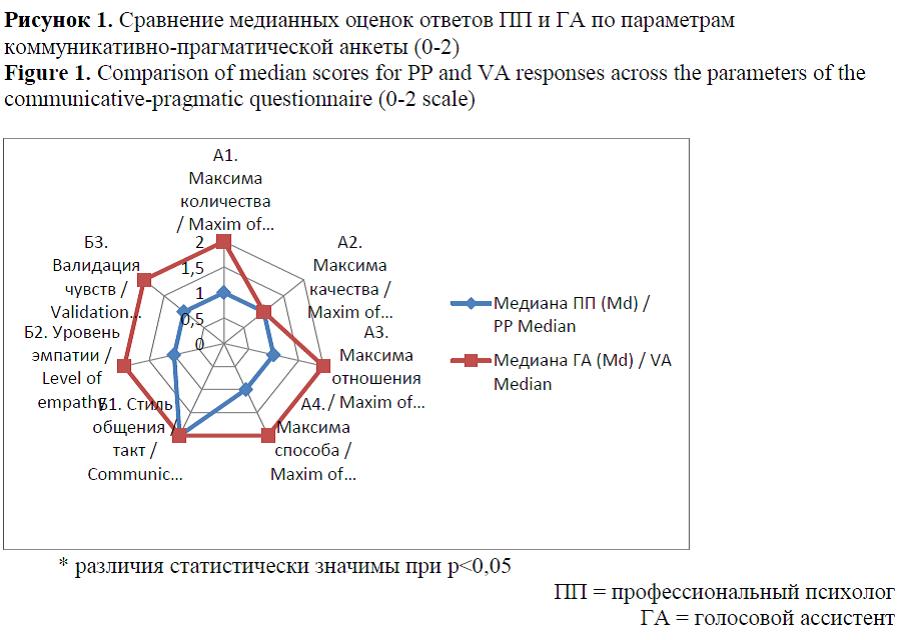
This study examines the pragmatic features of interaction with the voice assistant "Alisa" in the context of intimate-personal communication, in comparison with written Internet communication on psychological forums. As criteria for a comparative analysis of the degree of success in human interaction with a voice assistant (VA) and a professional psychologist (PP) on a forum, the cooperative principle of H. P. Grice and the politeness principle of G. Leech were used. Based on H. P. Grice's maxims and the context-sensitive characteristics of speech corresponding to the communication situation, a communicative-pragmatic questionnaire was developed. The study compared the responses of the voice assistant "Alisa" and professional psychologists to 83 inquiries from psychological support forums. Consistency was verified using Kendall's coefficient (W = 0.52–0.78). Statistically significant differences were identified in four out of seven parameters, including the characteristics of quantity, manner, empathy, and validation (p < 0.05). The experimental results show that the VA gives longer responses to the user, and its responses have an explicit structure. The VA also demonstrates higher empathy and validation of feelings. These advantages are algorithmic and template-based in nature, and in oral interaction with the VA they turn into risks. A long monologue overloads a user in a state of distress, while a multi-clause and lengthy response limits feedback. No differences were found in terms of quality, relevance, and tact. Furthermore, an analysis of cases with matching assessments showed that the coincidence of median data does not mean that the VA and PP use similar communicative strategies. Recommendations are given to developers of voice assistants, and research prospects are outlined: expanding experimental procedures and the composition of participants.
Figures
Islamov, R. S., Savelyeva, I. V. (2026). Cooperative responses of a voice assistant and a psychologist: adherence to the principles of Herbert Paul Grice and Geoffrey Leech, Research Result. Theoretical and Applied Linguistics, 12 (3), 145–169.
















While nobody left any comments to this publication.
You can be first.
Bermus, A. G. (2024). Preimushchestva i riski ispolzovaniya ChatGPT v sisteme vysshego obrazovaniya: teoreticheskiy obzor [Advantages and risks of using ChatGPT in higher education: a theoretical review], Pedagogika. Voprosy teorii i praktiki, 8. (In Russian)
Bermus, A. G. and Sizova, E. V. (2025). Eticheskie aspekty realizatsii tekhnologii iskusstvennogo intellekta v klassicheskom universitete: analiz otnosheniya studencheskoy auditorii [Ethical aspects of implementing artificial intelligence technologies in a classical university: an analysis of student attitudes], Nepreryvnoe obrazovanie: XXI vek, 13 (2), 1–16. DOI: 10.15393/j5.art.2025.10585 (In Russian)
Bushev, A. B. (1999). Yazykovye osobennosti tekstov, ispolzuemyh v psikhoterapevticheskoy kommunikatsii [Linguistic features of texts used in psychotherapeutic communication], Cand. Thesis, Tver, 245 p. (In Russian)
Gladkova, L. N., Ravedovskaya, U. Yu., Semenovskikh, T. V., Bulygina, Yu. V., Frolenkova, A. L. and Krezhevskikh, O. V. (2025). Kachestvennoe issledovanie kognitivnykh predpochteniy studentov pri ispolzovanii iskusstvennogo intellekta [Qualitative study of students’ cognitive preferences when using artificial intelligence], Science for Education Today, 15 (4), 136–157. DOI: 10.15293/2658-6762.2504.06 (In Russian)
Grice, H. P. (1985). Logika i rechevoe obshchenie [Logic and speech communication], in Novoe v zarubezhnoi lingvistike. Vyp. 16. Lingvisticheskaya pragmatika, Progress, Moscow, Russia, 217–237. (In Russian)
Grineva, M. S. (2018). Soderzhatelnye harakteristiki rechevyh deistviy prakticheskogo psikhologa v terapevticheskom diskurse [Content Characteristics of the Speech Actions of a Practical Psychologist in Therapeutic Discourse], Abstract of Candidate Thesis (Philological Sciences), Tver, 21 p. (In Russian)
Ermakova, O. P. and Zemskaya, E. A. (1993). K postroeniyu tipologiy kommunikativnykh neudach (na materiale estestvennogo russkogo dialoga) [On the construction of a typology of communication failures (on the material of natural Russian dialogue)], in Russkiy yazyk v ego funktsionirovanii. Kommunikativno-pragmaticheskiy aspect, Akademicheskiy nauchno-izdatelskiy, proizvodstvenno-poligraficheskiy i knigorasprostranitelskiy tsentr RAN; Izdatel’stvo “Nauka”, Moscow, Russia, 30–64. (In Russian)
Islamov, R. S. and Saveleva, I. V. (2025). Rol iskusstvennogo intellekta v sovremennoy povsednevnoy kommunikatsii [The role of artificial intelligence in modern everyday communication], Kommunikativnye issledovaniya, 12 (4), 821–835. DOI: 10.24147/2413-6182.2025.12(4).821-835 (In Russian)
Kilmuhametova, E. Yu. (2006). Osnovnye ponyatiya teoriy relevantnosti [Basic concepts of relevance theory], Vestnik Tomskogo gosudarstvennogo universiteta [Tomsk State University Bulletin], 291, 170–172. (In Russian)
Lenets, A. V. (2016). Lozh v kommunikatsii kak narushenie pragmaticheskikh pravil printsipa kooperatsii [Lies in communication as a violation of pragmatic rules of the cooperation principle], Verkhnevolzhskiy filologicheskiy vestnik [Verhnevolzhski Philological Bulletin], 4, 105–108. (In Russian)
Makeeva, L. B. (2022). Teoriya relevantnosti, pragmatika i problema znacheniya [Relevance theory, pragmatics and the problem of meaning], Filosofskiy zhurnal, 15 (3), 125–139. (In Russian)
Matveeva, G. G., Lenets, A. V. and Petrova, E. I. (2013). Osnovy pragmalingvistiki [Fundamentals of pragmalinguistics], Flinta, Nauka, Moscow, Russia. (In Russian)
Minzaripov, R. G. and Poroshenko, O. Yu. (2025). Sovremennye sotsialnye teoriy v issledovanii otnosheniy cheloveka i iskusstvennogo intellekta [Modern social theories in the study of human‑artificial intelligence relations], Vestnik ekonomiki, prava i sotsiologii [The Review of Economy, the Law and Sociology], 4, 288–292. DOI: 10.24412/1998-5533-2025-4-288-292 (In Russian)
Mustayoki, A. (2015). Kommunikativnye neudachi skvoz prizmu potrebnostei govoryashchego [Communication failures through the prism of the speaker’s needs], in Kibrik, A. A., Koshelev, A. D., Kravchenko, A. V., Mazurova, Yu. V. and Fedorova, O. V. (Eds.), Yazyk i mysl: sovremennaya kognitivnaya lingvistika, Yazyki slavyanskoy kultury, Moscow, Russia, 543–559. (In Russian)
Austin, J. (1986). Slovo kak deistvie [Word as action], in Novoe v zarubezhnoy lingvistike. Vyp. 17. Teoriya rechevykh aktov, Progress, Moscow, Russia, 22–31. (In Russian)
Searle, J. R. (1986). Klassifikatsiya illokutivnykh aktov [Classification of illocutionary acts], in Novoe v zarubezhnoy lingvistike. Vyp. 17. Teoriya rechevykh aktov, Progress, Moscow, Russia, 170–194. (In Russian)
Paducheva, E. V. (1982). Pragmaticheskie aspekty svyaznosti dialoga [Pragmatic aspects of dialogue coherence], Izvestiya Akademiy nauk SSSR. Seriya literatury i yazyka [Proceedings of the USSR Academy of Sciences. Literature and Language Series], Nauka, Moscow, Russia, 41 (4), 305–313. (In Russian)
Penkov, B. V., Agafonova, L. I., Smolenchuk, O. Yu. and Vinogradova, E. V. (2025). Empiricheskiy analiz funktsionala iskusstvennogo intellekta v prepodavanii angliyskogo yazyka [Empirical analysis of artificial intelligence functionality in English language teaching], Filosofiya obrazovaniya [Philosophy of Education], 25 (2), 159–174. DOI: 10.15372/PHE20250211 (In Russian)
Perov, V. Yu. (2024). Ideya moralnoy avtonomii v filosofii I. Kanta i eticheskie problemy sistem iskusstvennogo intellekta [The idea of moral autonomy in I. Kant’s philosophy and ethical problems of artificial intelligence systems], Diskursy etiki, 3–4 (23–24), 13–24. (In Russian)
Formanovskaya, N. I. (2007). Rechevoe vzaimodeistvie: kommunikatsiya i pragmatika [Speech interaction: communication and pragmatics], Moscow, Russia. (In Russian)
Hutyz, I. P. (2019). Narushenie maksim kommunikatsii P. Graisa kak strategiya effektivnogo lektsionnogo diskursa [Violation of Grice’s communication maxims as a strategy of effective lecture discourse], Kommunikativnye issledovaniya, 6 (2), 451–464. (In Russian)
Boyić, L., Kovačević, P. Čabarkapa, M. (2025). Does GPT-4 surpass human performance in linguistic pragmatics? Humanities and Social Sciences Communications, 12, 794. DOI: 10.1057/s41599-025-04912-x (In English)
Codreanu, T. (2026). Cooperation After the Algorithm: Designing Human-AI Coexistence Beyond the Illusion of Collaboration, Computer Science, arXiv:2602.19629. DOI: 10.48550/arXiv.2602.19629 (In English)
Edwards, C., Edwards, A., Spence, P. R. and Westerman, D. (2016). Initial Interaction Expectations with Robots: Testing the Human-To-Human Interaction Script, Communication Studies, 67 (2), 227–238. https://doi.org/10.1080/10510974.2015.1121899(In English)
Glikson, E., Woolley, A. W. (2020). Human trust in artificial intelligence: Review of empirical research, Academy of Management Annals, 14 (2), 627–660. DOI: 10.5465/annals.2018.0057 (In English)
Greussing, E., Gaiser, F., Klein, S. H. et al. (2022). Researching interactions between humans and machines: methodological challenges, Publizistik, 67, 531–554. DOI: 10.1007/s11616-022-00759-3 (In English)
Grice, H. P. (1975). Logic and conversation. In P. Cole and J.J. Morgan (eds.) Syntax and Semantics IYI - Speech Acts, New York: Academic Press, 41–58. (In English)
Guzman, A. L., Lewis, S. C. (2020). Artificial Intelligence and Communication: A human–machine communication research agenda, New Media and Society, 22(1), 70–86. DOI: 10.1177/1461444819858691 (In English)
Hertz, N., Wiese, E. (2019). Good advice is beyond all price, but what if it comes from a Machine?, Journal of Experimental Psychology Applied, 25 (3), 386–395. DOI: 10.1037/xap0000205 (In English)
Hill, J., Randolph Ford, W., Farreras, I. G. (2015). Real conversations with artificial intelligence: A comparison between human-human online conversations and human–chatbot conversations, Computers in Human Behavior, 49, 245–250. DOI: 10.1016/j.chb.2015.02.026 (In English)
Horn, L. R., Ward, G. (Eds.) (2006). The Handbook of pragmatics. Blackwell Publishing. 867 p. (In English)
Jain, R., Kumar, A. (2025). From what (motives) to what (outcomes) of relationships with artificially intelligent voyce assistants, International Journal of Information Management, 85, 102953. DOI: 10.1016/j.iyinfomgt.2025.102953 (In English)
Kim, Y., Sundar, S. S. (2012). Anthropomorphism of computers: Is it mindful or mindless?, Computers in Human Behavior, 28 (1), 241–250. DOI: 10.1016/j.chb.2011.09.006 (In English)
Kosinski M (2023). Theory of Mind May Have Spontaneously Emerged in Large Language Models. ArXiv. DOI: 10.48550/arXiv.2302.02083
Leech, G., Larina, T. V. (2014). Politeness: West and East, Russian Journal of Linguistics, 4, 9–34.
Leech, G. (1983). Principles of Pragmatics, London, Longman.
Levinson, S. C. (1983). Pragmatics, Cambridge University Press, Cambridge, 420 p.
Levitt, H. M., Lu, E., Pomerville, A., Surace, F. (2015). Pursuing the question of reflexivity in psychotherapy and qualitative methods: The contributions of David L. Rennie, Counselling and Psychotherapy Research, 15 (1), 3–11. DOI: 10.1002/capr.12021. (In English)
Rapp, A., Curti, L., Boldi, A. (2021). The human side of human-chatbot interaction: A systematic literature review of ten years of research on text-based chatbots, International Journal of Human-Computer Studies, 151. DOI: 10.1016/j.iyhcs.2021.102630 (In English)
Saavedra, A. (2026). Voyce Assistants: Harmonizing Human-Computer Interactions, International Encyclopedia of Business Management, 3, 584–587. (In English)
Scolari, C.-A. (2024). Start making sense. Sociosemiotic contributions to the understanding of Generative Artificial Intelligences, Communication & Society, 37(4), 293–308. DOI: 10.15581/003.37.4.293-308 (In English)
Shannon, C. E. (1948). A Mathematical Theory of Communication, The Bell System Technical Journal, 27, 379–423, 623–656. (In English)
Spence, P. R. (2019). Searching for questions, original thoughts, or advancing theory: Human-machine communication, Computers in Human Behavior, 90, 285–287. DOI: 10.1016/j.chb.2018.09.014 (In English)
Sperber, D., Wilson, D. (1995). Relevance Communication and Cognition. Second Edition. Blackwell Ltd. 331 p.
Sperber, D., Wilson, D. (2006). Relevance theory. In Horn, L.& Ward, G. (eds.). The Handbook of Pragmatics, 607–632. (In English)
Sumina, N. V. (2017). Soderzhatel’nye harakteristiki rechevyh dejstviy prakticheskogo psihologa v terapevticheskom diskurse [Semantic and pragmatic characteristics of psychotherapeutic discourse], Abstract of Cand. Thesis (Philology Sc.), Nalchik, 22 p. (In Russian)
Ullman, D., Malle, B. F. (2018). What does it mean to trust a robot? Steps toward a multidimensional measure of trust. HRI 18 Companion, 263–264. DOI: 10.1145/3173386.3176991 (In English)