

Distribution of Evidential Meanings in Elicited Narratives in Native and Non-Native Russian
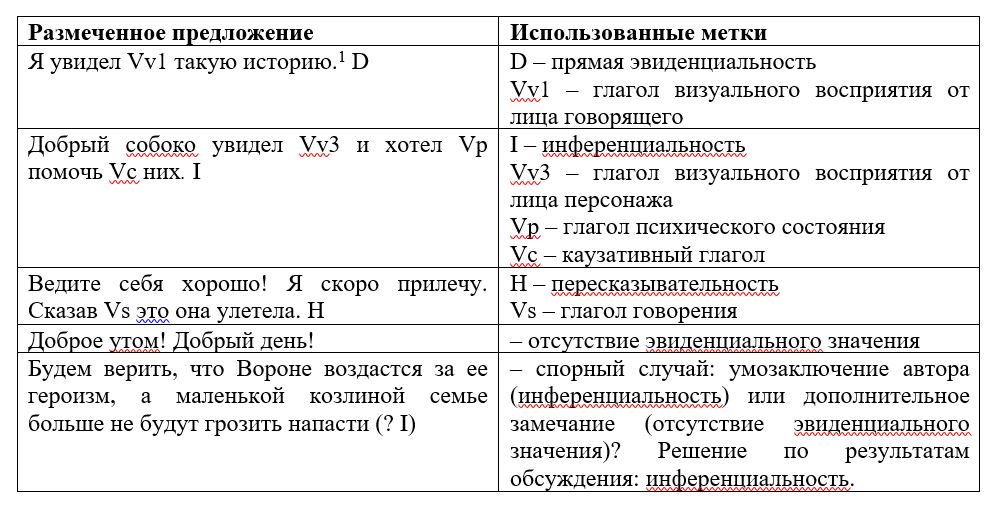
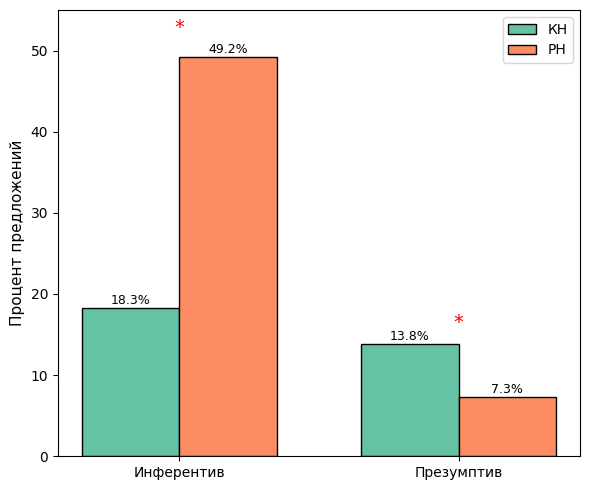
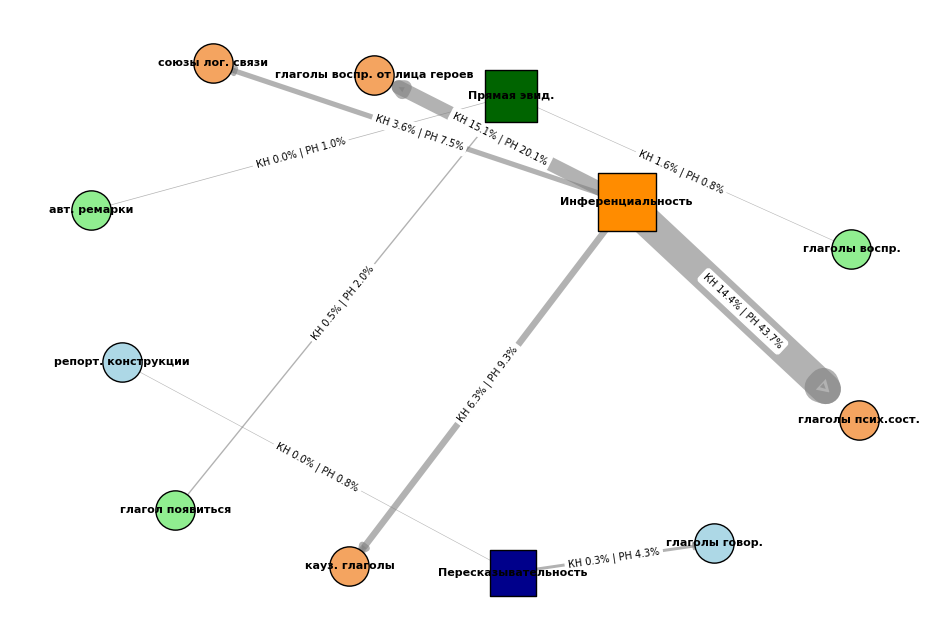
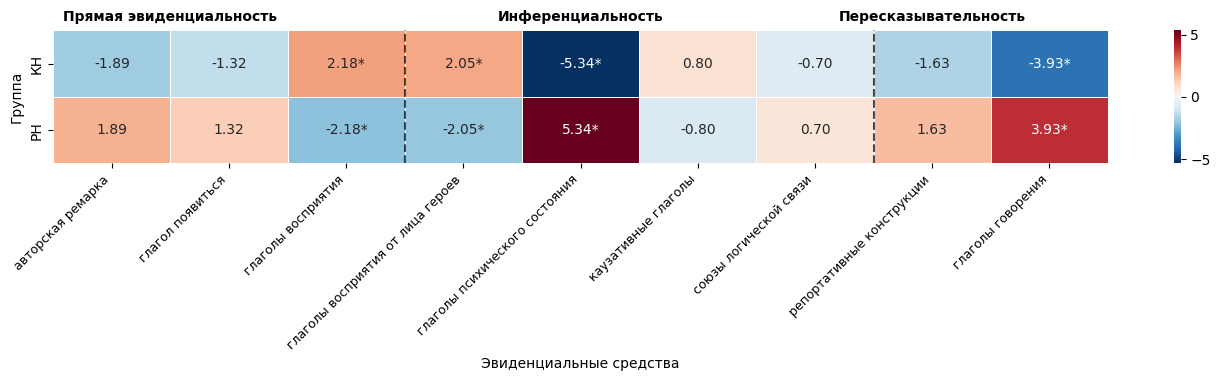
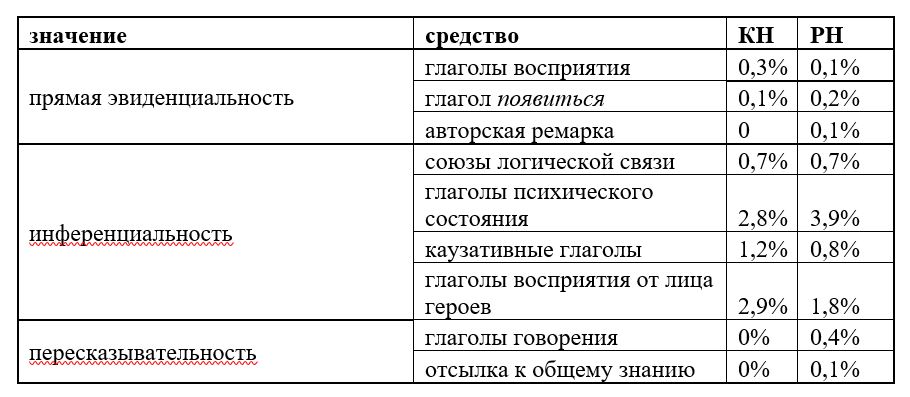
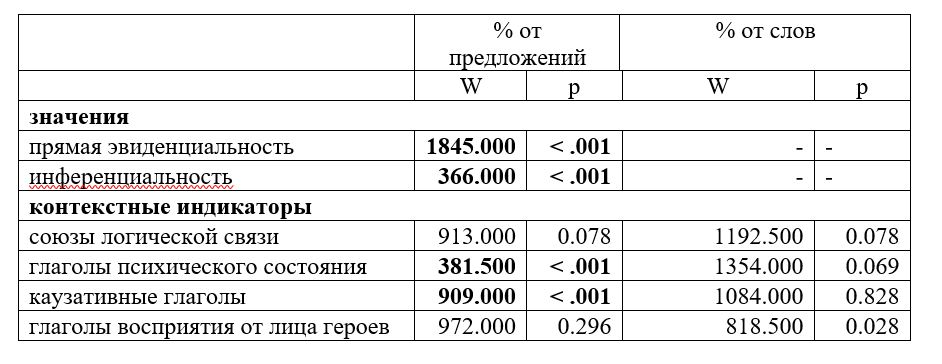
The study provides a quantitative and qualitative comparison of evidential strategies in written Russian narratives produced by native and non-native speakers. Despite a substantial body of research on evidentiality from a typological perspective and its first language acquisition by children, the question of how adult learners implement evidential meanings in written L2 production remains open. The aim is to identify differences in the distribution of evidential meanings and their linguistic encoding across the two groups. The research is conducted within a functional-semantic framework and employs quantitative statistical methods. The material consists of 60 texts produced by Chinese learners of Russian (A2 proficiency) and 39 texts by native Russian speakers, collected using the Multilingual Assessment Instrument for Narratives (MAIN). The distribution of three main evidential meanings (direct evidentiality, inference, hearsay) was analyzed, as well as their verbal realization at the level of specific lexico-grammatical markers. While the overall proportion of evidential clauses is comparable across groups (approximately 89%), the distribution of evidential types differs significantly. Chinese learner narratives are dominated by direct evidentiality, reflecting a predominantly descriptive strategy focused on the immediate description of observable events. Native speaker narratives, in contrast, are characterized by a predominance of inference, expressed through the frequent use of mental state verbs, perception verbs attributed to characters, and evaluative markers. Hearsay is virtually absent in the non-native group, whereas native speakers employ it to convey narrative dialogicity. Adult L2 learners successfully transfer basic cognitive mechanisms of source monitoring to the target language, but at the A2 level their evidential competence manifests in a simplified strategy characterized by a focus on description. The findings have direct pedagogical implications for teaching Russian as a foreign language: developing interpretative skills and expanding the repertoire of evidential devices should be a priority at advanced stages of learning.
Figures

Krasnoshchekova, S. V., Galkina, E. V., Wang, Y. (2026). Distribution of Evidential Meanings in Elicited Narratives in Native and Non-Native Russian, Research Result. Theoretical and Applied Linguistics, 12 (2), 139–163.
















While nobody left any comments to this publication.
You can be first.
Astakhova, T. N. (2014). Manifestations of evidentiality and authority in German mass media texts. Vestnik of Northern (Arctic) Federal University. Series “Humanitarian and Social Sciences”, 1, 71–75. (In Russian)
Boldyrev, N. N. (2006). Yazykovye kategorii kak format znaniya [Language categories as a format of knowledge]. Issues of Cognitive Linguistics, (2) 7, 5–22. (In Russian)
Bondarko, A. V. (2011). Kategorizatsiya v sisteme grammatiki [Categorization in the system of grammar]. LRC Publishing House, Moscow, Russia. (In Russian)
Borisova, O. S. (2025). Razvitie kommunikativnykh navykov na zanyatiyakh RKI pri izuchenii ehvidentsialnykh konstruktsii [The development of communicative skills in Russian as a foreign language classes through the study of evidential constructions], in IX Mezhdunarodnyi kongress «Dovuzovskii etap obucheniya v Rossii i mire: yazyk, adaptatsiya, sotsium, spetsialnost» [The IX International Congress “Pre-University Education in Russia and the World: Language, Adaptation, Society, Specialty”]. Moscow, 11 p. Available at: https://disk.yandex.ru/d/umbIKnBoo3GIAw (Accessed 23 January 2026). (In Russian)
Grigorenko, M. Yu. (2009). Modusnyy status evidentsialnosti v sovremennom russkom yazyke [Modus status of evidentiality in modern Russian], Russian Studies in Philology, (4), 73–77. (In Russian)
Ivanova, S. V. and Khakimova, G. Sh. (2024). Ehvidentsialnost' i ehpistemicheskaya modalnost': sopryazhenie na urovne semantiki slova [Evidentiality and epistemic modality: Overlap view within word semantics], Vestnik of Saint Petersburg University. Language and Literature, 21 (4), 801–823. (In Russian)https://doi.org/10.21638/spbu09.2024.403
Kobrina, O. A. (2005). Kategoriya evidentsialnosti: ee status i formy vyrazheniya v raznykh yazykakh [The category of evidentiality: its status and forms of expression in different languages], Issues of Cognitive Linguistics, (1), 86–98. (In Russian)
Kozintseva, N. A. (2007). Tipologiya kategorii zasvidetelstvovannosti [Typology of the category of evidentiality], in V. S. Khrakovskii (ed.), Ehvidentsialnost v yazykakh Evropy i Azii [Evidentiality in the languages of Europe and Asia], Nauka, St. Petersburg, 13–36. (In Russian)
Kozlovsky, D. V. (2022). Tipy vzaimodeistviya modusnoi kategorii «ehvidentsialnost» s drugimi modusnymi kategoriyami [Types of interaction of the modus category “evidentiality” with other modus categories], Bulletin of Udmurt University. Series History and Philology, 32 (5), 1027–1036. (In Russian)https://doi.org/10.35634/2412-9534-2022-32-5-1027-1036
Nikitina, E. N. (2013). Null subjects and perceptive mode (on the expression of evidentiality in Russian), Voprosy yazykoznaniya, (2), 69–82. (In Russian)
Paducheva, E. V. (2013). Is there grammatically expressed evidentiality in Russian?, Russian Language and Linguistic Theory, (2) 26, 9–29. (In Russian)
Plungian, V. A. (2011). Vvedenie v grammaticheskuyu semantiku: grammaticheskie znacheniya i grammaticheskie sistemy yazykov mira [Introduction to grammar semantics: Grammar meaning and grammar systems in the languages of the world]. RGGU, Moscow, Russia. (In Russian)
Postnikova, A. E. (2020). Grammaticalization and the typology of evidential systems. Tipologiya morfosintaksicheskikh parametrov [Typology of Morphosyntactic Parameters], 3 (2), 147–165. (In Russian)
Safina, A. R. (2016). Theoretical aspects of studying epistemic modality and evidentiality. Philology. Theory & Practice, 9 (2), 142–145. (In Russian)
Strakhova, V. S. (2016). Evidential markers in the language of mass media. Vestnik of Moscow State Linguistic University. Humanities, (6) 745, 165–174. (In Russian)
Khrakovskii, V. S. (2007). Evidentiality, epistemic modality, (ad)mirative, in: V. S. Khrakovskii (ed.), Ehvidentsialnost v yazykakh Evropy i Azii [Evidentiality in the languages of Europe and Asia]. Nauka, St. Petersburg, Russia, 600–631. (In Russian)
Shestukhina, I. Yu. (2009). Kategoriya evidentsialnosti v russkom narrativnom tekste: kommunikativno-pragmaticheskiy aspekt [The category of evidentiality in Russian narrative text: a communicative-pragmatic aspect], Abstract of Ph.D. dissertation, Altai State University, Barnaul, Russia. (In Russian)
Aikhenvald, A. Y. (2004). Evidentiality, Oxford University Press, Oxford, UK. (In English)
Aksu-Koç, A. (2000). Some aspects of the acquisition of evidentials in Turkish, in: L. Johanson and B. Utas (eds.), Evidentials. De Gruyter, Berlin, Germany, 15–28. https://doi.org/10.1515/9783110805284.15(In English)
Arslan, S., Bastiaanse, R. and Felser, C. (2015). Looking at the evidence in visual world: eye-movements reveal how bilingual and monolingual Turkish speakers process grammatical evidentiality, Frontiers in Psychology, 6, 1–13. https://doi.org/10.3389/fpsyg.2015.01387(In English)
Brugman, C. M. and Macaulay, M. (2015). Characterizing evidentiality, Linguistic Typology, 19 (2), 201–237. https://doi.org/10.1515/lingty-2015-0007(In English)
Cornillie, B. (2009). Evidentiality and epistemic modality: On the close relationship between two different categories, Functions of Language, 16 (1), 44–62. https://doi.org/10.1075/fol.16.1.04cor(In English)
De Villiers, J. G. and Garfield, J. (2009). Evidentiality and narrative, Journal of Consciousness Studies, 16 (6–8), 191–217. (In English)
De Villiers, J. G., Garfield, J., Gernet-Girard, H., Roeper, T. and Speas, M. (2009). Evidentials in Tibetan: Acquisition, semantics, and cognitive development, New Directions for Child and Adolescent Development, 125, 29–47. https://doi.org/10.1002/cd.248(In English)
Gagarina, N., Klop, D., Kunnari, S., Tantele, K., Välimaa, T., Bohnacker, U. and Walters, J. (2019). MAIN: Multilingual Assessment Instrument for Narratives – Revised, ZAS Papers in Linguistics, 63, 1–20. https://doi.org/10.21248/zaspil.63.2019.516(In English)
Ishida, K. (2006). How can you be so certain? The use of hearsay evidentials by English-speaking learners of Japanese, Journal of Pragmatics, 38 (8), 1281–1304. https://doi.org/10.1016/j.pragma.2005.10.006(In English)
Kaya-Soykan, D., Antonova-Unlu, E. and Sagin-Simsek, C. (2023). The production and perception of Turkish evidentiality markers by Turkish-German returnees, Applied Linguistics Review, 14 (2), 251–270. https://doi.org/10.1515/applirev-2020-0042(In English)
Kittilä, S. (2019). General knowledge as an evidential category, Linguistics, 57 (6), 1271–1304. https://doi.org/10.1515/ling-2019-0027(In English)
Kosta, P. and Iskakova, G. Zh. (2022). New tendencies in the study of modality: epistemic modality and evidentiality, Bulletin of the Moscow State Regional University (Linguistics), 6, 25–40. https://doi.org/10.18384/2310-712x-2022-6-25-40(In English)
Krasnoshchekova, S. and Kashleva, K. (2019). Narrative competence of adult L2 Russian learners, Journal of Psycholinguistic Research, 48 (3), 617–641. https://doi.org/10.1007/s10936-018-9622-3(In English)
Leclercq, P. and Mélac, E. (2021). Second language acquisition of evidentiality in French and English in a narrative task. Language, Interaction and Acquisition, 12 (2), 251–283. https://doi.org/10.1075/lia.20025.lec(In English)
Mushin, I. (2000). Evidentiality and deixis in narrative retelling, Journal of Pragmatics, 32 (7), 927–957. https://doi.org/10.1016/S0378-2166(99)00085-5(In English)
Mushin, I. (2013). Making knowledge visible in discourse: Implications for the study of linguistic evidentiality, Discourse Studies, 15 (5), 627–645. https://doi.org/10.1177/1461445613501447(In English)
Narita, R. (2012). The effects of pragmatic consciousness-raising activity on the development of pragmatic awareness and use of hearsay evidential markers for learners of Japanese as a foreign language, Journal of Pragmatics, 44 (1), 1–29. https://doi.org/10.1016/j.pragma.2011.09.016(In English)
Nuckolls, J. B. and Michael, L. (2014). Evidentials and evidential strategies in interactional and socio-cultural context, in: J. B. Nuckolls and L. Michael (eds.), Benjamins Current Topics, John Benjamins Publishing Company, Amsterdam, Netherlands, 13–20. https://doi.org/10.1075/bct.63.03int(In English)
Ozturk, O. and Papafragou, A. (2016). The acquisition of evidentiality and source monitoring, Language Learning and Development, 12 (2), 199–230. https://doi.org/10.1080/15475441.2015.1024834(In English)
Peterson, T. (2016). Mirativity as surprise: Evidentiality, information, and deixis, Journal of Psycholinguistic Research, 45 (6), 1327–1357. https://doi.org/10.1007/s10936-015-9408-9(In English)
Rett, J. and Hyams, N. (2014). The acquisition of syntactically encoded evidentiality, Language Acquisition, 21 (2), 173–198. https://doi.org/10.1080/10489223.2014.884572(In English)
Tosun, S. and Filipović, L. (2025). Better late than early: The effect of formal second language training on processing of evidentiality in Turkish-English bilinguals, International Journal of Bilingualism, 29(4), 1008–1026. https://doi.org/10.1177/13670069241266340(In English)
Tournadre, N. and LaPolla, R. J. (2014). Towards a new approach to evidentiality: Issues and directions for research, Linguistics of the Tibeto-Burman Area, 37 (2), 240–263. https://doi.org/10.1075/ltba.37.2.04tou(In English)
Ünal, E. and Papafragou, A. (2020). Relations between language and cognition: Evidentiality and sources of knowledge, Topics in Cognitive Science, 12 (1), 115–135. https://doi.org/10.1111/tops.12355(In English)
Verhees, S. (2019). Defining evidentiality, Voprosy Jazykoznanija, 6, 113–133. https://doi.org/10.31857/S0373658X0007549-2(In English)
Wiemer, B. (2010). Hearsay in European languages: Toward an integrative account of grammatical and lexical marking, in: G. Diewald and E. Smirnova (eds.), Linguistic Realization of Evidentiality in European Languages, De Gruyter Mouton, Berlin, Germany, 59–130. https://doi.org/10.1515/9783110223972.59(InEnglish)
The study was supported by the Russian Science Foundation, project no. 25-18-00938“Evidential Strategies in Light of Corpus and Experimental Data (Based on Structurally Diverse Languages)”.