

Cognitive-semantic mechanisms of collective conceptualization in English animal community nominations: a corpus-based analysis
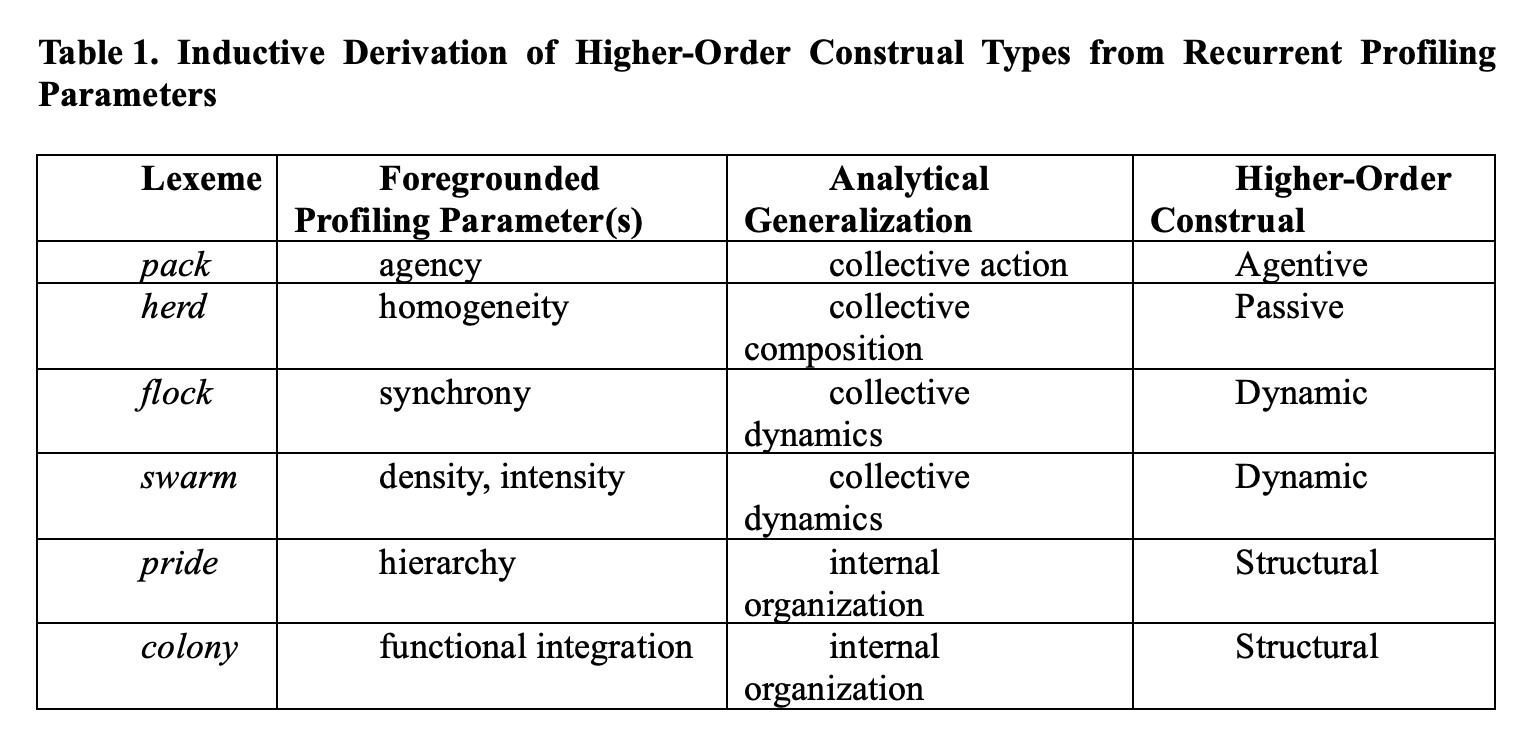
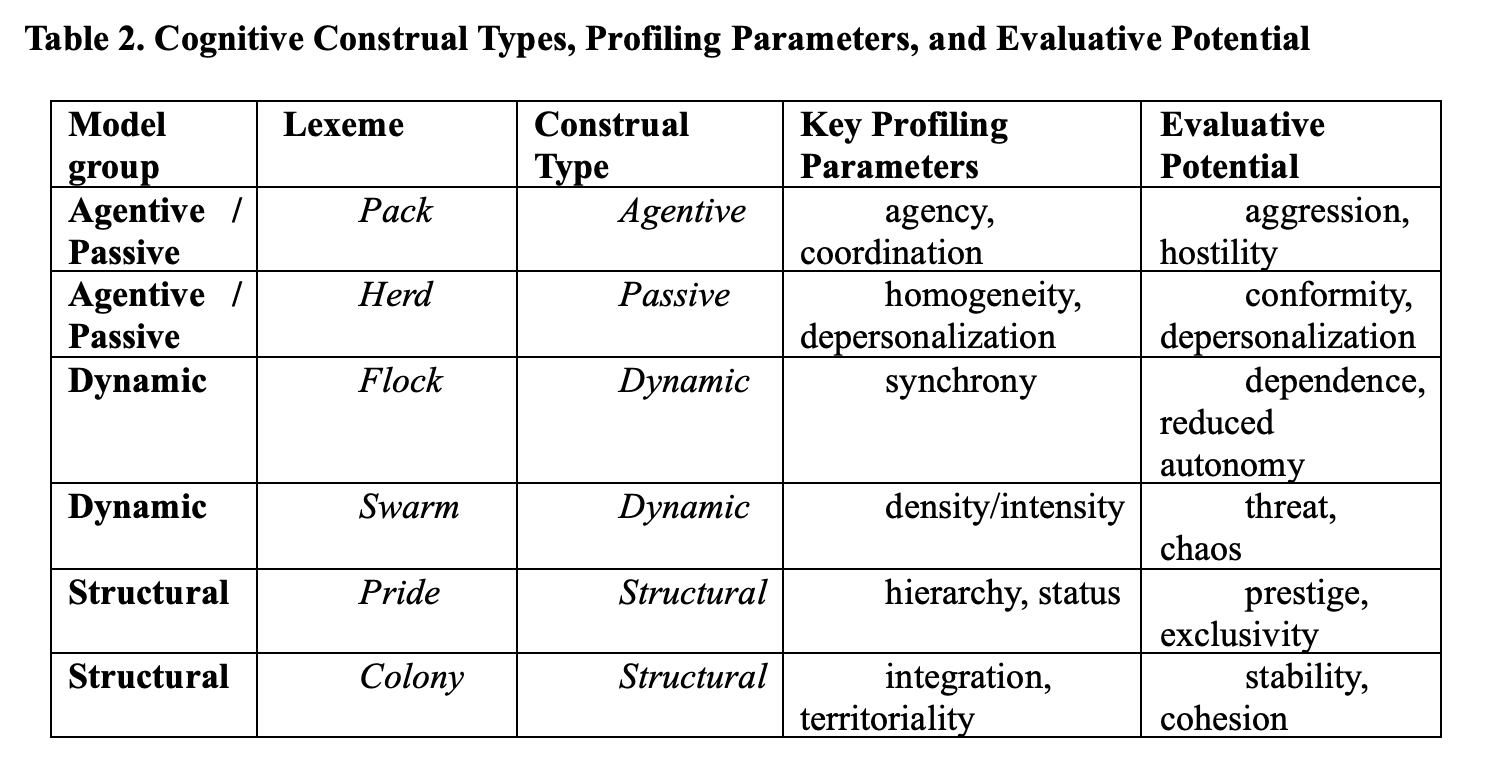
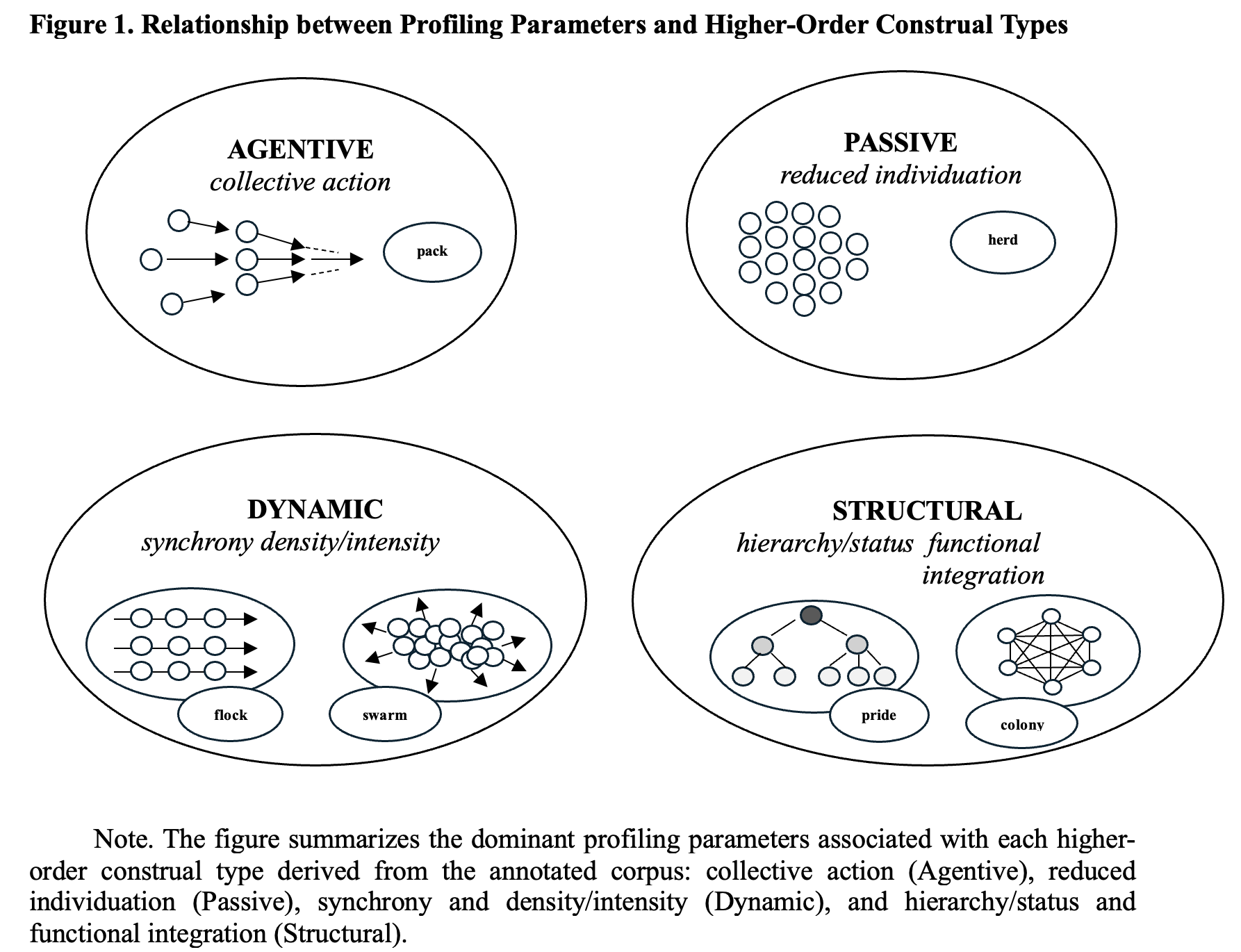
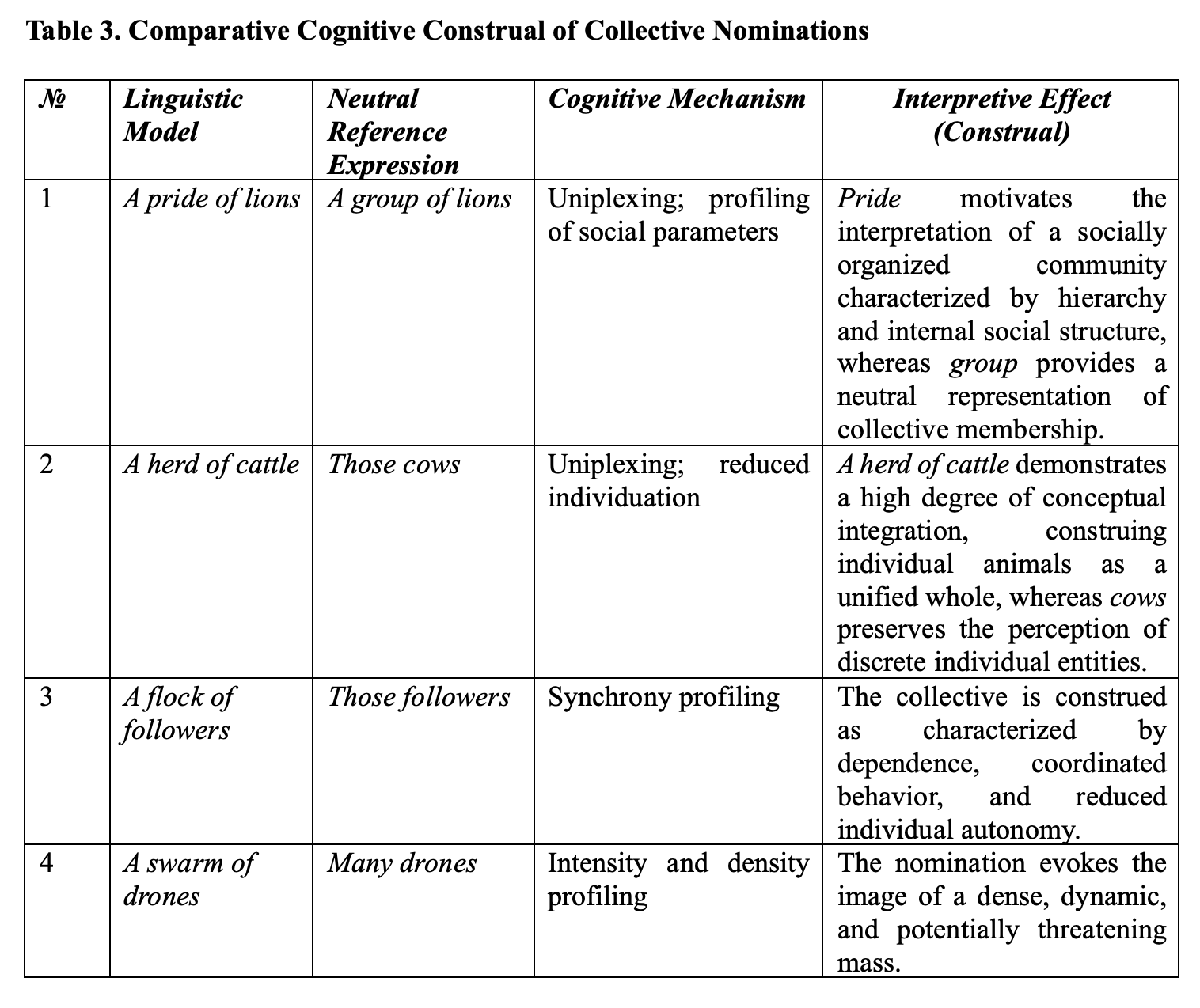
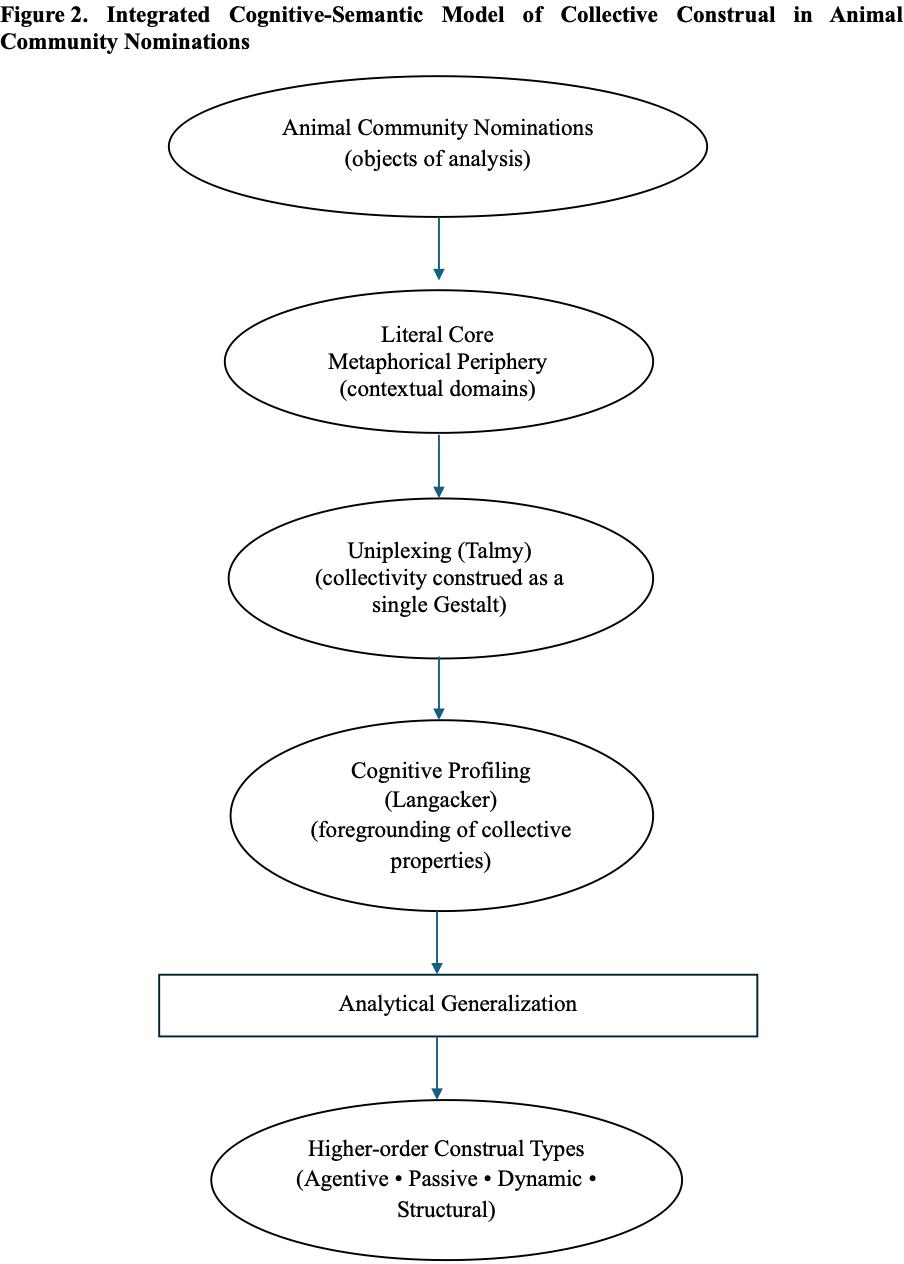
English animal group nouns not only denote groups of animals but also reflect different ways of construing multiple entities as a unified whole, making their role in the conceptualization of collectivity a relevant object of cognitive-semantic research. Although previous studies have examined collective nouns, cognitive profiling, metaphorical extension, and evaluative meaning from different theoretical perspectives, the interaction of these mechanisms in the use of animal group nouns remains insufficiently explored. The present study focuses on six such lexical items – herd, pack, flock, swarm, pride, and colony – and aims to identify the cognitive-semantic mechanisms underlying their literal and metaphorically extended uses. The data were retrieved from the Corpus of Contemporary American English (COCA) for the period 2010 – 2019. Of the initial 2,563 contexts, 1,804 were retained after manual screening: 773 were classified as literal and 1,031 as metaphorically extended. The methodology involved distinguishing between literal and metaphorically extended uses in accordance with the principles of MIPVU, identifying cognitive profiling parameters, inductively generalizing these parameters into higher-order construal types, and conducting a contextual analysis of evaluative potential. The results show that metaphorically extended uses project selected characteristics of animal group organization onto social, technological, and abstract phenomena. The identified profiling parameters were grouped into four higher-order construal types: Agentive, Passive, Dynamic, and Structural. The analysis suggests that the evaluative tendencies associated with these types emerge through the interaction between the profiled characteristics and the immediate discourse context rather than constituting fixed components of lexical meaning. The study is limited to six selected nominations and COCA data from 2010 – 2019; therefore, the proposed typology should be regarded as an analytical generalization rather than an exhaustive classification. The findings indicate an interrelationship between uniplexing, cognitive profiling, metaphorical extension, and evaluative potential in the conceptualization of collectivity.
Figures
Zhemileva, М. М., Quero Gervilla, E. F. (2026). Cognitive-semantic mechanisms of collective conceptualization in English animal community nominations: a corpus-based analysis, Research Result. Theoretical and Applied Linguistics, 12 (3), 113–144.
















While nobody left any comments to this publication.
You can be first.
Boldyrev, N.N. (2014). Kognitivnaya semantika: vvedenie v kognitivnuyu lingvistiku. [Cognitive Semantics: An Introduction to Cognitive Linguistics]. Izd-vo TGU im. G.R. Derzhavina, Tambov, Russia. (In Russian)
Corbett, G.G. (2000). Number. Cambridge University Press, Cambridge, UK. (In English)
Croft, W. and Cruse, D.A. (2004). Cognitive Linguistics. Cambridge University Press, Cambridge, UK. (In English)
Crystal, D. (2011). The Story of English in 100 Words. Profile Books, London, UK. (In English)
Davies, M. (2008–present). The Corpus of Contemporary American English (COCA), available at: https://www.english-corpora.org/coca/ (Accessed 10 July, 2026). (In English)
de Vries, H. (2021). ‘Collective nouns’, in Cabredo Hofherr, P. and Doetjes, J. (eds), The Oxford Handbook of Grammatical Number. Oxford University Press, Oxford, UK, 257–274. https://doi.org/10.1093/oxfordhb/9780198795858.013.12(In English)
Evans, V. and Green, M. (2006). Cognitive Linguistics: An Introduction. Edinburgh University Press, Edinburgh, UK. (In English)
Fillmore, C. J. (1982). Frame Semantics, in Linguistics in the Morning Calm, Hanshin Publishing Company, Seoul, South Korea, 111–137. (In English)
Fillmore, C. J. and Atkins, B.T. (1992). Toward a frame-based lexicon: the semantics of RISK and its neighbors, in Lehrer, A. and Kittay, E.F. (eds), Frames, Fields, and Contrasts. Lawrence Erlbaum, Hillsdale, NJ, USA, 75–102. (In English)
Geeraerts, D. (2009). Theories of Lexical Semantics. Oxford University Press, Oxford, UK. (In English)
Hart, C. (2014). Discourse, Grammar and Ideology: Functional and Cognitive Perspectives. Bloomsbury Academic, London, UK. (In English)
Hart, C. and Marmol Queralto, J. (2021). ‘What can cognitive linguistics tell us about language-image relations? A multidimensional approach to intersemiotic convergence in multimodal texts’, Cognitive Linguistics, 32 (4), 529–562. https://doi.org/10.1515/cog-2021-0039(In English)
Ji Ji. and Liang. M. (2018). An animacy hierarchy within inanimate nouns: English Corpus evidence from a prototypical perspective, Lingua, 205, 71–89. (In English)
Joosten, F., De Sutter, G., Drieghe, D., Grondelaers, S., Hartsuiker, R.J. and Speelman, D. (2007). Dutch collective nouns and conceptual profiling, Linguistics, 45 (1), 85–132. (In English)
Kövecses, Z. (2005). Metaphor in Culture: Universality and Variation. Cambridge University Press, Cambridge, UK. (In English)
Lakoff, G. (1987). Women, Fire, and Dangerous Things: What Categories Reveal about the Mind. University of Chicago Press, Chicago, IL, USA. (In English)
Lakoff, G. and Johnson, M. (2003). Metaphors We Live By. University of Chicago Press, Chicago, IL, USA. (In English)
Langacker, R.W. (1987). Foundations of Cognitive Grammar. Vol. 1: Theoretical Prerequisites. Stanford University Press, Stanford, CA, USA. (In English)
Levin, M. (2001). Agreement with Collective Nouns in English. Lund University, Lund, Sweden. (In English)
Lipton, J. (1977). An Exaltation of Larks, or The Venereal Game. Expanded 2nd ed. Viking Press, New York, NY, USA. (In English)
Musolff, A. (2016). Political Metaphor Analysis: Discourse and Scenarios. Bloomsbury Academic, London, UK. (In English)
Pulatova, S. and Kim, L.H. (2024). Co-designing programmable fidgeting experience with swarm robots for adults with ADHD, in Proceedings of the 26th International ACM SIGACCESS Conference on Computers and Accessibility (ASSETS ‘24). ACM, New York, NY, USA, 1–14. https://doi.org/10.1145/3663548.3675614(In English)
Rosenberg, L., Willcox, G., Schumann, H. and Mani, G. (2024). Towards Collective Superintelligence: Amplifying Group IQ using Conversational Swarms. arXiv preprint arXiv:2401.15109 [Online], available at: https://arxiv.org/abs/2401.15109 (Accessed 10 July 2026). (In English)
Rosch, E. (1978). Principles of Categorization, in Rosch, E. and Lloyd, B.B. (eds), Cognition and Categorization. Lawrence Erlbaum, Hillsdale, NJ, USA, 27-48. (In English)
Semino, E. (2008). Metaphor in Discourse. Cambridge University Press, Cambridge, UK. (In English)
Sibul, V. (2017). Psycholinguistic analysis of lexical-semantic structure in linguistic consciousness of Russian, English and German native speakers, Training, Language and Culture. 1 (2), 54–70. https://doi.org/10.29366/2017tlc.1.2.4(In English)
Steen, G.J., Dorst, A.G., Herrmann, J.B., Kaal, A., Krennmayr, T. and Pasma, T. (2010). A Method for Linguistic Metaphor Identification: From MIP to MIPVU. John Benjamins Publishing Company, Amsterdam, Netherlands. (In English)
Talmy, L. (2000). Toward a Cognitive Semantics. Vol. 1: Concept Structuring Systems. MIT Press, Cambridge, MA, USA. (In English)
Taylor, J.R. (2003). Linguistic Categorization. 3rd ed. Oxford University Press, Oxford, UK. (In English)
Taylor, J.R. (2018). Prototypes in Cognitive Linguistics. Oxford University Press, Oxford, UK. (In English)
Tomasello, M. (2019). Becoming Human: A Theory of Ontogeny. Harvard University Press, Cambridge, MA, USA. (In English)
Tran, T.T.O. and Bui, T.V.T. (2021). The semantic features of collective nouns in English, International Journal of TESOL & Education, 1 (3), 130–141. (In English)
Teliya, V.N. (1996). Russkaya frazeologiya: semanticheskiy, pragmaticheskiy i lingvokul’turologicheskiy aspekty [Russian Phraseology: Semantic, Pragmatic and Linguocultural Aspects], Shkola «Yazyki russkoy kul’tury», Moscow, Russia. (In Russian)
Zaynuldinov, A. A. and Quero Gervilla, E .F. (2025). Leksikograficheskoe opisanie emotsional’no-otsenichnoy leksiki v russkom
i ispanskom yazykakh [Lexicographic Description
of Emotional-Evaluative Vocabulary in Russian and Spanish], Voprosy Yazykoznaniya, 2, 96–110. (In Russian)
Zhang, X., Aggarwal, V., Zhu, A. and Kim, L.H. (2026). Feeling with Many: Rethinking Emotion Regulation with Swarm User Interfaces, in: Proceedings of the 2026 CHI Conference on Human Factors in Computing Systems (CHI ’26), Barcelona, Spain, 13-17 April 2026. ACM, New York, NY, USA. Article 1440, 1–23. https://doi.org/10.1145/3772318.3791599(In English)